China bolsters welfare safety net to help vulnerable groups, to provide small-amount emergency assistance within 3 days
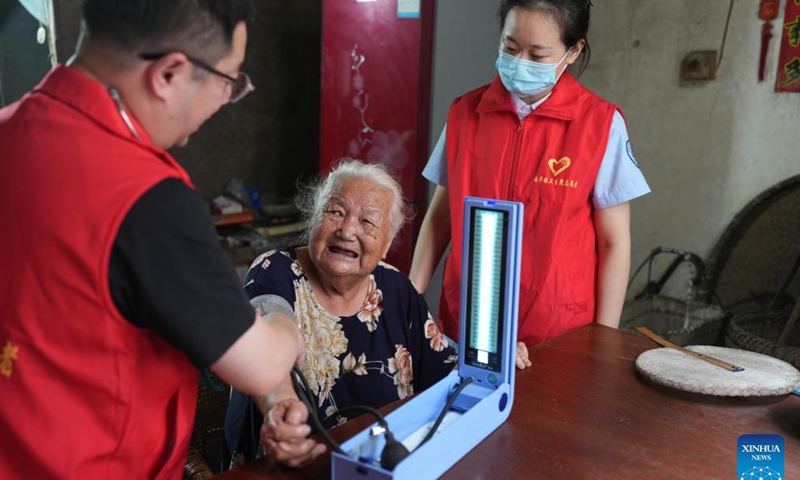
A medical service volunteer team provides family doctor contract services in a villager's home at Heyang Community of Anhua Town in Zhuji City, east China's Zhejiang Province, Aug. 26, 2025.
China's Ministry of Civil Affairs will take a range of measures, including allocating in advance 1.41 trillion yuan ($20.29 billion) in central government relief subsidy funds, to supervise and guide local authorities to strengthen the fundamental, last-resort arrangement within the social assistance framework, including providing small amount emergency assistance within three days, and ensure basic living standards for people in difficulty, China Central Television (CCTV) reported on Thursday.
The ministry will guide local authorities to comprehensively standardize and implement basic living assistance policies for people in difficulty and ensure that all eligible individuals are included in the social aid system, according to CCTV.
Earlier, the Ministry of Civil Affairs and the Ministry of Finance had allocated 1.41 trillion yuan in central government subsidy funds for 2026 to bolster local support for vulnerable groups. Multiple provincial-level regions including Beijing, Tianjin, Shanghai, Jiangsu and Ningxia have issued one-off living allowances to those in need in the form of cash, consumption vouchers, and in-kind goods, according to CCTV.
The two ministries also issued opinions to further improve the temporary assistance system, focusing on enhancing the timeliness and accessibility of temporary assistance, and putting forward a series of new measures and requirements, CCTV reported, citing a statement released on the website of China's Ministry of Civil Affairs on Thursday.
According to Yu Shaoxiang, a research fellow at the National Academy of Chinese Modernization under the Chinese Academy of Social Sciences, the opinions issued by the two ministries are a special policy that further elaborates on China's draft law on social assistance which was submitted for first reading to the Standing Committee of the National People's Congress, the national legislature, last June. The opinions supplement areas where the law lacks detailed provisions on temporary assistance.
This policy was issued against the backdrop of China's ongoing development and transformation, encountering more situations that require temporary assistance as a safety net - such as sudden unemployment or natural or man-made disasters - resulting in increased demand for social assistance, Yu told the Global Times on Thursday.
According to the opinions issued by the two ministries, for families or individuals whose basic living conditions temporarily fall into serious difficulty due to emergencies such as sudden incidents, accidental injuries, or major illnesses, review and approval procedures should be simplified, with direct registration of the recipients, reasons, and amounts of assistance, without requiring verification of household economic status or public disclosure. They will be provided with "small-amount fast assistance," with processing times generally not exceeding three days, chinanews.com.cn reported.
Since temporary assistance addresses urgent and difficult situations, the approval procedures stipulated in the original social assistance law were cumbersome and failed to achieve their intended effect. Simplifying these procedures aims to ensure timely help for those facing urgent hardship and can be seen as a key policy breakthrough with a significant positive impact, Yu said.
Meanwhile, the opinions emphasized that temporary aid will expand support for families struggling with unavoidable expenses and those just above subsistence allowance thresholds. Eligible households facing sudden spikes in essential costs such as education or medical bills can receive temporary assistance, typically approved once and paid out in installments, according to the statement released by the Ministry of Civil Affairs.
Besides, the temporary assistance program will supplement other social aid, providing timely support to those still facing severe hardship after receiving subsistence allowances, disaster, medical, education, housing, or employment assistance, according to the statement.
The two ministries also called on local governments to treat temporary assistance as a fundamental, last-resort arrangement within the social assistance framework, ensure sufficient funding and reasonable arrangements, coordinate the use of assistance funds for people in need, and tighten oversight to prevent the misappropriation, diversion, or withholding of funds, as well as any unauthorized expansion of their use, the statement said.
As an important component of China's tiered and categorized social assistance system, temporary assistance is primarily aimed at addressing sudden, urgent, and short-term basic living difficulties faced by urban and rural residents. Within the social assistance safety net, temporary assistance serves as the "last line of defense of the last resort." During China's 14th Five-Year Plan period (2021-25), the program has helped more than 8.8 million people each year, according to CCTV.
RELATED ARTICLES