World’s 1st L5 solar probe: China’s Xihe-2 eyes major advancement in space weather early warning, leading scientist tells GT
By and Li Xundian Published: Feb 03, 2026 01:04 PM

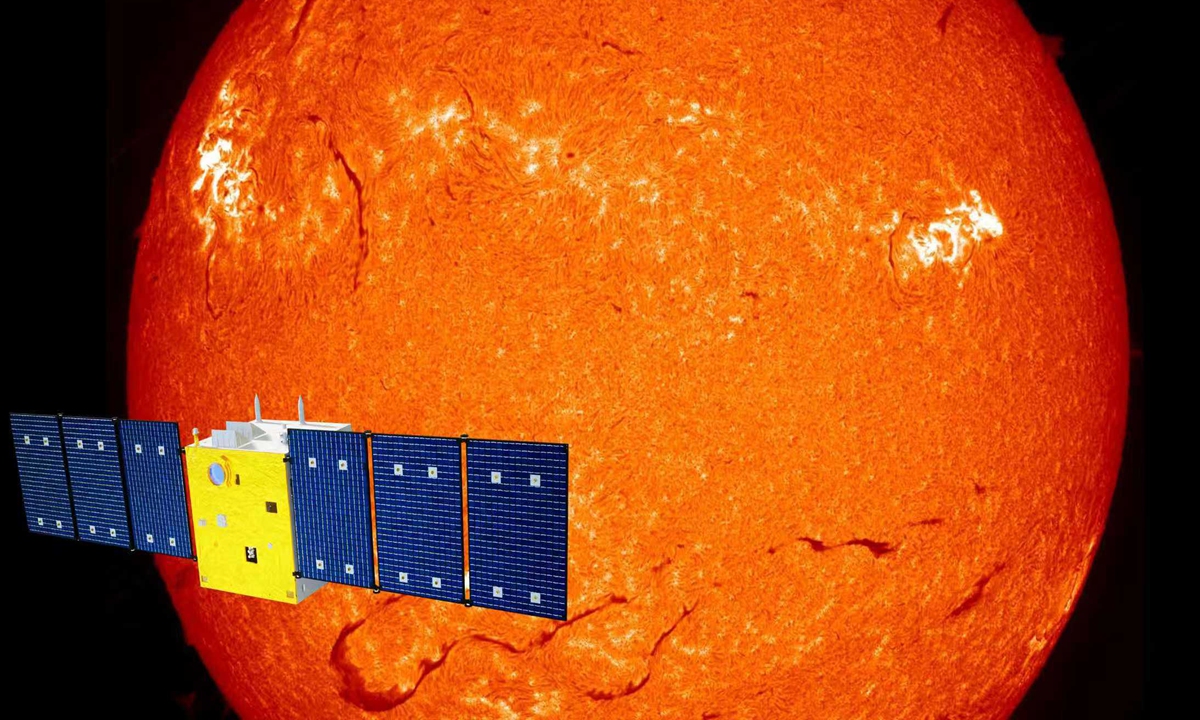
Illustration: Xihe Sun exploration satellite
China's planned Xihe-2 solar probe — set to launch between 2028 and 2029 and become the world's first spacecraft stationed at the Sun-Earth L5 point — will enable detection of solar active regions 4-5 days earlier than from Earth orbit. This promises a significant leap forward in space weather prediction and early warnings, a leading scientist of the program told the Global Times on Tuesday.
Ding Mingde, a professor at the Nanjing University who served as the chief scientist for the Xihe-1 mission and participated in the Xihe-2 mission, made the remarks in an interview with the Global Times on Tuesday.
The Sun-Earth L5 point is one of the five gravitational equilibrium points in the Sun-Earth system. It forms an equilateral triangle with Sun and Earth, allowing a spacecraft positioned there to remain relatively stable with minimal fuel consumption for orbit maintenance, Ding explained.
Compared to viewing Sun directly from Earth's line of sight, an observer at L5 sees Sun from a position approximately 60 degrees upstream in the direction of the Sun's rotation. This provides a "side view" that enables detection of active regions on the solar surface 4 to 5 days in advance — before those features rotate into Earth-facing view. This capability represents a major advancement for space weather early warning and forecasting, he continued.
Combining observations from an L5 probe with those from near-Earth spacecraft allows for multi-perspective, three-dimensional monitoring of Sun. This is highly beneficial for precisely measuring solar magnetic fields and dissecting the three-dimensional structure of solar activity phenomena, such as flares, coronal mass ejections, and their propagation, according to the scientist.
Prior to this new development, China has launched Advanced Space-based Solar Observatory (ASO-S,) which is also known as the Kuafu-1 - a satellite specially designed to carry out a comprehensive probe of the Sun - into preset orbit in 2022.
And as China's first dedicated solar "photographer," Xihe-1 has achieved five international firsts and generated approximately 1.2 petabits of scientific data since its launch on October 14, 2021.
China unveiled its national mid- and long-term development program for space science in October 2024, which will guide the country's planning of space science missions and space research from 2024 to 2050, Xinhua News Agency reported.
As part of the national space planning, the Sun-Earth panoramic view theme involves the exploration of Sun, the Earth, and the heliosphere to unravel the physical processes and laws governing the complex interactions within the Sun-Earth system.
Exploration of the Sun is also a common quest for international space agencies.
NASA launched the Parker Solar Probe in 2018 and made an approach as close as 6.1 million kilometers to the Sun. The collaborative European Space Agency (ESA) and NASA Solar Orbiter mission was launched in 2020 and carries a suite of instruments designed for high-resolution imaging and in-situ measurements, enabling detailed studies of solar activity and its effects on the heliosphere, according to the spacenews.com.
India's Aditya-L1 launched in September 2023 and is positioned at the Sun-Earth L1 with seven payloads for studying the solar atmosphere, magnetic field, and solar wind. Meanwhile, ESA's Proba-3 mission consists of an Occulter and Coronagraph spacecraft flying in precise formation to emulate total solar eclipses to allow study of the solar corona, according to the website.
"As of now, humans have launched more than 70 solar probes, the vast majority positioned along the Sun-Earth line, with a few in heliocentric orbits. None has yet been stationed at the Sun-Earth L5 point. Therefore, Xihe-2 will provide humanity with an entirely new 'bystander' or 'side-view' perspective for studying the Sun," said Li Chuan, chief designer of the science and application system of Xihe and a professor at Nanjing University.
Positioned at a gravitational equilibrium point, China's Xihe-2 can maintain orbital stability with minimal energy expenditure, and its designed lifespan reaches seven years, according to Li.
RELATED ARTICLES