South American countries’ pragmatic reassessment of ties with China amid US hegemonism, protectionism
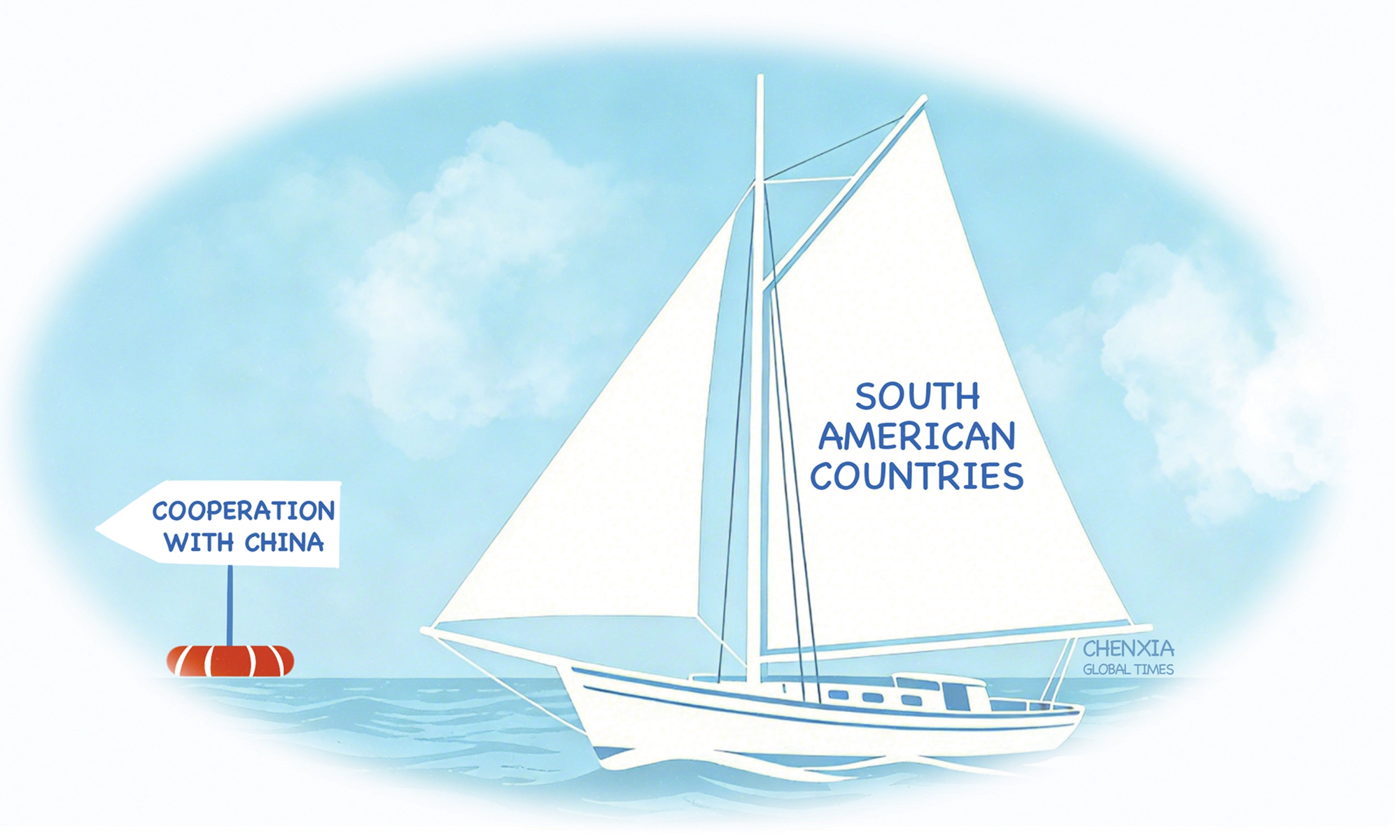
Illustration: Chen Xia/GT
A quiet but profound shift is reshaping the geopolitical map of South America, as revealed by an exclusive Reuters report, "Brazil signals new openness to Mercosur-China talks as Beijing seeks deeper ties": For the first time, senior Brazilian officials are considering a push for a "partial" trade agreement between the Mercosur bloc and China.
This represents a major shift for Latin America's largest economy. While Washington is busy raising tariffs and fortifying protectionist walls, countries in the Western hemisphere are recalculating their survival strategies. The result? A pragmatic reassessment of ties with Beijing.
We are already seeing the ripple effects of US pressure on neighbors like Mexico and Panama, but the shifting mood in the wider region is far more significant. The degree to which Latin American nations are pivoting is directly correlated to the economic squeeze they feel from the North.
Mercosur is the customs union comprising Argentina, Brazil, Paraguay, Uruguay, and newcomers Bolivia and Venezuela (currently a suspended member).
For decades, Brazil acted as the bloc's protectionist "gatekeeper" against Chinese influence. Fearing that its domestic manufacturing sector would be hollowed out by Asian imports, Brasília consistently vetoed formal negotiations with Beijing. However, what Reuters describes as a "new global scenario" is forcing a change. This is a diplomatic euphemism for a stark reality: the rise of US protectionism coupled with the undeniable allure of Chinese opportunity. Facing the headwinds of American unilateralism, Brazil has done the math. Traditional allies offer no alternative market access, only higher tariff barriers.
Meanwhile, however, China is not only offering a market but also bringing tangible industrial investment, from BYD to Great Wall Motor. When Washington offers only sticks without carrots, Brazil has little choice but to turn toward a pragmatic East. Uruguay's president, who recently visited China with a large business delegation to demand faster trade talks, is a clear testament to this regional impatience.
Historically, a Mercosur-China deal was viewed as "mission impossible" due to the bloc's Common External Tariff rules, which forbid members from negotiating individual trade deals. Politics also posed a formidable barrier. Paraguay, a member of Mercosur, maintains "diplomatic ties" with China's Taiwan region, creating a legal deadlock to any comprehensive Free Trade Agreement (FTA) with Beijing under the one-China principle.
Furthermore, Argentina's political pendulum - swinging from protectionist Peronism to Javier Milei's pro-US stance - has made a unified strategy difficult.
This is why the proposed "partial agreement" is a masterstroke of political pragmatism. It serves as a strategic bypass around these obstacles.
Unlike a full FTA targeting zero tariffs, a partial deal sidesteps the sensitive issue of tariff reduction that terrifies Brazilian manufacturers. It also navigates around Paraguay's diplomatic dilemma. Instead, it would focus on non-tariff barriers, such as harmonizing sanitary regulations, streamlining customs procedures and setting import quotas.
By shifting the focus from tariffs to regulatory cooperation, Brazil is doing more than just clearing the path for soy and iron ore. It is paving the way for deeper integration of Chinese capital.
The China-Brazil relationship has already evolved from simple trade to manufacturing. With Chinese EV makers taking over shuttered Ford factories in Bahia, the two economies are moving toward supply chain symbiosis. This partial agreement could provide the institutional framework needed to secure those investments.
From a macro perspective, this is a snapshot of the Global South's increasing autonomy. If these talks proceed, they will mark the opening of a new path - one where pragmatism supersedes ideology.
This serves as a stark reminder to policymakers in Washington: trying to block economic gravity with pressure tactics often accelerates the search for new partners. The shifting winds in South America are not merely a passive reaction to fading hegemony; they represent an active and powerful response from nations determined to define their own economic destiny.
RELATED ARTICLES