China signals commitment to stability, cooperation at NPC press conference amid turbulent global landscape
Global Governance Initiative offers China's wisdom, solution as many fear world is sliding toward 'law of the jungle': expert
By Feng Fan and Published: Mar 05, 2026 01:06 AM

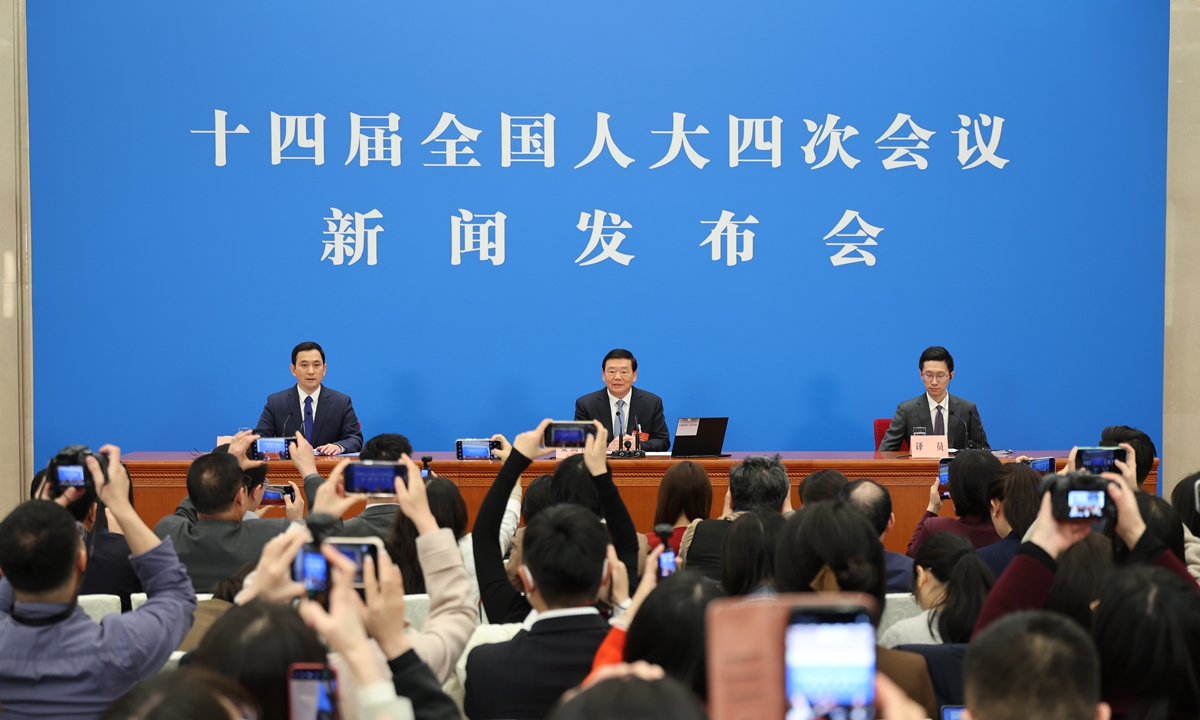
Lou Qinjian, spokesperson for the fourth session of the 14th National People's Congress, attends a press conference at the Great Hall of the People in Beijing, on March 4, 2026. Photo: VCG
A rare spring snow dusted Beijing on Wednesday, but the chill did little to deter the Chinese and foreign journalists waiting outside the Great Hall of the People. Hours before the doors opened for first press conference of the fourth session of the 14th National People's Congress (NPC), the line was already winding down the steps—a testament to the gravity of this year's "two sessions."
As the global order seems to be fracturing, fueled by the recently launched US-Israel military operations against Iran and the ongoing Ukraine conflict, the world is looking to Beijing for a much-needed signal: how will China respond to a world that many fear is sliding toward "the law of the jungle"?
At a press conference held Wednesday, one day ahead of the opening of the fourth session of the 14th NPC, Lou Qinjian, spokesperson for the fourth session of the 14th NPC, took 14 questions on a wide range of issues, covering China-US, China-EU and China-Japan relations, the situation in Iran, as well as China's economy, technology, and development.
The intensive exchanges, some observers said, conveyed China's position and actions in safeguarding global peace and stability, offering what they described as valuable stability and opportunities to a world marked by turbulence and uncertainty.
Global governance
At the Wednesday press conference, a reporter asked that in light of the developments in Iran, and the expected visit to China by US President Donald Trump in the near future, "how do you view the future trajectory of China-US relations, particularly given that more meetings between the two leaders are expected to be arranged this year?"
In response, Lou said as two major countries, China and the US should respect each other, and pursue peaceful coexistence and win-win cooperation.
Noting that head-of-state diplomacy plays an irreplaceable role of providing strategic guidance for China-US ties, Lou said as long as the two sides faithfully implement the important common understandings between the two presidents, uphold equality, respect and mutual benefit, and work to lengthen the list of cooperation and shorten the list of problems, the bilateral relationship will be able to move forward steadily.
Meanwhile, China adheres to its own principles and red lines, and will, as always, resolutely safeguard its sovereignty, security, and development interests, he added.
In response to a question regarding successive visits to China by many European politicians and leaders of EU institutions, leading to views that Europe is turning toward China and that Europe is facing competition and challenges from China, Lou said that "China stands ready to work with Europe to uphold the basic positioning of partnership, properly handle trade and economic differences, cultivate more cooperation agendas, and jointly meet global challenges."
As reporters noted China's frequent high-level exchanges with neighboring countries and the positive momentum of regional cooperation, one journalist asked about recent difficulties and fluctuations in China-Japan relations. Responding to the question, Global Times reporters at the press conference noted that the spokesperson struck a noticeably firmer tone.
Safeguarding national sovereignty, security and development interests is the overarching principle guiding all foreign engagements, Lou said.
The Taiwan question is an internal affair of China and is at the core of China's core interests, he said, adding that China firmly opposes the Japanese leader's erroneous remarks on Taiwan.
One journalist also asked for the spokesperson's comment on the growing use of unilateral actions and military force in international relations, especially related to the US-Israel military operations against Iran, the forceful seizure of the president of Venezuela and the US' interest in annexing Greenland.
Regarding the Iran situation, Lou said that China calls for an immediate stop to military operations, preventing further escalation of tensions, and resuming dialogue and negotiations to uphold peace and stability in the Middle East. Iran's sovereignty, security, and territorial integrity must be respected, he added.
Lou also said that in the past year, the international landscape has reached an important turning point, economic globalization has encountered severe shocks, and regional wars and cross-border conflicts have become increasingly frequent.
In the face of a world marked by transformation and turbulence, peaceful development and win-win cooperation remain the right path forward, Lou said, adding that China-proposed the Global Governance Initiative stresses the need to adhere to sovereign equality, abide by international law, practice multilateralism, advocate the people-centered approach, and focus on taking real actions. This offers a Chinese solution for making the global governance system more just and equitable.
"Some countries look backward, hoping to bring the world back to an era when power alone determined outcomes. China, by contrast, looks forward and offers new governance proposals suited to today's international landscape," Wang Yiwei, a professor at the School of International Studies of Renmin University of China, told the Global Times on Wednesday.
Wang said China's proposals are grounded in long-term planning and provide predictable and trustworthy frameworks. Rather than empty rhetoric, he noted, China's global initiatives consist of concrete and actionable initiatives already being implemented, through which China will play a greater role in addressing specific global challenges.
At the venue, Marlon Samuels, a reporter from Jamaica's Public Broadcasting Corporation, told the Global Times that China has consistently been a peace-loving country and hopes to uphold a common position with other nations. He noted that all countries and peoples should possess and safeguard their own sovereignty, adding that the global initiatives proposed by China represent important concepts concerning world peace.
Innovative development
Beyond international affairs, the press conference also highlighted new drivers of China's economic development.
China has called for an open, fair, just and non-discriminatory global environment for sci-tech development, while emphasizing its sci-tech self-reliance, Lou said, adding that scientific and technological innovation cannot do without an open, inclusive and mutually beneficial global ecosystem.
In response to a question regarding China's rapid development in humanoid robots, he noted that enabling robots to feel, think, decide and act like humans requires global collaboration, and addressing the ethical and social issues arising from this advancement demands collective global efforts.
He also said that the key to sci-tech innovation and development currently lies in having home-grown, risk-controllable core technologies.
During the 15th Five-Year Plan period (2026-2030), China will strengthen original innovation and work to make decisive breakthroughs in critical core technologies in key areas, according to Lou.
China's emphasis on technology and innovation has attracted much attention from global media. In an article title "China is about to show the world its plan to win the future," CNN wrote, "China spent the last five years cultivating innovation and new technology at home. The next half decade will be dedicated to deploying the fruits of its labor to transform its economy - and its place in the world. That's set to be an overarching message as thousands of delegates from across China gather in the nation's capital for the 'two sessions'."
BBC, in its article "What to know about the 'two sessions', China's biggest political meeting," wrote that "From electric vehicles and solar panels to humanoid robots and AI apps, China's industrial and technological footprint has expanded at breathtaking speed in recent years. These developments follow a state-driven road map to transform the country's status from the world's factory floor to a global tech powerhouse. This did not come about as an accident, but rather follows a deliberate government strategy. This became clear in the language used at previous NPCs, so analysts will be watching this year's congress for any clues as to what comes next."
As the Wednesday press conference concluded, Lou was immediately surrounded by reporters seeking to ask more questions. After a series of inquiries on global security, geopolitics and economic development, one journalist posed a lighter but forward-looking question: "Between AI and humanoid robots, which technology does the spokesperson personally prefer?"
Lou laughed and referred to the impressive humanoid robot performance during China's Spring Festival Gala, saying that such applications of AI offered a glimpse of the future.
"It was truly astonishing and exciting, and of course something I felt very proud of," he said.
RELATED ARTICLES