China establishes technical committee to standardize satellite internet systems and services
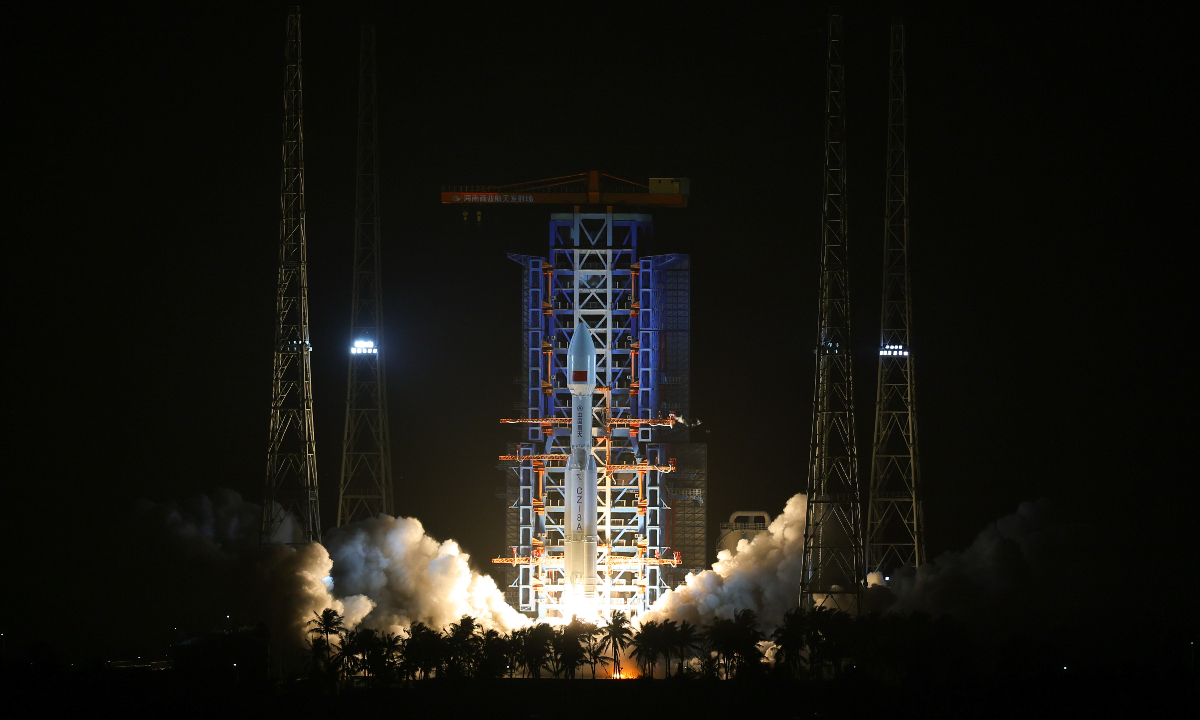
China successfully launched a Long March-8A carrier rocket from the Hainan commercial spacecraft launch site on March 13, 2026, and successfully placed the payloads, the 20th group of low-orbit internet satellites, into the preset orbit. Photo: IC
China's State Administration for Market Regulation has officially approved the establishment of a national technical committee to standardize satellite internet systems and services, China Central Television (CCTV) reported on Monday.
As the deployment of low-Earth-orbit (LEO) satellite constellations has been accelerating in recent years, the applications of satellite internet have continued to expand in areas such as direct mobile connections, emergency communications, marine fisheries, transportation and logistics, and communications support in remote regions, with China's satellite internet industry ecosystem becoming increasingly dynamic and its industrial capabilities steadily strengthening, CCTV reported.
At this year's national two sessions, the Government Work Report for the first time highlighted the need to accelerate the development of satellite internet, and listed the satellite internet together with artificial intelligence, computing infrastructure, and the data factor system, as a core supporting pillar of the digital economy, China National Radio (CNR) reported.
As important infrastructure, satellites function like mobile base stations in space. When deployed as large constellations, they form satellite internet networks that provide global broadband internet access to ground and airborne terminals and support international data transmission, according to the People's Daily.
In April 2020, China's National Development and Reform Commission classified satellite internet as a key component of information infrastructure under its new infrastructure initiatives.
According to Yu Guang, an international space affairs expert, it is necessary to establish a national technical committee for standardizing satellite internet systems and services, as China's LEO satellite sector includes both state-backed and private players and faces growing market demand, but uncoordinated expansion could lead to chaotic competition and wasted resources.
Without coordination, satellite constellations could create space traffic congestion, frequency interference, and orbital conflicts. Establishing coordination mechanisms, including setting standards, can effectively address most of these problems, Yu told the Global Times on Monday.
The newly established national technical committee for standardization of satellite internet systems and services will focus on the sector's rapid technological advances and the growing number of market participants, in order to fully leverage the leading and foundational role of standardization in building satellite internet as a new type of infrastructure and to promote the healthy development of the smart economy, CCTV reported.
The committee will bring together stakeholders from across the industry, promote the sharing of resources, speed up the development of urgently needed standards, including those for satellite internet terminology, in-orbit constellation performance assessment, and key system products.
The committee will also continue to improve the satellite internet standards system, actively participate in the formulation of international standards, and promote the high-speed, well-regulated, and healthy development of the satellite internet industry, according to CCTV.
The technological innovation in satellite internet is expected to accelerate further and applications are set to expand, with the growing market positioning the industry as a new driver of China's economic growth, Zhu Zhengxian, co-founder and CTO of GalaxySpace, a Chinese private satellite internet solutions provider and satellite manufacturer, told the Global Times on Monday.
RELATED ARTICLES