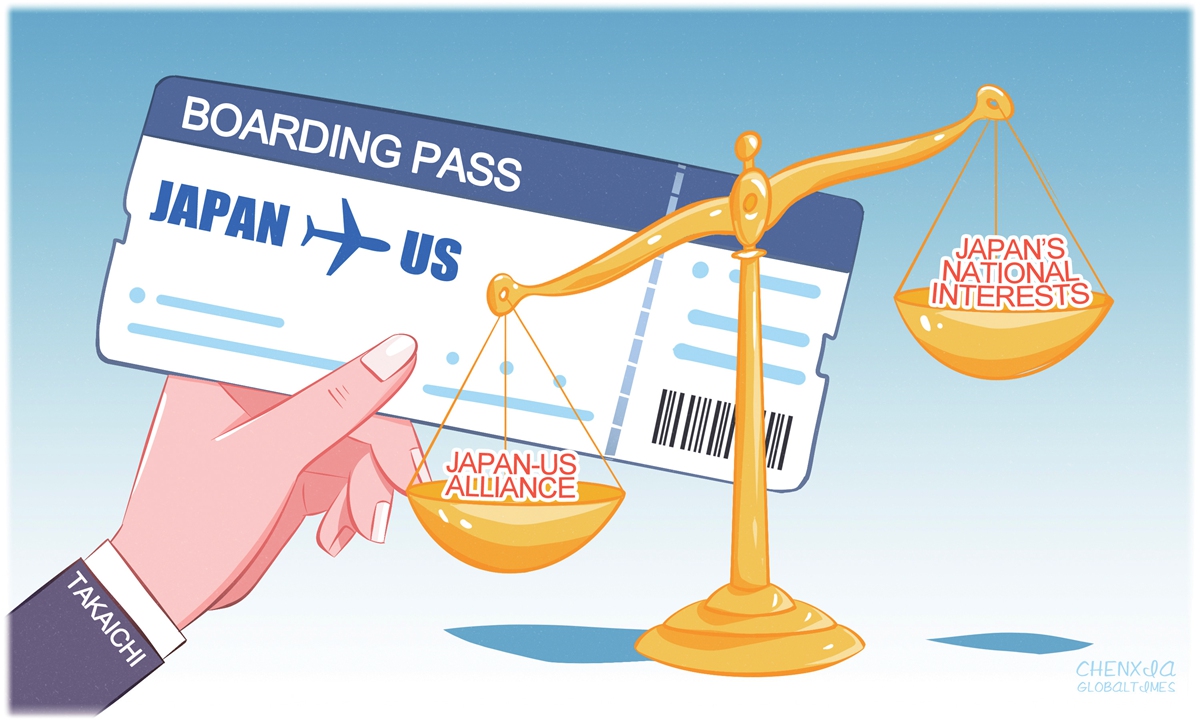
Illustration: Chen Xia/GT
As Japanese Prime Minister Sanae Takaichi is set to depart on Wednesday for her first US trip since taking office last October, the current development of the relations between the US and Japan is under global attention. According to media reports, Takaichi's visit will be a chance to "reaffirm the unwavering alliance of the two countries."
This leads us to an interesting phenomenon: While other US allies are pivoting away from the idea of viewing Washington as a "Plan A" and are instead seeking a "Plan B" that emphasizes strategic autonomy, why does Japan continue to pursue closer ties with the US?
The 2025 US National Security Strategy reveals a trend toward the selective retrenchment of US global hegemony. At the same time, Washington is transforming into a predatory hegemon - one that regards its own allies as among the most exploitable targets. Against this backdrop, many of the US traditional allies - Europe foremost among them - have begun to seriously question Washington's reliability.
Japan has watched all of this with considerable unease. Yet, rather than putting some distance between itself and the US, Japan has moved even closer to its "Plan A" - exhibiting what might be called a "Plan A plus" disposition. As a German scholar explained, the essence of "Plan A plus" is that "Japan must prove that 'America First' goals are better achieved with Japan at America's side - even though Japan harbors serious reservations about that agenda."
An example would be a recent article in Foreign Affairs by former national security adviser and vice foreign minister of Japan Masataka Okano, in which, despite acknowledging the undermining role of the "America first" policy on US alliances, he still calls for Washington to recognize that maintaining its leadership will require "steady, trust-based cooperation with its allies," emphasizing Japan's role in US strategy in the Asia-Pacific.
Okano's article reflects the mainstream thinking within Japan's strategic community. Why has this happened? It is closely connected to Japan's asymmetric dependence on the US that took root during the "restoration of its sovereignty" in 1952 and became embedded in its national structure.
At the political level, pro-US politicians dominated Japan's post-World War II reconstruction. "Pro-Americanism" has become deeply embedded in Japan's strategic culture over nearly eight decades. Even as the US began abandoning and exploiting its once-close allies, Japanese politics remained on the pro-US trajectory, unable to correct the course in time.
At the security level, Japan occupies a position of pronounced structural disadvantage within the alliance. Article 9 of the Constitution of Japan restricts Japan from possessing offensive weapons. Under such constraints, achieving any meaningful offensive-defensive balance requires Japan to rely on US security guarantees.
At the societal level, Japanese citizens have grown entirely accustomed to US presence in their lives, even as Japan rarely occupies a central place in US attention. In Japan, the US-Japan relationship commands intense public focus, and the outcome of US presidential elections has direct ripple effects on Japanese policy.
In recent years, the effectiveness of Tokyo's diplomacy toward Washington has gradually become one of the factors voters consider when deciding whether to support the ruling Liberal Democratic Party. Yet, from the US side, Japan is by no means a core preoccupation. This asymmetry in perception tends to leave Japan perpetually more anxious and more eager to reach agreements in the relationship.
Currently, Takaichi is eager to meet US President Donald Trump, hoping to reaffirm US security commitments to Japan and ensure that Tokyo would not be left behind amid strategic competition between Washington and Beijing. The US, for its part, will not waste the chance to exploit the Japanese leader's anxiety to extract greater concessions in bilateral economic negotiations.
Throughout history, there have been efforts in Japan to push for strategic autonomy. The harsh reality, however, is that Japan is so deeply dependent on the US across so many dimensions - one might even argue that a Japanese prime minister's political longevity is, to some extent, contingent on Washington's support. Thus, it is unlikely that Japan will tilt away from its strategic choice of pursuing a "Plan A plus" with the US.
The author is a lecturer at Shanghai University of International Business and Economics. opinion@globaltimes.com.cn
RELATED ARTICLES