Japan flaunts loot as 'war merits,' sidesteps plunder truth and China's repatriation calls
The ‘trophy’ lie
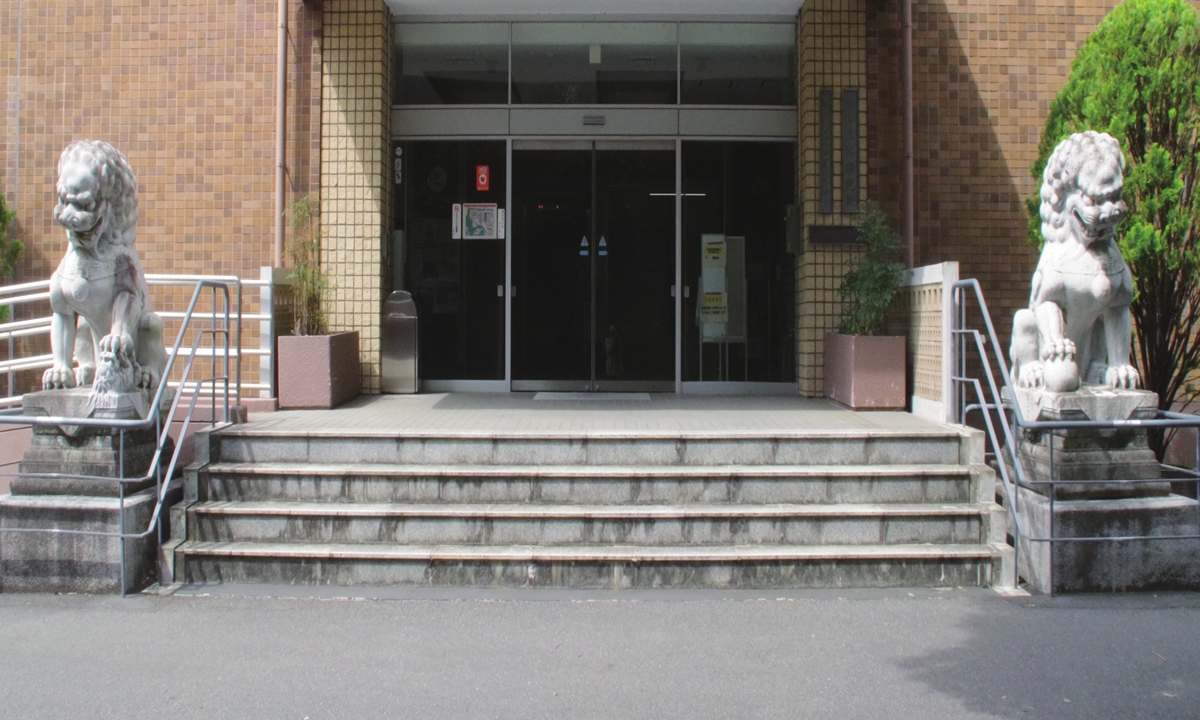
A male stone lion statue (left), believed to have been looted from China, stands at the entrance of the Institute for Advanced Studies on Asia at the University of Tokyo, with its right front paw treading on an embroidered ball. A female stone lion statue (right), believed to have been looted from China, also stands at the entrance, with its left front paw caressing a lion cub. Photo: Courtesy of China Cultural Relics Return Movement Association
Japan has long tied Chinese cultural relics plundered during its aggression and war atrocities during World War II to its so-called war merits to whitewash its history of aggression, while having remained silent on the legitimate ownership of these relics and the truth behind the plunder.
An on-the-spot investigation by Global Times reporters uncovered that Japan has even touted the looted Chinese cultural relics as "war trophies" of its militarism, with the notorious Yasukuni Shrine among the sites where they are displayed. Yasukuni Shrine enshrines Japan's infamous class-A war criminals who symbolized Japan's war atrocities and militarism during World War II.
However, in response to widespread calls urging for the return of Chinese cultural relics, the shrine offered an evasive answer in its exclusive reply to inquiry from the Global Times, persistently dodging the core demand of repatriating the relics.
A century of displacement, a journey of thousands of miles - this century-long battle for the recovery of cultural relics is, in essence, an act of accountability for Japan's militaristic history of aggression, and even more a defense of historical justice.
Dodging answers
Exiting Kudanshita Station on the Toei Subway Shinjuku Line and walking westward for five minutes, Global Times reporters saw a pair of stone lions standing on either side of the Yasukuni Shrine's Daicihi Torii (First Shrine Gate).
"As you are reporters from China, you must first see this pair of stone lions," Junichi Hasegawa, a former Shinjuku ward council member, told the Global Times. "Because these are the very stone lions looted by Japanese invaders from Haicheng [in Northeast China's Liaoning Province] during the Sino-Japanese War of 1894-1895."
"A total of three were seized: Two are kept at the Yasukuni Shrine, and the third is housed at the Yamagata Aritomo Memorial Hall in Tochigi Prefecture," Hasegawa added.
Approaching for a closer look, the Global Times reporters found that the male lion on the left rests its right paw on an embroidered ball, its pedestal inscribed with the Chinese characters: "Respectfully erected on the fifth day of the sixth lunar month in the second year of the Guangxu reign of the Qing Dynasty [1644-1911]." The female lion on the right has playful cubs under its left paw and on its back, with inscriptions on the pedestal clearly indicating that both lions originated from China.
Near these looted cultural relics, visitors occasionally stepped forward to "pay respects to the spirits of the war dead," while Japanese high school students sat on benches under the shade of trees, eating lunchboxes and chatting. Seeing this, Hasegawa said, "Many young Japanese today have no idea what the Yasukuni Shrine truly represents. This is no ordinary shrine; it is a shrine of war."
Today, over 130 years have passed since the Sino-Japanese War of 1894-1895, and these stone lions, bearing the stain of wartime plunder, still stand conspicuously at the entrance to the shrine as "war trophies" to glorify Japanese militarism.
To press for the repatriation of Chinese cultural relics plundered and kept in Japan, Japanese civic group "China Cultural Relics Return Movement Association" has engaged with the shrine in negotiations on five separate occasions. Except for the first meeting, at which the shrine's director of general affairs and chief of the general affairs section met with members of the association, the shrine has since refused all further in-person talks on the pretext of being "unable to respond."
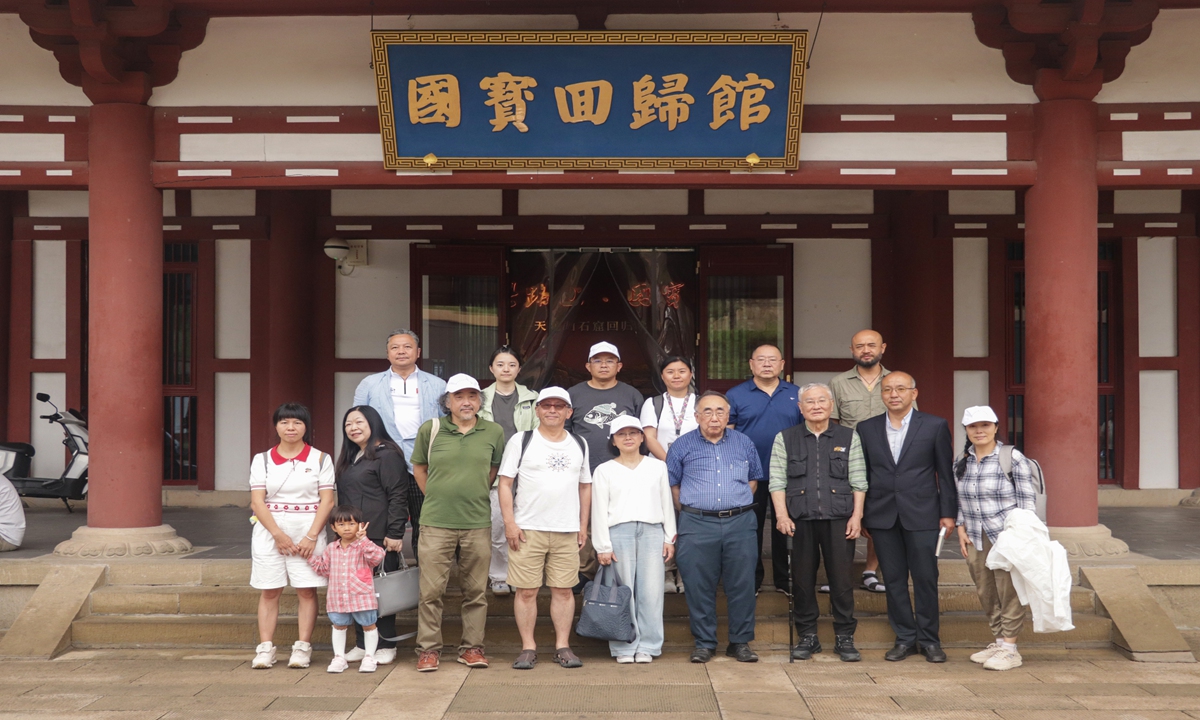
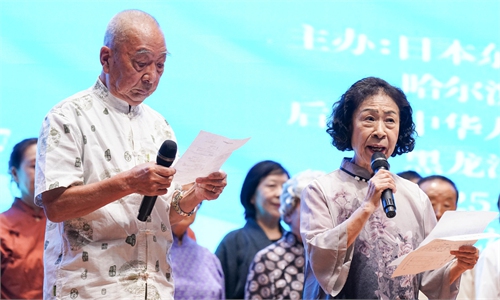
Members of Japanese civic group "China Cultural Relics Return Movement Association" visit China to conduct site visits and research in August 2025. Photos on this page: Courtesy of China Cultural Relics Return Movement Association
Founder of the association and Japanese lawyer Keiichiro Ichinose said: "Previously, even when reaching the same conclusion, the Yasukuni Shrine would issue a written reply. Yet on the fifth occasion, it rejected our request by telephone - leaving no paper trail." He noted that "we therefore judge that the shrine's attitude has regressed further."
However, in an exclusive response to the Global Times, the shrine office, responsible for public information, claimed, "Regarding the petition submitted by the Association, the shrine has provided a written reply clarifying our position." The shrine had remained silent on the telephone refusal, omitting any mention of this evasion.
Tough but tenacious
Japan, in its efforts to resist the repatriation of Chinese cultural relics looted and retained in Japan, has erected a solid "wall of defense" at the legal level.
Kunihiko Yoshida, former law professor in Hokkaido University, explained that the article of good faith acquisition under Japan's Civil Code stipulates that a person acquires the rights that are exercised with respect to the movables immediately if the person possesses it in good faith and without negligence, thereby restricting the original right holder's right of recovery.
However, whether or not this article applies to the cultural relics looted and brought to Japan has sparked persistent controversy in recent years.
The Japanese government, disregarding the unique nature of cultural relics, sets a three-year statute of limitations for claiming ordinary stolen property. For most looted relics, this period has long expired. Coupled with the passage of a century, direct evidence of many wartime plundering acts by the Japanese military has become elusive, posing challenges to establishing a complete chain of evidence.
While the repatriation of cultural relics is a legal issue, it carries far greater weight on moral grounds. Yoshida said that Japan must first confront the historical truth, ceasing deliberate obfuscation and instead increasing transparency - this is key to resolving the issue. Building on this foundation, the Japanese government must clarify its responsibility, issue a formal apology and repatriate all Chinese cultural relics looted and held in Japan.
As a leading scholar in the field of repatriating China's cultural relics lost overseas, Professor Huo Zhengxin from the China University of Political Science and Law told the Global Times that the repatriation of looted cultural relics constitutes, in legal terms, a matter of restitution of property ownership, specifically, a demand for the return of the original artifacts.
This is neither war reparations nor compensation for damages, but a demand for the return of the original items, Huo said.
Accordingly, while the Chinese government renounced its demand for war reparations from Japan at the state level, it has never relinquished its call for Japan to return the Chinese cultural relics Japan had plundered.
Huo believes that the repatriation of cultural relics can by no means be achieved overnight and requires gradual and sustained advancement.
He said that efforts to trace the provenance of cultural relics must be intensified, but, as it stands, if Japan refuses to cooperate, this will prove extremely difficult to fulfill through China's unilateral endeavors alone.
However, Huo noted that continuous steps should be taken to advance the reform of international law, break through the constraints of existing statutes of limitations, and ultimately facilitate the repatriation of the looted cultural relics.
Through long-term investigative reporting, Global Times reporters have come to realize that preventing Chinese cultural relics dispersed overseas from becoming the "last prisoners of war" is a shared aspiration among visionary people in both China and Japan.
While progress in pressing the Japanese government to take substantive action on the repatriation of the looted relics may be slow, "to enable more Japanese people to understand the historical truth of the cultural relic plunder and correct their distorted perceptions is in itself an immensely valuable achievement," lawyer Ichinose said.
RELATED ARTICLES