Illustration: Liu Rui/GT
Editor's Note:
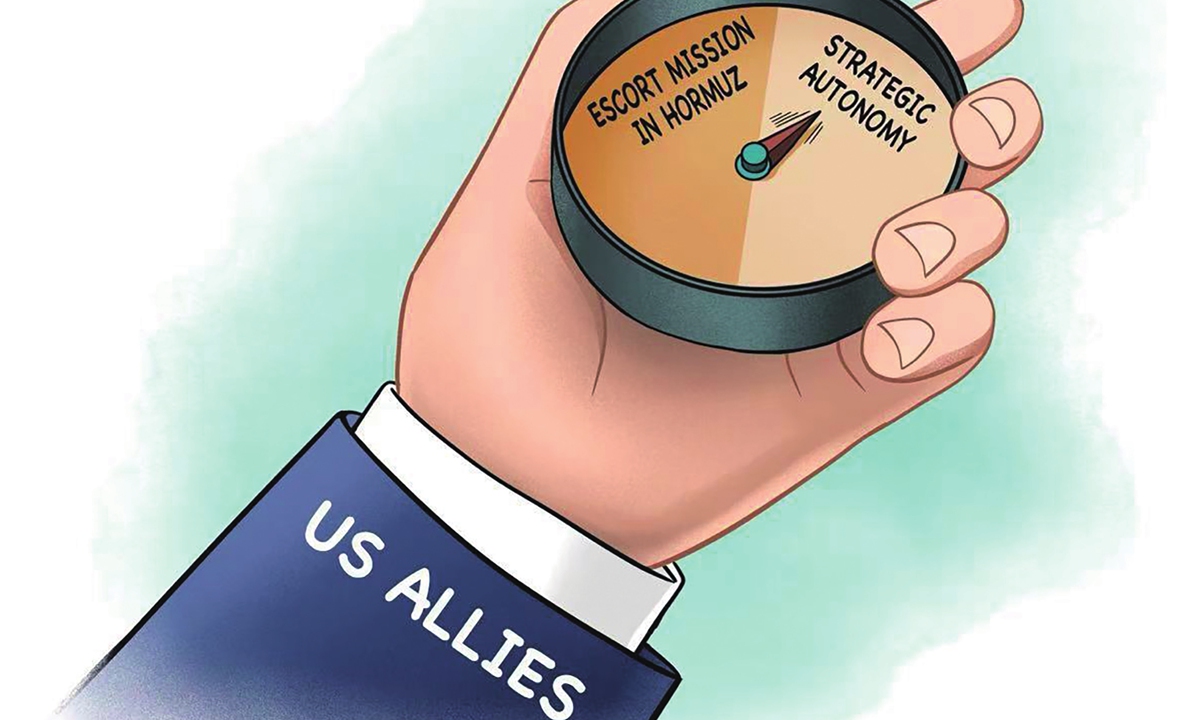
Amid the recent developments surrounding the Strait of Hormuz, the US has continued to press its allies to participate in escort missions, while responses from Europe and other US allies have shown clear caution: They are re-evaluating their strategic choices regarding Middle East issues. Although under US pressure, a recent statement issued by the UK, France, Germany, Italy, the Netherlands, and Japan - later joined by Canada and South Korea, among others - indicated that they are ready to "contribute to appropriate efforts to ensure safe passage through the Strait," several countries clarified that this only represents a potential multilateral initiative after a ceasefire. The Global Times invited four scholars to share their perspectives, exploring the evolving positions of US allies and the deeper logic behind them.
Hector Gomez, a Spanish geopolitical analyst and translator based in China
The crisis in the Middle East is not only testing regional stability; it is revealing something deeper: a quiet shift in the balance of ideas about how the world should be governed. In the face of the escalation triggered by the aggression of the US and Israel against Iran, Europe has been forced to choose between inertia and independent judgment. This time, at least in part, it has chosen the latter.
Spain's decision to reject the use of its military bases and to refrain from joining the naval mission in the Strait of Hormuz is not merely a political gesture. It is a statement of position. The Spanish government has revived the "No to war" stance not as a slogan of the past, but as a contemporary response to a world that is increasingly unwilling to accept the logic of imposition and force.
Spain's position has largely resonated across Europe, where several countries have conditioned any involvement on a ceasefire. Europe is beginning to act as if it understands that security cannot be built through successive escalations but rather by preventing them.
This is where a meaningful convergence emerges. For years, China has advocated a vision of international relations based on non-confrontation, mutual respect and shared solutions.
What we are witnessing now is that this logic, long overlooked or underestimated in certain Western circles, is beginning to gain traction. When Spain says "no," it is not only distancing itself from a specific operation; it is aligning with a broader trend that questions the use of force as the central tool of international politics.
Europe is not breaking with the US, but it is beginning to draw a line. In that still cautious yet meaningful move lies the possibility of something greater: a broader network of global understanding in which international law, sovereignty and human life are not secondary variables, but the starting point.
At a moment of global uncertainty, the question is no longer who leads, but which model prevails. And there are growing signs that the future will belong to cooperation, not confrontation.
Pierre Picquart, an expert in geopolitics and human geography from the University of Paris-VIII
The position of US allies, particularly in Europe, regarding the security of the Strait of Hormuz, appears increasingly nuanced. While several countries, including France, have expressed their willingness to contribute to maritime security, they remain cautious about any concrete military engagement, especially in the absence of a ceasefire.
This stance reflects deeper strategic, legal and political considerations. European countries have consistently sought to avoid military escalation in the Gulf. Their approach toward Iran has emphasized diplomacy, dialogue and regional stability, particularly within the framework of the nuclear issue. Direct military involvement, without a clear de-escalatory framework, risks exacerbating tensions.
Domestic political constraints reinforce this position. European public opinion remains cautious about new military engagements in the Middle East, especially in the absence of a clear international mandate.
Beyond this, the situation reflects an evolution in transatlantic relations. Rather than a rupture, it suggests a gradual reconfiguration marked by greater strategic autonomy among US allies within an increasingly multipolar international environment.
Peace appears as an essential condition for stability in a highly sensitive region, in a context where the growing involvement of international actors reflects a shift toward more multipolar forms of regulation.
Jaewoo Choo, a professor of Chinese foreign policy at the Department of Chinese Studies, Kyung Hee University
The US appeal for allies to send ships to the Strait of Hormuz has met with hesitation from European nations, and both South Korea and Japan have also expressed their concerns. The South Korean government has highlighted its inclination toward diplomatic solutions rather than military actions, a stance that resonates with the significant public opposition to such measures.
Opponents of military involvement express a strong belief that US intervention threatens peace in the Middle East and jeopardizes the safety of citizens in South Korea. Numerous voices are calling for South Korea to assume a mediating role instead of pursuing direct military involvement, citing economic and humanitarian considerations as primary factors. Some critics contend that military actions could heighten tensions and threaten peace in the East Asian country.
The US is leveraging South Korea's significant reliance on Middle Eastern oil and the vital role the Strait of Hormuz for its energy security. It is using the vulnerable positions of allies like Japan and NATO members to apply intense pressure as a persuasive tactic. Nevertheless, many South Koreans interpret these actions as manipulative, believing they are being tasked with resolving problems created by US policies that lack legitimacy. This sense of being treated as pawns in a broader geopolitical strategy is fueling domestic resistance to any military engagement, as the public widely rejects participating in conflicts that do not serve the nation's interests.
Wang Siyu, a scholar at the Shanghai Academy of Global Governance and Area Studies at Shanghai International Studies University
The UK, France, Germany, Italy, the Netherlands and Japan issued a joint statement on March 19 declaring that they would "contribute to appropriate efforts to ensure safe passage through the Strait." Canada and other countries later joined the statement. However, several countries subsequently clarified that this did not refer to "immediate military help," but rather a potential multilateral initiative after a ceasefire. Viewed against the backdrop of the US repeatedly urging European countries and other allies to participate in escort missions in the Strait of Hormuz, this hastily issued statement, to some extent, exposes strategic anxiety and divisions within the US alliance camp.
The statement stems from direct pressure from Washington. Under this pressure, the US allies are reluctant to openly refuse the US, yet are equally reluctant to be drawn into a military quagmire in the Middle East. As a result, they have opted for deliberately ambiguous diplomatic language - seeking to reassure Washington on the one hand while leaving room to manage domestic public opinion on the other.
While this joint statement may have been intended to stabilize the situation in the Strait, it has, under the combined influence of alliance pressure and their own strategic hesitation, become a form of "ambiguous signaling." For these countries, only by clearly stating their position at this critical moment - and by upholding international law and sovereignty - can they truly fulfill the responsibilities of influential powers and contribute constructively to peace in the Middle East. It is clear that pressing the "stop button" on military action, upholding multilateralism and sovereign equality, and addressing regional security concerns through political and diplomatic means remain the only viable path forward. Otherwise, tension over the Strait of Hormuz will continue to erode regional stability and impose heavy costs on the world.
RELATED ARTICLES