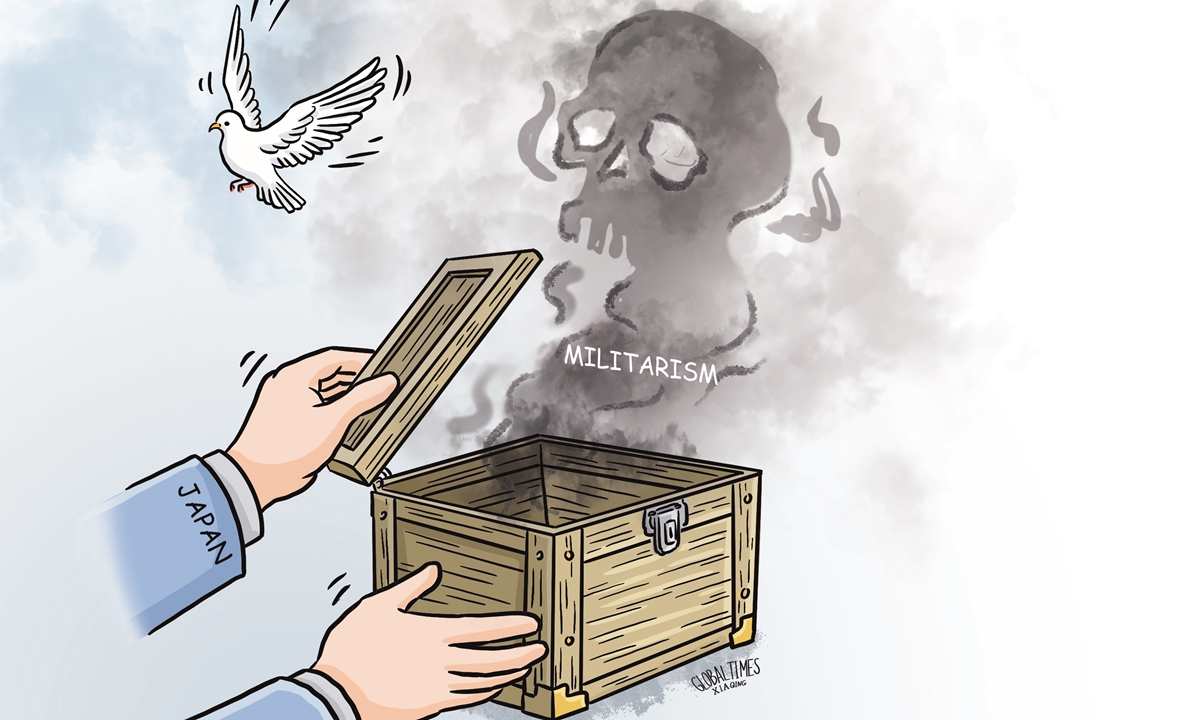
Illustration: Xia Qing/GT
This year marks the 80th anniversary of the beginning of the work of the International Military Tribunal for the Far East, commonly known as the Tokyo Trials. From 1946 to 1948, the Tribunal held collective trials of Class-A Japanese war criminals from WWII in Tokyo. Following the Nuremberg Trials, it represented another large-scale, multinational trial for war crimes. After two and a half years of hearings, judges from 11 nations found all 25 defendants guilty.
The Tokyo Trials were an unprecedented legal endeavor of the 20th century. With 818 court sessions, 419 witnesses, 4,336 pieces of evidence and more than 48,000 pages of trial records, the Tokyo Trials provided irrefutable proof of the darkest chapters of human aggression. During the proceedings, the full extent of unspeakable atrocities, such as the Nanjing Massacre and the Bataan Death March, was exposed to the world, and the crimes of Japan's fascist war of aggression were systematically revealed and repudiated.
The historical significance of the Tokyo Trials is profound. Together with the Nuremberg Trials, they marked the first time in human history that international judicial practice systematically established aggressive war as an international crime, and clarified that state leaders bear individual criminal responsibility for launching wars of aggression. The Trials sent a clear message to the world that "aggression must be punished and atrocities must be repudiated," making peace, justice and humanity the core values of the post-war order, and laying an important legal and political foundation for the post-war international system. Eighty years on, the Tokyo Trials have long become a symbol of justice, an irrefutable record of history, a cornerstone of legal principles and a warning bell for humanity.
However, as the Tokyo Trials coincided with the beginning of the Cold War, a large number of Japanese war criminals escaped punishment, and the root causes of Japanese militarism were not completely eradicated. Emperor Hirohito was exempted from war responsibility; war criminals such as Nobusuke Kishi were released; and the crimes of Unit 731 of the Imperial Japanese Army, including human experimentation and bacteriological warfare, were covered up. These unresolved issues allowed Japanese right-wing forces to survive and, over time, grow stronger, leading to the rise and spread of historical revisionism.
Over the past 80 years, Japanese right-wing forces have never ceased denying the Tokyo Trials. From implicit doubts in the early post-war years to open disputes following Japan's economic rise, and then to attempts at a full reversal amid the accelerating political shift to the right after the Cold War, they have continuously laundered Japan's war responsibility, rejected the Tribunal's verdicts and used arguments of "Victor's Justice" and "Ex Post Facto Law" to whitewash its aggression and remove legal and public-opinion obstacles to military expansion. They claim that the Tokyo Trials were a verdict imposed by the victorious powers, portray Japan as a "victim," falsely argue that the Trials ignored Japan's "suffering" from the air raids on Tokyo and the atomic bombings of Hiroshima and Nagasaki, and even describe Japan's war of aggression as "self-defense" against sanctions by the US, Britain and other countries. By glorifying aggressive wars and promoting the absurd myth of the "Greater East Asia Co-Prosperity Sphere," they deliberately mislead the international community.
Today in Japan, historical revisionism and resurgent militarism are colluding, posing a real threat to regional peace and stability. Successive Japanese prime ministers have paid homage to the notorious Yasukuni Shrine, which honors Class-A war criminals, in an attempt to glorify them as "heroic spirits." Right-wing forces systematically distort history by revising textbooks and producing misleading films and television shows. Japan's defense budget has been rising for 14 consecutive years; it has lifted the ban on collective self-defense and relaxed restrictions on arms exports, rendering its "pacifist constitution" virtually dead. All these actions are an open provocation to the verdict of the Tokyo Trials and a reckless trampling on the shared desire of humanity for peace.
Mei Ru'ao, the Chinese judge at the International Military Tribunal for the Far East, once said: "Forgetting the sufferings of the past may cause a calamity in the future." Eight decades later, this warning remains as relevant as ever. No matter how the international landscape may evolve, the just verdict must not be shaken, ironclad historical evidence must not be altered and the legal foundation must not be undermined. Only by safeguarding historical truth and upholding human conscience and justice with a common resolve can we eliminate the specter of militarism, and prevent human civilization from suffering once again from the tragedy of war.
The author is an observer of international affairs. opinion@globaltimes.com.cn
RELATED ARTICLES