Intruder into Chinese Embassy referred to prosecutors; Chinese observers ask, with right-wing ideology infiltrating SDF, how far is Japan from producing another ‘Kodai Murata’?

Kodai Murata leaves the Tokyo Metropolitan Police Department and is transferred to the public prosecutor's office on March 26, 2026. Photo: Screenshot from media reports
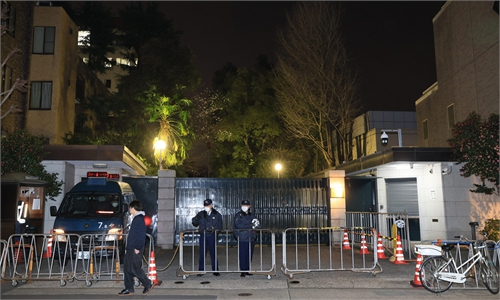
A silver van crept from an underground parking garage in Tokyo on Thursday, bathed in the frantic strobe of media flashbulbs. In the back seat, behind barred windows and mostly obscured by shadows, sat 23-year-old Kodai Murata, a Japan Ground Self-Defense Force (SDF) member who was arrested earlier for breaking into the Chinese Embassy in Japan.
The Tokyo Metropolitan Police Department said it had referred Murata, identified as a second lieutenant, to prosecutors on suspicion of illegal entry after he forcibly entered the premises of the Chinese Embassy in Japan, according to a Kyodo News report on Thursday.
Armed with a knife, Murata's unlawful intrusion has left many in China grappling with a chilling question: What drove a young active-duty Japanese military officer to break into the Chinese embassy and threaten to kill Chinese diplomats in the so-called "name of god"?
The answers may point to a troubling ideological undercurrent. Several Japanese news outlets have drawn a line between Murata's actions and the creeping influence of right-wing ideology within the Self-Defense Forces, where some factions increasingly frame China not just as a regional rival, but as an imminent military adversary. For Chinese observers, the incident is seen as evidence of a broader conscience regression in Japan, pointing to a culture where far-right sentiment ideologies advocating violence and xenophobia are on the rise.
According to Kyodo News, Murata is believed to have entered the embassy premises by climbing over a barbed-wire fence from a building adjacent to the embassy, Kyodo News reported, citing the investigative source. He sustained injuries to his hands from the barbed wire, per the report.
The police department also claimed that the suspect carried an 18-centimeter blade and was attempting to meet and question the Chinese ambassador, and if he was rejected, he planned to commit suicide to create a "shock".
Murata also claimed that he wanted China to refrain from making tough statements toward Japan, according to the department.
A seeming downplay
According to the Article 130 of the Japanese Penal Code, a person who enters the property of another without justifiable reason shall be punished with imprisonment for not more than three years or a fine of not more than 300,000 yen ($1,881).
Liu Jiangyong, a professor at the Institute of International Studies at Tsinghua University, told the Global Times on Thursday that the Japanese side has characterized the incident as "illegal entry" into a building, a formulation that dilutes the factual nature and downplays the seriousness of the matter.
The embassy is not an ordinary building, but a diplomatic mission protected by international law, Liu noted.
As a contracting party to the Vienna Convention on Diplomatic Relations, Japan bears clear obligations as the receiving state: to take all appropriate steps to protect the premises of the mission against any intrusion or damage and to prevent any disturbance of the peace of the mission or impairment of its dignity.
Liu said that based on the physical evidence and the motives stated in existing reports, the man's actual conduct has constituted an infringement of the rights of China's overseas missions and an act of hostility against China.
Global Times reporters observed that major Japanese media outlets - including Asahi Shimbun, Yomiuri Shimbun and Jiji Press - had not featured the story on the front pages of their news websites as of Thursday, and had instead relegated it solely to their "society" sections.
Kyodo News, citing the Japanese Defense Ministry, claimed that the suspect took a leave of absence the day before the incident. The ministry also claimed that by the required deadline, Murata failed to report for duty, despite attempts by his unit to contact him.
Lü Chao, an expert at the Liaoning Academy of Social Sciences, said that by highlighting the suspect's failure to return to his unit on time and his being unreachable, the Japanese government also appears to be deliberately sending a subtle message to its public that the incident is not attributable to governmental responsibility, but merely an act of individual disciplinary misconduct by an SDF officer.
The incident occurred at a time when China-Japan relations are already at a low point, yet Japanese government still attempt to downplay the situation, exposing its clumsy effort to cover up the truth.
Is another assailant far off?
What has led to the incident of a Ground SDF member forcibly intruding into the Chinese Embassy? Fundamentally, it is linked to the infiltration of right-wing ideologies.
The suspect, holding the rank of a second lieutenant, is classified as a "junior officer" by the Japanese Defense Ministry. Yet most SDF instructors are unqualified for their teaching roles; many lack even a master's degree, and some have never produced a single credible academic paper, Kyodo News reported, citing an article covering education at the national defense academy published by Haruo Tohmatsu, Professor of Diplomatic and War History at the National Defense Academy, published in 2023.
These members are swayed by superficial conspiracy theories, and worse still, they are invited to listen to "politically biased lectures" by problematic external commentators, per the report.
Sucho Montani, a former Maritime SDF officer and military commentator, was quoted by Nikkan Gendai as saying that "He [Kodai Murata] was most likely bought into believing the rhetoric such as 'China's actions are going too outrageous.'"
Montani said that roughly 80 percent of officer candidates who hold university degrees are science majors, and they generally lack a solid liberal arts education, making them easily swept up in an atmosphere that equates right-wing views with justice.
He added that the so-called "ideological education" provided at the Officer Candidate School has gone to excess, with right-wing figures being invited to serve as lecturers, according to the Nikkan Gendai.
Former Japan Ground SDF member Takao Izutsu said the motives behind the incident is that the SDF has been persistently advancing operations and training such as the "redeployment toward the southwest," clearly designating China as a hypothetical adversary, Tokyo News reported.
As a result, a pervasive sense of crisis regarding China exists among personnel, said Izutsu, adding that the outrageous act of breaking into the embassy may well be a manifestation of this cognitive atmosphere within the Self-Defense Forces, according to the report.
In response to a question from a Global Times reporter asking for a comment on the extremely vile act of a Japan Ground SDF member who broke into the Chinese Embassy in Japan and was referred to prosecutors, Senior Colonel Jiang Bin, deputy director-general of the Information Office of the Ministry of National Defense and the ministry spokesperson, said on Thursday that the incident is of an extremely vile nature. "It reflects the grim reality that the rampant right-wing extremist ideology in Japan has deeply infiltrated and influenced the SDF."
The Japanese side must immediately conduct a thorough investigation into the incident, severely punish the perpetrator, and give a responsible explanation to China, the spokesperson said.
Xiang Haoyu, a distinguished research fellow at the China Institute of International Studies, told the Global Times on Tuesday that at present, Japan's sense of justice and conscience is regressing, while extremist ideologies advocating violence and xenophobia are on the rise.
If left unchecked, such trends could breed more extremist incidents, even alter Japan's post-war development trajectory, and jeopardize peace and stability in the region, Xiang added.
RELATED ARTICLES