Chinese FM says Japan's regret is far from enough, urges responsible response to embassy break-in incident
Expert outlines concrete actions Japan should take to resolve diplomatic incident
By and Li Yu Published: Mar 27, 2026 11:15 PM

Chinese Foreign Ministry
It is far from enough that the Japanese side only expressed regret for the intrusion into the Chinese embassy in Tokyo, Chinese Foreign Ministry spokesperson Lin Jian said on Friday, urging Japan to conduct a thorough investigation and give a responsible response.Three days after a forcible intrusion by a Japan's Ground Self-Defense Force (JGSDF) officer into the Chinese embassy in Japan earlier this week, Japan's Defense Minister Shinjiro Koizumi on Friday called the incident "regrettable" and vowed to strictly deal with the case.
Although Japan's Chief Cabinet Secretary had issued responses to this major diplomatic incident previously, Chinese experts argued that Japan's series of similar narratives lack genuine reflection or any sincere admission of wrongdoing. Meanwhile, within Japan itself, there is a growing chorus of voices calling on the government to offer a formal apology to China, rather than trying to brush it off with mere expressions of "regret."
One more 'regrettable' not enough
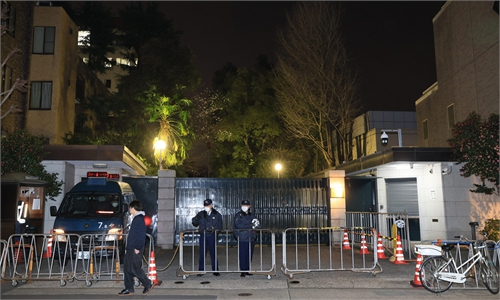
There are now more details about the incident. The perpetrator chose a time when the embassy staff were commuting to work, scaled the wall, broke into the embassy in clear violation of the law, carrying a 31cm sharp knife, and hid in the bush for a long time, Lin said at a regular news briefing.
"We have to ask, who is he waiting for in hiding, and what did he intend to do? The Japanese side has not given any explanation about this by far," he said.
When this incident was first known to the public, Japanese far-right forces tried to deny that the perpetrator is an Self-Defense Forces (SDF) officer, but now the facts are crystal clear. It is far from sufficient that the Japanese side only expressed regret to the Chinese side, Lin said.
Responding to the intrusion incident at a press conference on Friday morning, Koizumi told media that "it is truly regrettable that a SDF officer, who should be complying with the law and maintaining discipline, had been arrested for breaking into the Chinese embassy in Japan," according to a report from Asahi.
He also claimed that once the facts are clarified, the matter will be dealt with strictly, adding that maintaining discipline within the JGSDF is very important, per the Asahi report.
On Thursday, Japan's defense ministry claimed that the JGSDF officer took a leave of absence the day before the incident. By the required return deadline, the officer failed to report for duty, despite attempts by his unit to contact him, per Japanese media reports.
The suspect, a second lieutenant in JGSDF, was referred to prosecutors on Thursday. On Tuesday, he scaled a wall and forcibly entered the Chinese Embassy at around 9 am with a knife, and was later restrained and handed over to the Japanese police, Yomiuri Shimbun previously reported.
JGSDF said on Wednesday that they felt the incident was "regrettable" and will cooperate with the police investigation. On the same day, Japanese Chief Cabinet Secretary Minoru Kihara said that it is "regrettable" that a JGSDF officer, "who should abide by the law", was arrested on suspicion of breaking into the Chinese Embassy in Tokyo, Jiji Press reported.
Japan's official response still lacks the correct attitude for resolving the issue, said Lü Chao, an expert at the Liaoning Academy of Social Sciences.
"Regret" does not constitute a formal apology. Furthermore, Japan has focused its expression of "regret" on the suspect's violation of JSDF's internal discipline and his individual actions, rather than on the diplomatic incident itself, he added.
With the repeated use of the word "regrettable" in a highly consistent manner by different authorities, Japan is attempting to frame the diplomatic incident as an isolated individual act and rhetorically distance itself from institutional responsibility, Xiang Haoyu, a distinguished research fellow at the China Institute of International Studies, told the Global Times on Friday.
According to Xiang, the mentality in Tokyo is deeply contradictory. "On the one hand, it fears that the incident could leave it at a diplomatic disadvantage. On the other, it remains unwilling to confront the deeper underlying problems — the proliferation of far-right ideologies and the loss of control over JGSDF management. Moreover, it seeks to avoid holding the military accountable, lest doing so disturb the interests of conservative forces."
"Japan's perfunctory tendency to downplay the incident is fundamentally at odds with the responsible explanation and accountability demanded by the Chinese side," said Xiang, "In essence, it reveals a lack of sincere remorse, an avoidance of responsibility, and an opportunistic mindset that puts self-interest above all else."
The expert stressed that, according to international law, diplomatic protocol, and the standards expected of a responsible major power, Japan should take concrete actions. These include strictly punishing the individual involved in accordance with the law, fully reporting the entire investigation process and its results to the Chinese side, immediately strengthening 24-hour security protection for Chinese diplomatic and consular missions in Japan to ensure the absolute safety of Chinese diplomatic institutions and personnel, purging far-right ideologies within the JGSDF while carrying out comprehensive disciplinary rectification, and issuing a formal apology to China through diplomatic channels.
Calls for apology
At a House of Councillors Budget Committee session on Friday, Japanese Constitutional Democratic Party (CDP) lawmaker Mari Takagi questioned the government over the latest intrusion incident and pointed to concerns over delays in information disclosure and said that Defense Minister Shinjiro Koizumi should be held accountable, the Sankei Shimbun reported.
Since the intrusion incident took place, Global Times reporters observed that more Japanese politicians have chosen to remain silent. In stark contrast, many Japanese internet users have voiced strong dissatisfaction on social media with the government's response, calling on Tokyo to offer a formal apology to China, particularly amid the growing tensions in the already fragile China-Japan relationship.
"The Diet has finally held question sessions on the SDF officer's intrusion into the Chinese Embassy, yet it didn't offer even a single word of apology to the victim (China). What on earth is going on?" said Japanese net user @ashitawawatashi, who has 27,700 followers, in an X post on Friday.
In a separate X post that received more than 1,600 likes, former Asahi Shimbun journalist and political commentator Akira Sato urged the Japanese government to show sincerity. "Prime Minister Takaichi or Defense Minister Koizumi ought to have personally gone to the Chinese Embassy to deliver a formal apology and give an explanation."
"You're responding only now? And without even a single word of apology? This is not only showing contempt for China, but also treating your own citizens like fools," said a Japanese netizen @adjacencypair under TBS's report on Koizumi's response.
"If Japan does not cure this 'apology-will-kill-me' disease, the country will truly be unable to survive in the international community," Japanese net user Kaz Hagiwara concerned.
"Japanese society is not unaware that this is a serious diplomatic incident. There are also many rational voices within Japanese society," Lü said. "However, it is regrettable that almost the entire Japanese political circle has collectively fallen silent. Even some politicians who were previously relatively moderate find it difficult to speak out. This highlights the enormous influence that right-wing forces currently exert in Japanese politics."
Japanese right-wing forces have shaped anti-China sentiment and a tough stance into a political correctness, making those who stand on the right side of international law and advocate for a formal apology to China seen as politically unwelcome, Lü noted.
The Chinese Embassy in Japan on Thursday issued a travel alert advising Chinese citizens to avoid traveling to Japan, citing "constant deterioration of security environment for Chinese nationals in Japan" while referring to the extremely vile act of a Japan Ground Self-Defense Force member who broke into the Chinese Embassy in Japan.
The Embassy has issued at least six alerts on its website since 2026, reminding Chinese citizens to pay attention to personal safety in the country and advising Chinese citizens to avoid traveling to Japan recently.
In contrast to South Korean President Lee Jae-myung, who actively worked to curb anti-China sentiment and repair relations with China after taking office, the Japanese government has not only failed to take similar measures, but has instead allowed far-right ideologies to spread unchecked domestically. Its passive and perfunctory response has further eroded mutual trust, Xiang said.
Xiang warned that the current China-Japan relationship clearly lacks effective "guardrails." "Without substantive reflection and a correction of its China policy from the Japanese side, bilateral relations will continue to fall into a vicious cycle of rising security risks, depleted political mutual trust, and intensifying public antagonism."
On Thursday, Kyodo News uploaded a video clip on YouTube of the suspect being transferred to the prosecution. Japanese netizens noticed in the comments that people at the scene were shouting "Banzai!" (long live), and singing a militaristic song dating back to the 1930s. The revelation has triggered widespread unease among many Japanese online users.
It is hard to believe that "I heard a military song accompanied by three loud cries of 'Banzai!'… What is this? What on earth is this?" commented Japanese netizen @nachtmusik4703.
"Those pure eyes [of the suspect] that is incapable of doubt is always terrifying to see. It's bottomless madness," said another Japanese net user @brionac2972.
RELATED ARTICLES