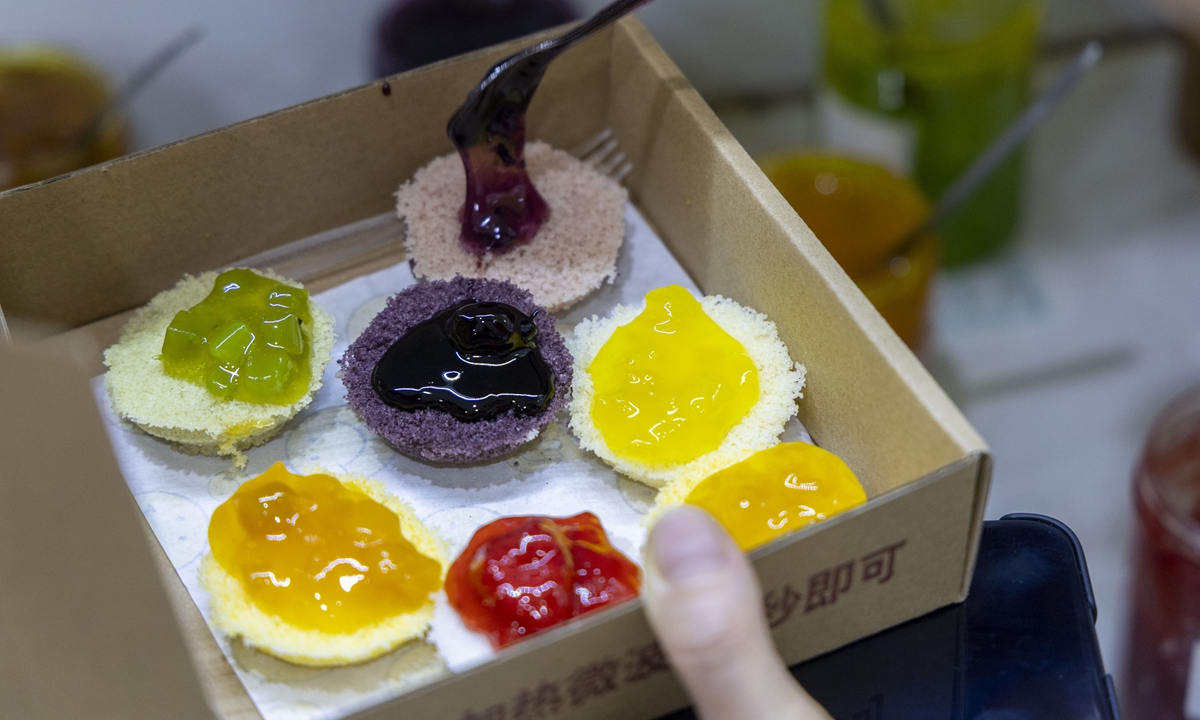
Tianjin snack shuligao (steamed pear cake) Photo: VCG
Recently, an interesting topic has sparked attention on social media platforms: Chinese tourists and students abroad have discovered that Spring Festival snacks from China have unexpectedly become favored among many foreign friends.According to posts on social media, the story began when a Chinese tourist traveling in Milan was asked by the hotel front desk staff to bring back some candies from the Chinese confectionery company Hsu Fu Chi during her next visit, with the staff even offering to pay a deposit in advance. This unusual experience was shared on social media, triggering a wave of "snack gifting." Now, many Chinese tourists and students in Milan carry various Chinese candies with them. What started as a personal sharing story of "snack gifting" has evolved into a lively cross-cultural exchange.
In fact, Chinese-style snacks like White Rabbit milk candies, Chinese walnut cookies, and snowflake crisps have already gained considerable popularity on overseas social media platforms. This reveals a clearer trend: Today's China is increasingly being rediscovered by the world through food, daily experiences and interpersonal interactions. This is precisely where "Chinese food diplomacy" is most vibrant and impactful.
The "Chinese food diplomacy" discussed here is not the traditional state-led formal diplomacy, but rather a form of people-to-people and cultural contact that occurs in everyday life. It may not be solemn, but it is more accessible. In the face of serious, official narratives, people may hesitate to accept the values embedded in this culture; however, it is difficult to refuse a sincere sharing, a curious tasting or a relaxed exchange centered around flavors. It could be a packet of candies, a hotpot invitation or a snack review posted on social media - these seemingly minor acts quietly build bridges across cultural divides.
From the perspective of dissemination, the significance of "Chinese food diplomacy" clearly extends beyond pleasing taste buds. For many foreigners, China often exists within macro narratives, perceived as an object to be understood through political, economic and institutional frameworks. However, a single candy, a piece of pastry or a packet of snacks can transform this abstract perception into a tangible, everyday experience, changing China from a distant, vague concept into something that can be tasted, shared, and discussed in conversation. The spontaneous relay of "gifting" by netizens also allows foreigners to feel the "human touch" within Chinese flavors - the kindness and warmth hidden behind food. If the trend of "China Travel" has opened a window for foreigners to directly understand China, then Chinese food offers a softer, more everyday way to perceive this country. International communication is shifting from "seeing China" to "experiencing China."
What makes this kind of "experience" so moving is that it often occurs in the most unintentional moments, such as a student sharing mooncakes with foreign roommates. Through trust and goodwill, cultural understanding finds a gentle landing point.
More importantly, "Chinese food diplomacy" does not merely carry the logic of product export; it represents a natural spillover of a lifestyle. Foreigners become interested in Chinese food, but this interest is not an end in itself. They begin to enter the daily lives of Chinese people via food, perceiving Chinese tastes, sharing habits, holiday memories and social customs. When food becomes a non-verbal communication medium, it does not preach grand principles. Instead, it conveys cultural codes related to family, reunion and hospitality through shared meals, gift-giving and tasting experiences.
Similarly, for today's consumers, many products are no longer just functional objects but part of emotional identity and lifestyle. Candies and pastries, in particular, can resonate with overseas audiences precisely because they transmit not just "Chinese flavors," but also a warm, lively atmosphere and human connection. This serves as a reminder that China's international communication should go beyond macro narratives, major themes and official platforms - more attention should be paid to resources that carry daily life, warmth and intimacy. In the everyday connections built through a packet of candies, a meal or a cup of tea, China's image can truly enter others' sensory experiences, social scenes and life memories - becoming something tangible, approachable and vibrant.
The author is a professor and executive director of the Academy of International and Regional Communication Studies at the Communication University of China. opinion@globaltimes.com.cn
RELATED ARTICLES