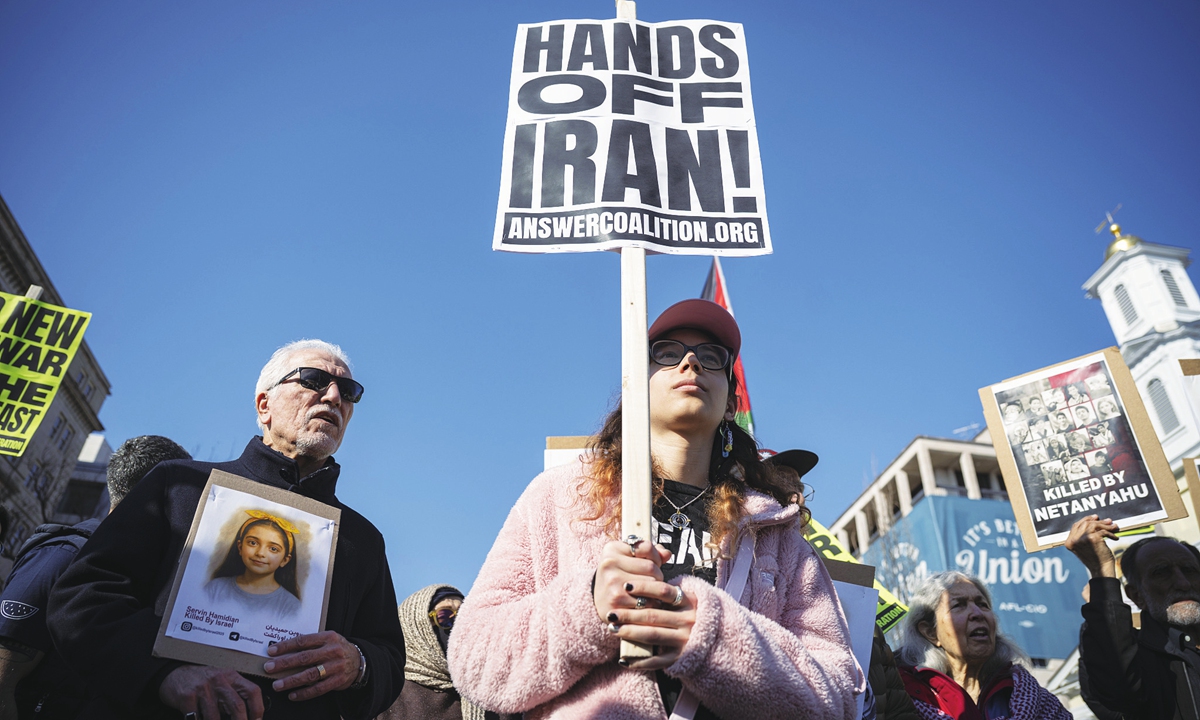
Protesters gather outside the White House in Washington, DC, to demonstrate against US and Israeli attacks on Iran, on March 7, 2026. Photo: VCG
The US-Israel war against Iran continues, as do protests across US states. On March 28, an estimated 8 million people took to the streets of cities across 50 US states and more than a dozen countries around the world to protest against US actions in Iran. Among them were US veterans, a group that keenly understands the tragic long-term fallout from past conflicts. In her I-Talk show, Global Times (GT) reporter Wang Wenwen talked to Mike Ferner (Ferner), who served as a Navy corpsman during the Vietnam War, about his reflections on the US-Israel war against Iran and the limits of US power.
GT: Looking back at the wars the US has been involved in over the past two decades - Iraq, Afghanistan and now Iran - are any of them justified? Should war be a legitimate means to achieve national goals?
Ferner: The real reason the US launches wars is that its goals are imperial. The country's goals are to promote the empire. And it's the private companies that benefit from the expansion of the empire. It has nothing to do with its national interests. Our national interests, for example, would be to have free college education for everybody, healthcare for everybody and a good mass transit system - all of those things. But we don't have a democracy here. The US government is being run in the interests of those private elites who are making the most money out of the way the system operates now. And that's why we keep seeing the US time after time going into wars and assassinating foreign leaders. War certainly should not be a means to pursue national goals.
GT: From your perspective, what is the ultimate goal of the US in launching strikes against Iran?
Ferner: I think the ultimate goal is to make sure that there is no more opposition to the US empire and no more opposition to Israel in West Asia.
By attempting to overthrow the Iranian government and turn Iran into a failed state - just as the US did in Libya and Syria - the US aims to significantly weaken opposition to both American interests and Israel in the region. However, this opposition will not disappear completely. But that's what the US is going after.
And, of course, the oil. Our country, like most industrial countries, runs primarily on oil. Our military, which is by far the largest military in the world, runs on oil. We could have wind power or solar power that would power homes and factories. But if you want to have aircraft carriers and fighter bombers and tanks, you're not going to power those with solar energy. So, this empire, this country, has got a real interest in maintaining hegemony over the world's oil supply, primarily to make sure that our military has all the oil it needs, and then secondarily to prop up the US economy.
GT: The current US-Israel war against Iran has lasted longer than the US had expected. The US wants a speedy end, but Iran has made it clear it will not allow the US to dictate the timing of the conflict's conclusion. The US said it is negotiating with Iran, which Iran has denied. Against these backdrops, are you concerned that the US could once again slip into a prolonged, uncontrollable war quagmire?
Ferner: Very much so. The war that was going on in Vietnam when I was in the military was kind of the textbook case of a quagmire. It just kept going on and on, and we kept killing more and more people in Indochina, and more of our soldiers kept getting killed. But the companies made a lot of money. Even losing wars makes money. When you look at it from that standpoint, the US servicemen and [service]women and their families lost greatly, but the companies made out like bandits.
That's the dynamic that drives these quagmires. The US, particularly under the current administration, is going in a direction that even the generals and the admirals think is a mistake. No sane military person would think that what this administration is doing is good.
GT: Each war the US enters seems to test the limits of its power. From where you stand, having witnessed the arc from Vietnam to now, does the US-led war against Iran mark a moment where those limits become more visible?
Ferner: Our military strength has never been greater, but that doesn't necessarily mean that we're going to be successful when we always take military action instead of diplomacy. We rely on the military option because we have such a strong military, because the weapons companies want to make more weapons. That's the way we go, but it's not necessarily successful as the world can see here.
Iran is really dictating the terms of this war. And the US, with all its weaponry and technology, is not dictating the terms of this war. The word hubris best describes what's going on here. The people in this administration think that the US can do no wrong, can do whatever it wants to do. They're even starting to tell the troops that we are in a war blessed by God. That is the craziest thing. It sounds like the Crusades in the 13th century.
The people in the US are learning lessons. But we don't have a democracy. The people in this country don't run the government. The government goes off on these horrible, illegal, immoral operations, like you're seeing in Iran and Gaza. There's no way that the majority of people in this country would like to see our money spent that way. If I go outside to my neighbors who are not politically involved at all and ask them, "Would you like to send your children to college for free?" They'd say, "Sure, absolutely." "Would you like to have guaranteed medical care to have all your medical bills taken care of?" "Absolutely." But the thing is, we don't have a democracy, and because of this, the US is suffering, as well as the whole world.
GT: Veterans of your generation have faced high rates of suicide, PTSD and disability after returning home. Do you believe the US government has built a sufficient social safety net to cover the "hidden casualties" of war?
Ferner: Of course not. But those costs are what are built into the total cost of war. It's just that sometimes those costs are in dollars and cents when it comes to missiles, bombs, and hospitals. And other times, those costs are borne by the individuals whose lives have been changed and, in some cases, ruined, and by the communities and their families. Those are the costs of war that are always present. The federal government's budget does not cover any of those. It's a bad situation that is manufactured by people who control a nexus of power and are making a lot of money from how the system works.
RELATED ARTICLES