Illustration: Chen Xia/GT
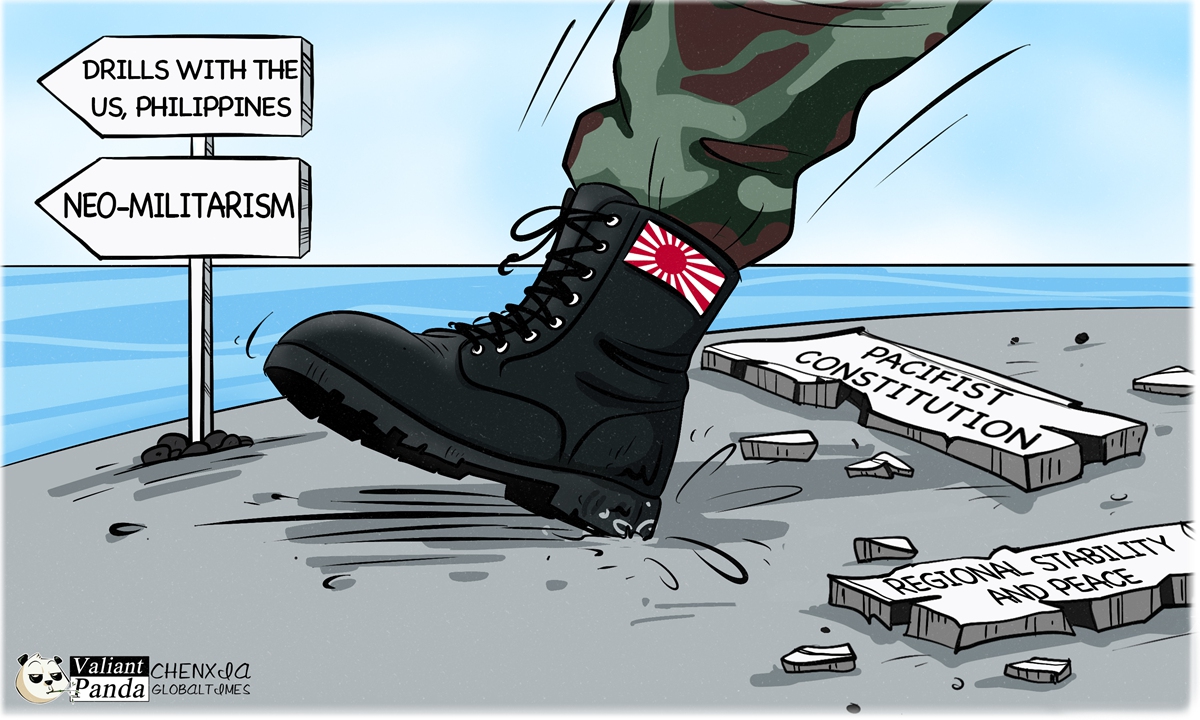
Recently, the US, Japan, and the Philippines held the Salaknib joint military exercises. This marks the first time Japanese combat troops have set foot on Philippine soil since the end of World War II. Under the guise of regional security cooperation, these military drills are a deliberate erasure of historical memory by the Philippines and Japan. They play down the deep-seated enmity stemming from World War II, remain silent on Japan's militarist war crimes, and turn a blind eye to the sufferings inflicted on the peoples of all countries. Such moves have breached the bottom line for peace and stability in the Asia-Pacific region. Japan's presence in the US-Philippines military exercises should serve as a wake-up call to Southeast Asian nations to revisit their historical memories.Historically, after Japan launched an all-out war of aggression against China in 1937, it formulated a "southward advance" strategy to fuel its ambition of building a "Greater East Asia Co-Prosperity Sphere," targeting resource-rich Southeast Asia. On December 7, 1941, Japan attacked Pearl Harbor, sparking the Pacific War, and subsequently launched an offensive into Southeast Asia. At that time, most Southeast Asian countries were under Western colonial rule with weak defense capabilities, allowing Japanese troops to swiftly overrun the entire region and impose a brutal colonial occupation.
The Philippines was among the worst-hit victims. On December 8, 1941, Japanese forces launched air raids on US military bases in the Philippines, followed by landings on Luzon Island to launch attacks on US-Philippine coalition forces. During the war, Japanese troops flagrantly violated international conventions on the treatment of prisoners of war (POWs), subjecting more than 76,000 surrendered US and Philippine soldiers to brutal abuse in the Bataan Death March. Over a 12-day, 100-kilometer march, Japanese troops beat and killed POWs, leaving more than 10,000 dead. In May 1942, Japan occupied the entire Philippines, established a puppet regime, plundered grain, rubber and other resources on a massive scale, and forced civilians into hard labor, causing countless deaths from exhaustion and starvation. In February 1945, during the Allied recapture of Manila, Japanese troops retaliated against unarmed Philippine civilians in the Manila massacre, killing an estimated 100,000 civilians - one-seventh of Manila's total population. During Japan's three-year military occupation of the Philippines, around 1.1 million Philippine civilians lost their lives.
The sufferings of the Philippines are merely a microcosm of the tragic fate of the entire Southeast Asia region. In Myanmar, after the Japanese invasion cut off the Burma Road, Japan forced 62,000 Allied POWs and nearly 200,000 Asian laborers to build the Thailand-Burma Railway, resulting in the deaths of 12,000 POWs and 100,000 laborers, earning the railway the infamous title of the "Death Railway." In Singapore, Japan established Unit Oka 9420, building a bacteriological warfare network spanning Southeast Asia and launching germ weapon attacks on Myanmar, China, Papua New Guinea and other regions. In Indonesia, Japan forced conscripted "laborers" to build fortifications and manufacture weapons and ammunition. Alone on Java Island, 270,000 laborers were sent to other Japanese-occupied Southeast Asian areas for forced labor, with only 52,000 repatriated, resulting in a mortality rate as high as 80 percent. These ironclad historical facts are irrefutable evidence of Japanese militarism's crimes and a shared memory of suffering for Southeast Asian nations.
In recent years, however, the Philippines and Japan have deliberately whitewashed this chapter of history, continuously strengthening bilateral ties through military cooperation. The Philippines seeks to bolster its security capabilities by relying on Japan, while Japan seizes the opportunity to break free from post-war military constraints and expand its strategic footprint in Southeast Asia. Their actions are political calculations driven by immediate interests. Yet this "cooperation" at the cost of abandoning historical memory is a desecration of war victims and a betrayal of the hard-won peace.
History cannot be distorted, nor can trauma be forgotten. Japan must confront its war guilt, deeply reflect on its history, completely abandon its ambition of external expansion, and win the trust of its Asian neighbors and the international community through concrete actions. Southeast Asian countries, including the Philippines, must uphold the bottom line of history, remember their national sufferings and war traumas, and not be misled or coerced by short-term interests. Only by upholding justice and resolving security issues through equal cooperation can we prevent the recurrence of historical tragedies.
The author is an associate professor of the School of Marxism, Beijing Jiaotong University. opinion@globaltimes.com.cn
RELATED ARTICLES