China and Vietnam coordinate to contribute stability and positive energy to a rapidly changing world
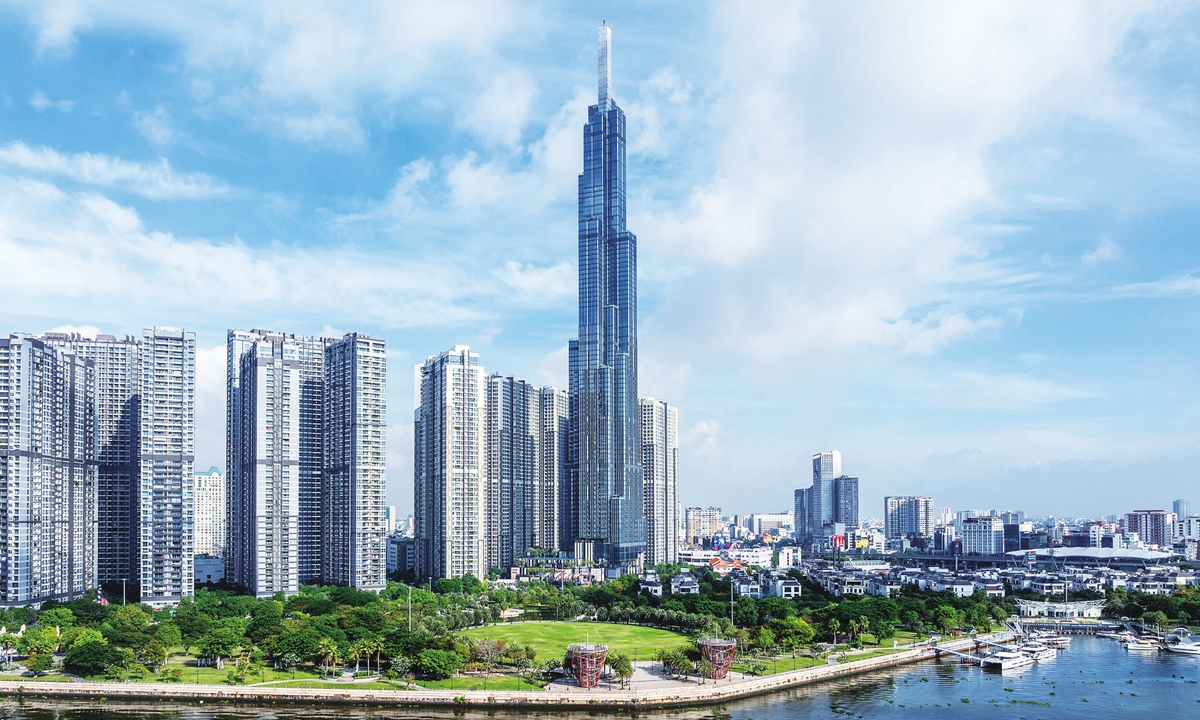
A view of Hanoi, Vietnam Photo: VCG
Editor's Note:To Lam, general secretary of the Communist Party of Vietnam (CPV) Central Committee and president of Vietnam, is currently on a state visit to China from Tuesday to Friday. As China is the first country To Lam is visiting following his recent election as Vietnamese president, what does this visit reveal about China-Vietnam relations? As the two countries advance development, how can they leverage the alignment of their respective national strategies? Global Times (GT) reporters Wang Wenwen and Xing Xiaojing interviewed Duong Van Huy (Duong), a senior research fellow at the Institute of Asia-Pacific Studies, Vietnam Academy of Social Sciences, about these matters.
GT: The Vietnamese leader's visit takes place one year after General Secretary of the Communist Party of China (CPC) Central Committee and Chinese President Xi Jinping made a state visit to Vietnam. To Lam also visited China in 2024 after being elected general secretary of the CPV Central Committee. How do you see the significance of such frequent exchanges between the two countries?
Duong: The common understandings reached between the high-level leaders of the two countries during their reciprocal visits play a profound strategic role in guiding the development of relations between the parties and countries in the coming period.
To Lam's visit as general secretary and president in his new capacity takes place immediately after the country completed the restructuring of state leadership positions at the first session of the 16th National Assembly. Meanwhile, China has just held the fourth session of the 14th National People's Congress and the fourth session of the 14th National Committee of the Chinese People's Political Consultative Conference, thereby establishing socio-economic development goals for the next period.
During To Lam's visit, the two countries signed cooperation documents covering a number of areas including inter-party exchanges, public security, judicial cooperation, economy, industrial and supply chain cooperation, customs cooperation, science and technology, people's livelihoods, human resources development, media, and sub-national cooperation. The two countries are presented with opportunities for more comprehensive, deeper, more substantive and more effective cooperation.
GT: During their meeting in Beijing on Wednesday, General Secretary Xi said, "The leadership of the communist party is the most essential feature and the greatest strength of socialism, and defending the socialist system and the ruling position of the communist party is the greatest common strategic interest of the CPC and the CPV." What is your understanding of this statement?
Duong: Vietnam and China share similar political systems and are both pursuing socialism. The two parties have maintained close ties since the early stages of their respective revolutions and have always stood side by side in their revolutionary struggles. Currently, both countries are at a crucial stage in their socialist construction, especially in the context of complex global changes.
Through the long-standing relationship, a traditional friendship of "both comrades and brothers" has been formed. The frequent exchanges between the top leaders of both sides reflect the strategic depth and stature of the relationship between the two parties and countries. Moreover, they send a clear message to the international community that Vietnam and China are coordinating to ensure the security of their political systems, promote national development, and contribute stability and positive energy to a rapidly changing world.
GT: How do you evaluate the political mutual trust between the two countries?
Duong: Political trust between the two countries is considered a key factor in promoting bilateral cooperation. It is the first element in the overarching goals pursued by both sides, characterized by "six mores": stronger political mutual trust, more substantive security cooperation, deeper practical cooperation, a more solid popular foundation, closer coordination and collaboration on multilateral affairs, and better management and resolution of differences. This trust is also emphasized in high-level meetings between the leaders of both sides. The strengthening and enhancement of political trust continue to play a strategic guiding role in the development of bilateral relations across various fields.
GT: During their meeting on Wednesday, the Chinese and Vietnamese top leaders held talks on advancing wide-ranging cooperation. As Vietnam has begun to realize the Resolution of the 14th National Party Congress that figures out Vietnam's development vision and targets for the next five years (2026-30) and beyond and China is embarking on its 15th Five-Year Plan for the same period, how can the two countries utilize the alignment of the two national strategies?
Duong: As we can see, 2026 marks the beginning of China's 15th Five-Year Plan for socio-economic development, with many ambitious goals and tasks. Meanwhile, Vietnam has just successfully held its 14th National Congress of the CPV and elected a new National Assembly and People's Councils at all levels, marking a promising start to a new era, an era of national progress for Vietnam.
Vietnam and China are two neighboring socialist countries with close geographical proximity, shared ideals, broad strategic interests, and a shared vision and future. In the context of both countries setting important development goals, the China-Vietnam relationship is entering a period of unprecedented historical opportunity. Frequent interactions and exchanges between the two parties have continuously promoted the acceleration of building a higher-level China-Vietnam community with a shared future that carries strategic significance. Senior leaders maintain regular and close contact, facilitating timely discussions on the strategic direction of the bilateral relationship.
Currently, the two countries are actively continuing to deepen their comprehensive strategic cooperative partnership based on the "six mores" direction. This effort is expected to contribute to the development of socialism amid a complex and volatile global situation.
GT: What demonstration effect will the new developments in China-Vietnam relations have on the Asia-Pacific region?
Duong: The rapid progress in China-Vietnam relations today is significant not only for the two countries but also for promoting regional cooperation. Vietnam is an active member of ASEAN, so the development of China-Vietnam relations contributes positively to the development of ASEAN-China relations as well as to peace, stability, development and prosperity in the region and the world.
In the context of an increasingly complex global situation and armed conflicts occurring in many places, the Asia-Pacific region has so far maintained an environment of peace, stability and cooperation. However, this region also faces significant risks. Nevertheless, bilateral cooperation among countries in the region, including China-Vietnam relations, contributes to finding solutions that can prevent potential conflicts and promote cooperation. Therefore, the current development of China-Vietnam relations has gone beyond the scope of bilateral relations, and this relationship will make a significant contribution to promoting cooperation and development in the region.
RELATED ARTICLES