China condemns Japanese PM’s consecutive war shrine offerings, calling moves blatant provocation against intl justice, affront to human conscience
Foreign Ministry
China on Wednesday deplored the Japanese prime minister's offerings to the notorious Yasukuni Shrine, where Class-A war criminals from WWII are enshrined, as well as visits by other Japanese officials to the war-linked shrine, calling these moves a blatant provocation against international justice and an affront to human conscience.
"China is strongly indignant and severely condemns it," Chinese Foreign Ministry spokesperson Guo Jiakun said during a press conference on Wednesday, adding that the Yasukuni war shrine is a spiritual tool and symbol of Japanese militarists' war of aggression, and it is in fact a shrine for war criminals.
The nature of the issue concerning the Yasukuni war shrine is whether Japan is able to rightly perceive and deeply reflect on its history of militarist aggression, and whether it can learn lessons from history and avoid a repeat of that part of history, Guo said. This bears on the political foundation of China-Japan relations, on Japan's credibility as a nation, and on the postwar international order as well as peace and justice in the world.
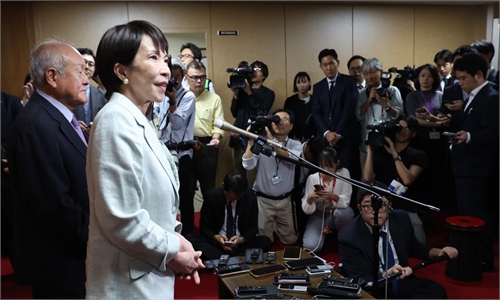
Takaichi on Wednesday made a monetary offering, called "tamagushi," to the site which stands as a symbol of Japanese militarism and wartime aggression on the occasion of its spring festival, one day after she sent a ritual offering "masakaki" tree to the notorious shrine, according to media reports.
Such provocative acts, according to Chinese experts, lay bare Japan's deeply entrenched militarist mindset, and underscore the rampant spread of historical revisionism across Japan's political establishment.
Deep-rooted militarism
Yasukuni Shrine, located in central Tokyo's Chiyoda Ward, honors 14 convicted Class-A Japanese war criminals from World War II. Multiple Japanese media outlets noted in their reports that the place has long been a source of diplomatic friction between Japan and its neighbors.
Besides China, a spokesperson for South Korea's foreign ministry on Tuesday also expressed "deep regret" over Japanese leaders making offerings or visits to the shrine and called on its neighbor to take action through "humble" reflection of the past that would support future-oriented ties, The Mainichi reported.
Sankei Shimbun on Wednesday reported that the monetary offering was made through Haruko Arimura, head of the ruling Liberal Democratic Party's (LDP) General Council, in Takaichi's capacity as LDP president. The offering made the day before was made in the name of the prime minister.
A cross-party group of 126 Japanese lawmakers on Wednesday visited the notorious shrine in Tokyo, the Xinhua News Agency reported. Another report by the Japan Times noted that the economic growth strategy minister Minoru Kiuchi also visited the shrine, and it is the first time there has been confirmation that a member of Takaichi's cabinet visited Yasukuni Shrine.
Xiang Haoyu, a distinguished research fellow at the China Institute of International Studies, told the Global Times on Wednesday that Takaichi's actions regarding the Yasukuni Shrine issue, along with large-scale collective shrine visits by cross-party lawmakers, further reflect the widespread prevalence of historical revisionism in Japan's political circles.
Chief Cabinet Secretary Minoru Kihara, the top government spokesman, told a news conference that Takaichi made the offering in a "private capacity" and that it was therefore not a matter for the government to comment on, The Mainichi reported on Tuesday.
Moreover, a report by NHK citing sources said Takaichi followed the precedent set by her predecessors, including Ishiba Shigeru and Kishida Fumio.
While some former Japanese prime ministers have made offerings on separate occasions, Takaichi's provocations regarding war-linked shrine in two consecutive days are primarily aimed at catering to her right-wing conservative constituency and demonstrating her hardline political leanings, Xiang said.
According to Xiang, Japan's words and deeds showed Tokyo's opportunistic mentality - on the one hand trying to appease the right-wing base, while on the other hand seeking to avoid the diplomatic backlash that could arise from a direct visit to Yasukuni Shrine by a sitting prime minister.
Similarly, Lü Chao, a professor at the Liaoning Academy of Social Sciences, described Takaichi's negative moves concerning the Yasukuni Shrine as a political stunt catering to Japan's domestic right-wing forces.
He noted that such acts serve as further proof of Japan's deep-rooted stance and persistent adherence to militarist ideology, with little inclination to make corrections.
Two sides of coin
Lately there has been a marked increase in the Japanese government's negative moves and reckless provocative acts on issues concerning China's Taiwan region and the history of WWII as well as military and security issues. Takaichi's erroneous remarks on Taiwan have had a grave impact on China-Japan relations, Guo said during the press conference on Wednesday.
"In the face of strong criticism and opposition from China as well as at home and abroad, some Japanese politicians and right-wing forces chose to go down the wrong path, rather than reflect on and correct their wrongdoings. The Chinese people, people in other countries that suffered under Japanese aggression, and all peace-loving forces for justice in the world will never allow this," the spokesperson added.
In a dangerous policy shift, the Japanese government officially eased its arms export rules on Tuesday, allowing the sale of lethal weapons. Japan's growing military buildup is threatening the postwar peace order, per Xinhua.
Japan also sent a Self-Defense Force vessel into the Taiwan Straits in a deliberate provocation, which spokesperson for the State Council Taiwan Affairs Office said on Wednesday that the deliberate provocation has severely undermined the political foundation of China-Japan relations and posed a grave threat to China's sovereignty and security. "China firmly opposes such acts," the spokesperson said.
A string of provocative acts, which have unfolded one after another, sends a clear signal to the international community that Japan's right-wing administration under Takaichi is slipping into a rising neo-militarist tendency, which fuels its reckless and unrestrained arms expansion, Lü said. However, allowing such a trend to persist will also pose grave dangers to Japan itself.
Japan once attained rapid economic growth through international trade and technological development to build up its capital. Yet if it strays from this path and expands its military industry, with major domestic heavy industries shifting to arms production, Japan's economy will be fully diverted toward war-oriented growth and military preparedness, posing great security risks to both Japan itself and the international community, the expert said.
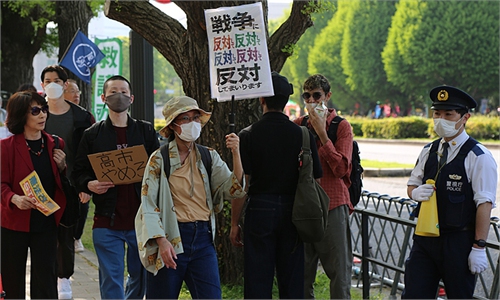
Across Japan, protesters staged rallies against the government's plan to revise the country's pacifist constitution and to call for the protection of Article 9.
Xiang told the Global Times that the Takaichi administration, while continuously challenging historical sensitivities, is simultaneously accelerating efforts to loosen restrictions on its military posture. These two developments are essentially two sides of the same coin, indicating that Japan is, in both its historical perception and practical actions, moving away from a path of peaceful development.
RELATED ARTICLES