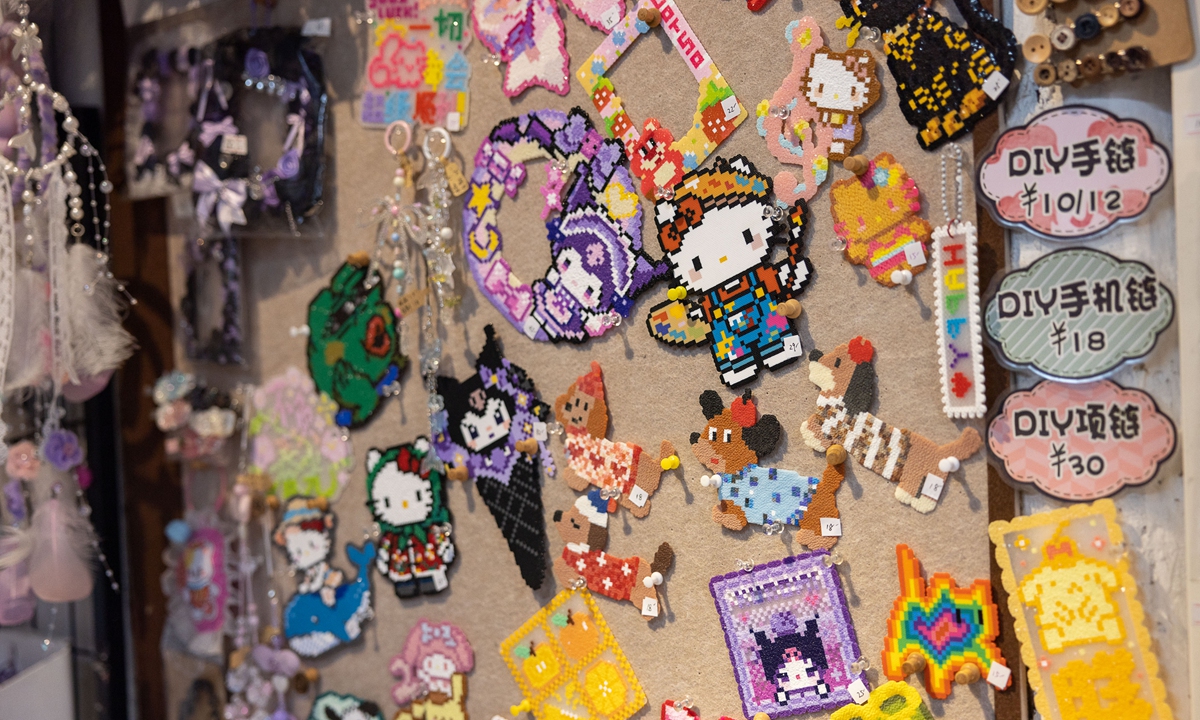
Perler bead products at a handicraft workshop in Huzhou, East China's Zhejiang Province on April 14, 2026 Photos: VCG
Arranging colorful plastic beads into patterns and fusing them with heat to create pixel-style trinkets such as keychains and fridge magnets, pindou, or perler beads, have become the latest craze among young people in China. In 2026, the craft has been gaining traction for its simplicity, affordability, and the oddly soothing, almost "mechanical" sense of calm it provides.Following the popularity of squishy stress-relief toys, perler beads have quickly emerged as a new darling in China's fast-growing "emotional consumption" market. According to CCTV News, the niche has already entered the billion-yuan ($146 million) market segment, with online discussions surpassing tens of millions. Alongside collectibles, journaling, and film photography, perler beads have become one of the year's most talked-about hobbies.
The trend has only accelerated in 2026. During the Spring Festival holidays, group-buying orders placed by Gen Z consumers rose by 65 percent year-on-year, while orders specifically for perler beads surged by a staggering 9,018 percent, according to a Spring Festival consumer spending report conducted by Douyin, the Chinese version of TikTok.
Compared with traditional handicrafts that require time, patience, and technical skill, perler beads offer instant gratification. "Users can simply follow a pattern and achieve a finished product, which provides a quick sense of accomplishment," Zhang Yi, CEO of iiMedia Research Institute, told the Global Times on Wednesday.
"It allows people to express their aesthetic preferences and creativity in a low-pressure environment without strong social demands."
With tutorials, design templates, and finished works widely shared online, the hobby is increasingly evolving into a lightweight social medium, Zhang Yi said.
Quirky trend
In a small handicraft workshop tucked into the basement level of a shopping mall in Beijing's Chaoyang district, the trend is on full display. The roughly 50-square-meter space is lined with pegboards covered in completed works, while two to three dozen tables are filled with young customers and children experimenting with perler beads, beading, and squishy crafts.
Staff at the workshop told the Global Times that in 2025, most customers were focused on making squishy toys and bracelets. In 2026, however, perler beads have taken center stage, with the majority of participants in their early 20s.
The origins of perler beads date back to 1971, when Swedish engineer Gunnar Knutsson invented the plastic bead system and patented it. Initially designed to help elderly residents in nursing homes improve hand mobility, the product was later introduced to the North American market in the 1980s. Through systematic branding and promotion, it gradually evolved into the globally recognized craft system seen today, reported CCTV News.
"In reality, we rarely see elderly customers now," a staff member said. "Most customers are young people who come with their favorite anime or cartoon designs. We provide materials, guidance, and help with the final ironing process."
Zhang Fan, a Beijing-based graduate student, told the Global Times that she first encountered perler beads through short videos on social media and started by replicating small, simple designs.
"It feels really rewarding when you finish a piece," she said. "You can chat with friends while working on it, and in the end, you have something tangible to take home, whether as decoration, a fridge magnet, or even a handmade gift. It gives you a strong sense of participation."
For Zhang Fan, the craft has also become a casual social activity. "My younger sister enjoys it too, and she often makes pieces to give her classmates," she said. "Sometimes after dinner, my high school friends and I don't know what to do, and it feels too early to go home. So we'll spend an hour or two making perler bead crafts."
A search for perler beads on social media platforms reveals a vast ecosystem of beginner tutorials and immersive crafting videos, many of which garner tens or even hundreds of thousands of likes.
"Our research shows that many people first encounter perler beads through social media," Zhang Yi noted. "Its social attributes are amplified online, as users share finished works, patterns, and tutorials. From selecting beads to arranging them and ironing them into shape, every step involves techniques that spark curiosity and discussion."
He added that the appeal also lies in the flexibility of engagement. "It can be both social and solitary. Participants do not have to bear excessive social pressure during the process. Unlike dining, where people may feel pressured to maintain conversation, or watching movies, which requires cognitive effort to follow the plot, perler beads offer a relaxed, low-demand experience," Zhang Yi said.
As familiarity grows, some enthusiasts transition from workshops to crafting at home. Zhang Fan said she now prefers making perler beads on her own.
"Once you get used to it, you can just do it at home from time to time," she said.
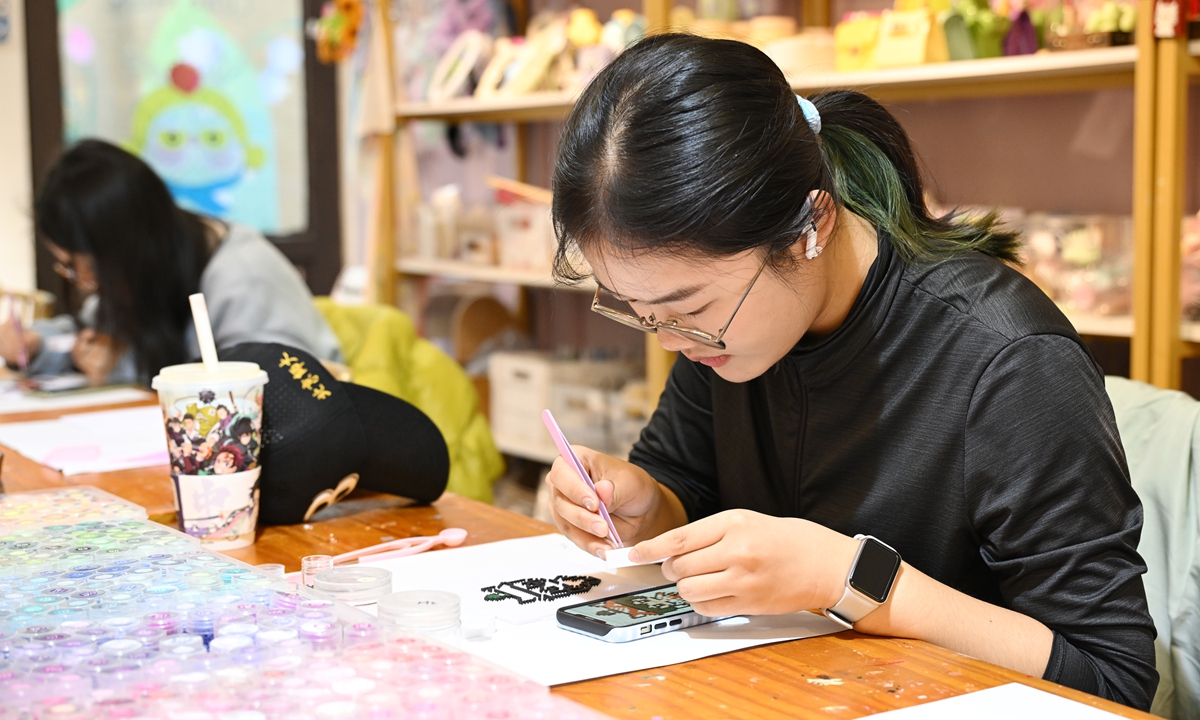
A college student works on a perler bead artwork at a shop in Shichahai, a famous scenic area in the northwest part of Beijing, on November 7, 2025.
Potential risksDespite its rapid rise, the trend is not without concerns. A recent incident in Southwest China's Guizhou Province, in which a young girl suffered an electric shock while using a mini-iron included in a perler bead kit, has drawn attention to potential safety hazards.
According to the Xinhua News Agency, the ironing stage - an essential step in fusing the beads - often involves the use of small electric irons packaged with the toys. These seemingly harmless devices have exposed multiple risks.
On social media, some users have shared experiences of accidental burns during the process, affecting fingers, arms, and palms, with damage ranging from redness to blistering.
Beyond burn injuries, defective products may also pose risks of electric leakage or even fire. Some parents have also expressed concerns about whether harmful substances such as formaldehyde could be released while heating the beads.
Zhang Fan noted that she has seen parents accompany children to workshops, with adults typically handling the ironing step.
"I don't worry too much about occasional exposure, but it's definitely something you shouldn't do every day," she said. "When I iron the beads, I prepare towels in advance to avoid burns."
In response to these concerns, market regulators in provinces including Guizhou, Sichuan, and Guangdong have launched special inspection campaigns targeting perler bead products and related equipment, reported Xinhua.
The China Consumers Association has also weighed in, noting that emotional consumption sectors represented by perler beads are becoming new growth points in the consumer market. However, the association urged consumers to remain rational, avoid chasing novelty blindly, and prioritize safety and health by choosing certified products.
RELATED ARTICLES