Illustration: Liu Xidan/GT
This year, discussions within the international community regarding the topic of "middle powers" have steadily increased. Not long ago, leaders from the five Nordic countries and Canada issued a joint statement expressing their intent to meet more regularly at different levels "to advance shared principles and interests." International observers have interpreted such moves as an attempt to forge a "new alliance of middle powers," with the goal of reducing dependence on the US.
"If we are not at the table, we are on the menu." Earlier this year, Canadian Prime Minister Mark Carney made this pointed remark, articulating the growing collective anxiety felt by many nations - including traditional US allies - against a backdrop of rising power politics and the reshaping of global rules. At the time, Carney's suggested remedy was clear: Middle powers must wake up.
Amid this, how should we understand the impact of such a trend on the international landscape? It is worth analyzing through the following questions.
First, what defines a middle power?
The concept lacks a clear-cut boundary, and its definition adjusts alongside shifts in the international power structure. Generally, middle powers are seen as occupying the middle tier of the global political ladder. While they lack the capacity to lead the international order, they are not entirely dependent on others when handling international affairs. They are a group of nations possessing a certain economic scale, diplomatic agency, and regional influence.
In recent years, countries identifying as middle powers have played an increasing role in international affairs. They are increasingly becoming a vital variable in global governance. The desire of middle powers to become active shapers of regional and international orders is closely linked to shifts in the global situation. Frequent geopolitical conflicts and intensifying major-power competition in recent years have impacted the existing international order, significantly increasing uncertainty within the international system.
Over the past year, as hegemonic powers have more recklessly undermined global peace and development, a group of middle powers has faced a bitter reality where their own interests are directly damaged. Driven by the urgent need to protect their interests, these nations are constantly adjusting their foreign policies, placing greater emphasis on independent action and mutual cooperation.
Second, what does the rising "presence" of middle powers mean for the world?
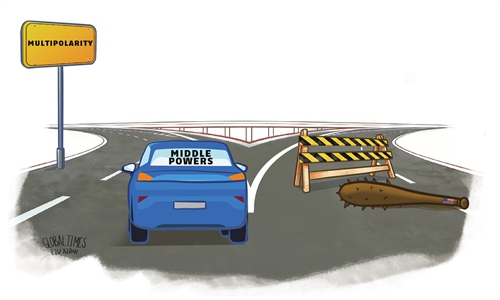
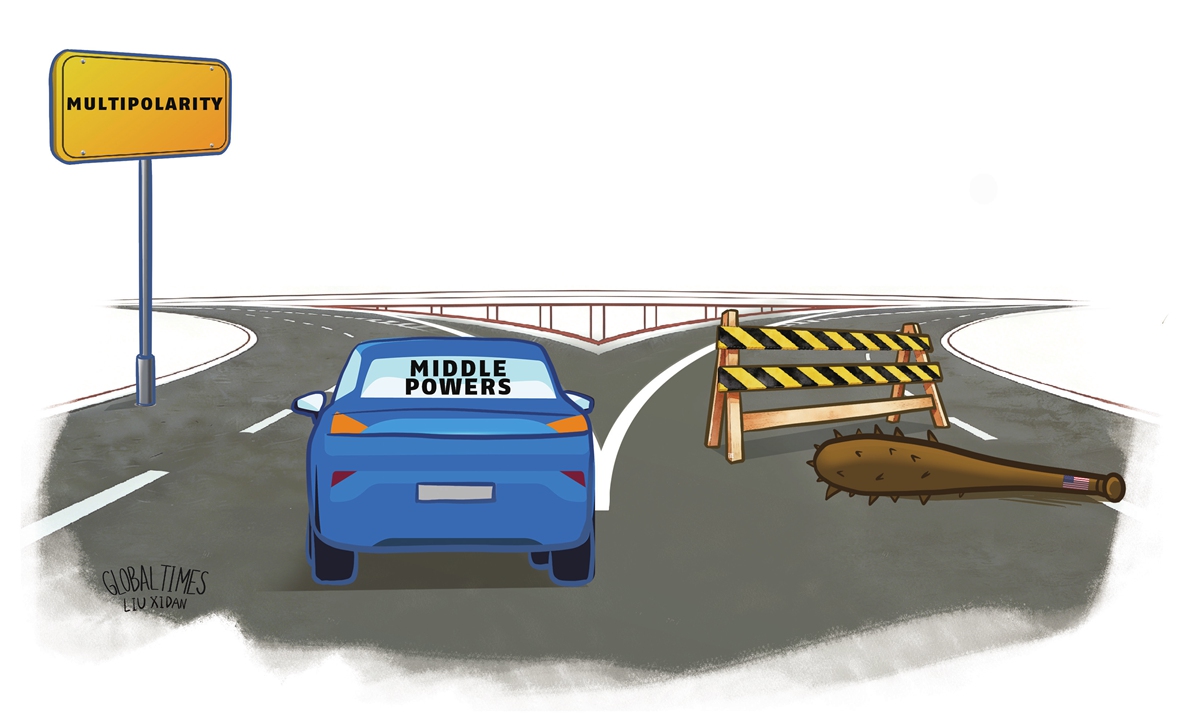
The strengthened initiative of middle powers is a manifestation of the continued evolution of world multipolarity. Despite the persistent rise of hegemonism and power politics, the general trend toward multipolarity remains unchanged. Members of the international community, including many Western nations, have significantly deepened their understanding of this trend.
The essence of multipolarity lies not just in the change of power dynamics, but in the growing co-existence of diverse development paths, governance models, and civilizations. For a long time, the international order was largely dominated by a few major powers. Today, as middle powers strengthen their strategic autonomy and focus on collective voices and coordinated positions, they help check unilateralism and hegemonic behavior, promoting a more diverse and inclusive international system.
Some scholars point out that middle powers are a diverse group, and the key lies in finding the right alliances for the right issues. While it is beyond reproach for middle powers to draw closer under volatile circumstances, this "grouping" should not further weaken multilateralism. If these countries act solely out of self-interest or for the benefit of a small clique, deviating from established international rules, the so-called "awakening and alliance" of middle powers could degenerate into a new exclusive "small circle" or even a tool for more complex bloc confrontation. For a significant portion of middle powers, if they continue to view their strategic dilemmas merely as a need for "reactive" responses to hegemonic behavior - and fail to face their long-standing structural dependence on hegemonic states - they will be unable to truly escape the manipulation of those powers.
Third, how should middle powers add strength to global peace and stability?
Historical experience proves that the root cause of international disorder is never the "multipolar" structure itself, but rather the abandonment of principles and the violation of norms. Facing a world intertwined with change and chaos, middle powers indeed need to protect their rights, but their actions should maintain a broad perspective, addressing the roots of order and governance to help shape an overall environment conducive to peaceful development.
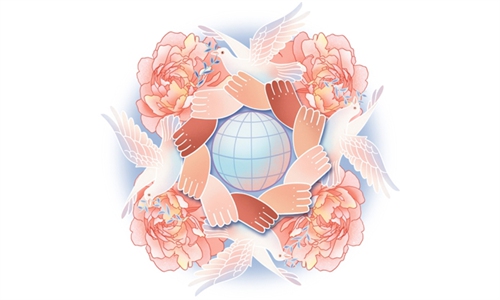
First, middle powers should adhere to the correct direction of an equal and orderly multipolar world. Promoting world multipolarity toward equality and order is a realistic necessity for maintaining global peace. "Equality" means that all nations - regardless of size or strength - are equal members of the international community, each finding its place and playing its due role in a multipolar landscape. "Order" means that all nations must abide by universally recognized international rules, namely the purposes and principles of the UN Charter and the basic norms governing international relations. Only then can the "awakening" of middle powers be transformed into a driver for cooperation and truly promote world peace and development.
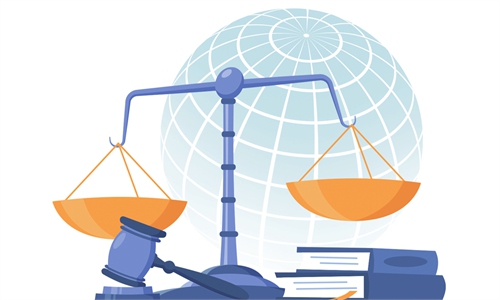
Second, they need to steadfastly defend the international rule of law, fairness and justice. In contemporary international relations, the international rule of law is the fundamental guarantee and the core of fairness and justice. Certain major powers view international law as an obstacle to their national interests, adopting an approach of accepting international rules when they suit their interests and rejecting them when they do not, while being prone to withdrawing from treaties and organizations. This seriously damages the authority of the international rule of law and multilateral mechanisms. Middle powers must protect their rights through the rule of law and fully, comprehensively, and completely abide by the basic norms of international relations. By avoiding "double standards," they can effectively maintain the seriousness of the international legal framework.
Third, middle powers should resolutely oppose hegemonism and power politics. The prominent challenge facing the world today is that hegemonic behavior seriously threatens the international order. This affects all countries -middle powers and smaller, weaker powers alike. To truly play a greater positive role in international affairs, middle powers must unite the broader international community, insist that international affairs be handled through consultation among all parties, form the most extensive common ground for maintaining multilateralism, and speak with a common voice to defend the international order.
The anxiety of middle powers reflects the problems of our era. To truly move past this anxiety, the root causes must be identified and targeted. By bidding farewell to the outdated logic of international relations - where countries are either "at the table" or "on the menu" - and moving toward a new paradigm of international cooperation based on extensive consultation and joint contribution for shared benefit, we can build a wider international consensus and jointly contribute to a world of peace, stability, and development.
Huan Yuping is an international commentary column of the People's Daily. opinion@globaltimes.com.cn