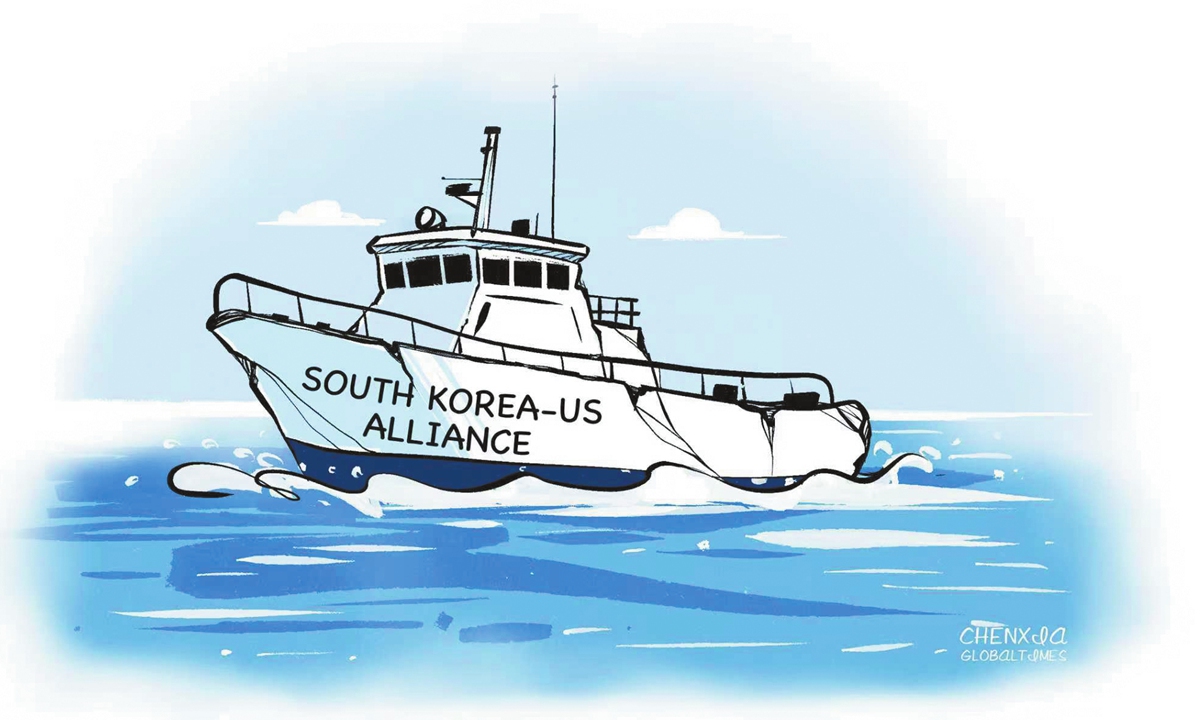
Illustration: Chen Xia/GT
Recently, South Korean media reported that the US has partly restricted intelligence sharing with South Korea due to policy divergences. At the same time, the revision of the demilitarized zone law, pushed by South Korea, has drawn opposition from Washington. Coupled with previous public criticism from the US side claiming South Korea "didn't help" in Middle East issues, these overlapping events have created an "abnormal airflow" between the two countries that cannot be ignored. The "emotional" and "trust-based" foundations of the South Korea-US alliance have been visibly damaged.Such frictions are not unprecedented; rather, they are a structural phenomenon triggered by the transition of South Korean political cycles. Whenever South Korea attempts to expand its autonomous space on key issues, tensions with the US arise. The root cause lies in the US' inability to tolerate South Korea deviating from its established strategic orbit. Whenever Seoul demonstrates a degree of policy independence, Washington often exerts pressure through security issues. Meanwhile, conservative forces in South Korea tend to use external pressure to constrain progressive administrations, creating a dynamic of internal and external synchronization. Therefore, quarrels within the South Korea-US alliance are often the combined result of specific political cycles and domestic political structures.
Unlike in the past, current frictions are compounded by policy variables under Washington's "America First" policy. Under this logic, the US no longer prioritizes the Korean Peninsula within its global strategy, preferring instead to measure the alliance through a cost-benefit lens. From demanding higher defense cost-sharing to using economic and trade levers to pressure South Korea into investing $350 billion in the US, it is evident that Washington's view of the relationship has become "instrumentalized." This approach has sparked resentment within South Korean society; particularly as tensions escalate in the Middle East, some South Korean voices have begun to question the reliability of US security commitments. When an alliance evolves into a transactional relationship, the bonds of communication and mutual trust naturally loosen up.
Under the dual influence of South Korea's cyclical political structure and shifts in US strategy, the foundation of alliance is indeed shifting. On the one hand, US strategic discourse has adjusted, with weakened emphasis on "extended deterrence". On the other hand, in practical operations, the US increasingly uses its own global strategic needs as a yardstick. This "strategic flexibility" means that the US Forces Korea is, to some extent, shifting from a force "protecting South Korea" to a "mobile asset" serving global US strategy.
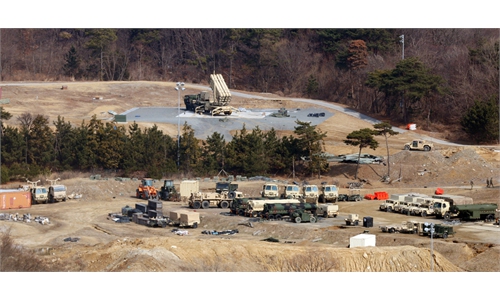
However, it must be pointed out that although the foundations of the South Korea-US alliance have loosened significantly, the institutional basis remains intact. The mutual defense treaty between the two countries is still in effect, approximately 28,000 US troops remain stationed in South Korea and military communication mechanisms are functioning normally. In other words, the current cracks in the South Korea-US alliance have not yet reached the core of the relationship.
Currently, the South Korea-US alliance is transitioning from ties based on "shared values" and long-term commitments toward a transactional relationship centered on interest calculations. In this context, the key issue for Seoul is how to respond to rising uncertainty. South Korea does not lack the capacity for autonomous defense; it possesses a sufficient defense budget, a sophisticated military-industrial complex and a conventional military force that ranks among the best in the world. Its security is not entirely dependent on the US. If Seoul can view the current friction with Washington as an opportunity to improve its independent national defense and security systems while expanding its diplomatic flexibility, this "alliance volatility" could serve as a strategic opportunity. Conversely, if South Korea continues to rely on US security provision without strategic restructuring, it may remain repeatedly constrained in the future.
In summary, the South Korea-US alliance is in a phase of adjustment. The future direction of the relationship largely depends on whether US policy maintains continuity and whether South Korea can enhance its strategic autonomy. For Seoul, the key is not waiting for Washington to change, but rather breaking free from the structural dilemma of being "simultaneously dependent on the US and constrained by it."
The author is the director and professor of the Center for Korean Peninsula Studies at the Shanghai University of International Business and Economics. opinion@globaltimes.com.cn
RELATED ARTICLES