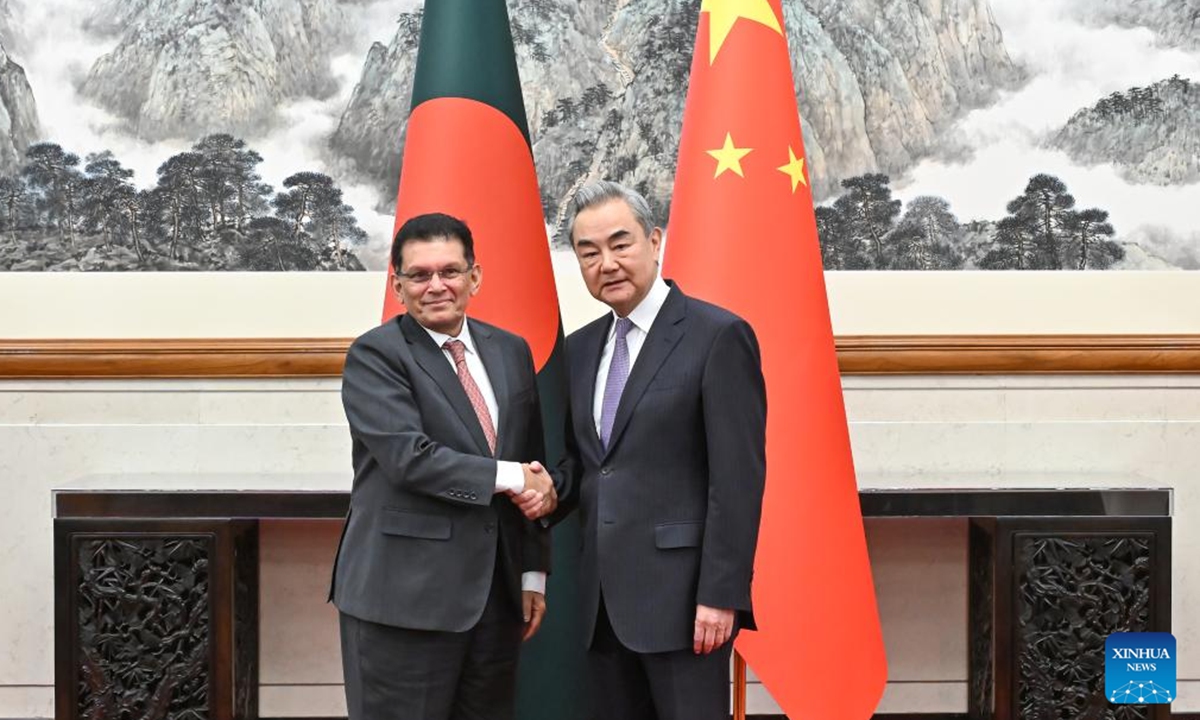
Chinese Foreign Minister Wang Yi, also a member of the Political Bureau of the Communist Party of China Central Committee, holds talks with Bangladeshi Foreign Minister Khalilur Rahman in Beijing, capital of China, May 6, 2026. Photo: Xinhua
Bangladesh's Foreign Minister Khalilur Rahman has just concluded a three-day official visit to China, marking his first China trip since the new Bangladeshi government under the Bangladesh Nationalist Party (BNP) assumed office in February. The visit underscores the stability, continuity and pragmatic orientation of China-Bangladesh relations.
Following the political transition in the summer of 2024, Bangladesh has maintained consistent engagement with China across official and non-governmental channels. At the governmental level, in January 2025, then-adviser for foreign affairs of the interim government of Bangladesh Touhid Hossain traveled to Beijing and held talks with Chinese Foreign Minister Wang Yi. Concurrently, major Bangladeshi political parties, civil society organizations, academic institutions, research centers, student associations, and media representatives have continued their engagement with their Chinese counterparts. These multifaceted interactions have significantly enhanced mutual understanding and reinforced bilateral trust.
From a practical standpoint, political stability is instrumental to Bangladesh's long-term development. Following this year's peaceful general election and orderly transfer of power, Bangladesh has entered a new phase of development. Accordingly, the cultivation and management of constructive relations with major countries have become a central priority for the new government.
This year commemorates the 10th anniversary of Bangladesh's participation in the Belt and Road Initiative (BRI). Over the past decade, China and Bangladesh have cultivated extensive and mutually beneficial cooperation across multiple sectors.
The past years have witnessed tens of billions of dollars in committed investments, primarily directed toward large-scale infrastructure projects in transportation, energy, and information and communications technology. A series of transformative projects, some directly implemented under BRI frameworks and others enabled through BRI-facilitated financing, technical collaboration, or policy coordination, have significantly enhanced Bangladesh's transport networks, power generation and distribution capacity. Looking ahead, bilateral cooperation holds substantial potential for further refinement and deepening, particularly in emerging priority domains such as the digital economy.
Moreover, the political mutual trust between the two countries manifests itself across multiple dimensions. Bangladesh firmly supports the one-China principle and opposes "Taiwan independence," a position that is intuitively important for safeguarding China's core interests. The two countries also coordinate closely on broader regional and global issues, including efforts to resolve the Middle East conflict. They have reached a shared understanding on key principles, such as upholding multilateralism, resolving disputes through peaceful means and advancing the vision of a multipolar world order.
In his meeting with Bangladeshi Foreign Minister Rahman on Wednesday, Wang Yi said China respects Bangladesh's independence, sovereignty and national dignity, as well as the development path and political system chosen by its people, and supports Bangladesh in pursuing an independent foreign policy. According to Rahman, the new Bangladeshi government attaches high importance to its relations with China and it stands ready to strengthen coordination with China to jointly safeguard multilateralism.
It is also worth noting that the Teesta River issue could offer an opportunity for Bangladesh to cooperate with China. Dhaka said it has sought the involvement and support of China in the Teesta River Comprehensive Management and Restoration Project, while the Chinese side has also expressed its willingness to proactively participate in the project.
Empirical evidence demonstrates that China-Bangladesh cooperation extends well beyond rhetorical declarations. At this new starting point, bilateral cooperation is neither targeted against any third party nor susceptible to external interference. Rather, it represents a continuation of the longstanding friendship between the two nations, aimed at co-writing a new chapter in their comprehensive strategic cooperative partnership.
The author is director of the South Asian Communication Studies Centre at the Academy of International and Regional Communication Studies, Communication University of China. opinion@globaltimes.com.cn
RELATED ARTICLES