Illustration: Chen Xia/GT
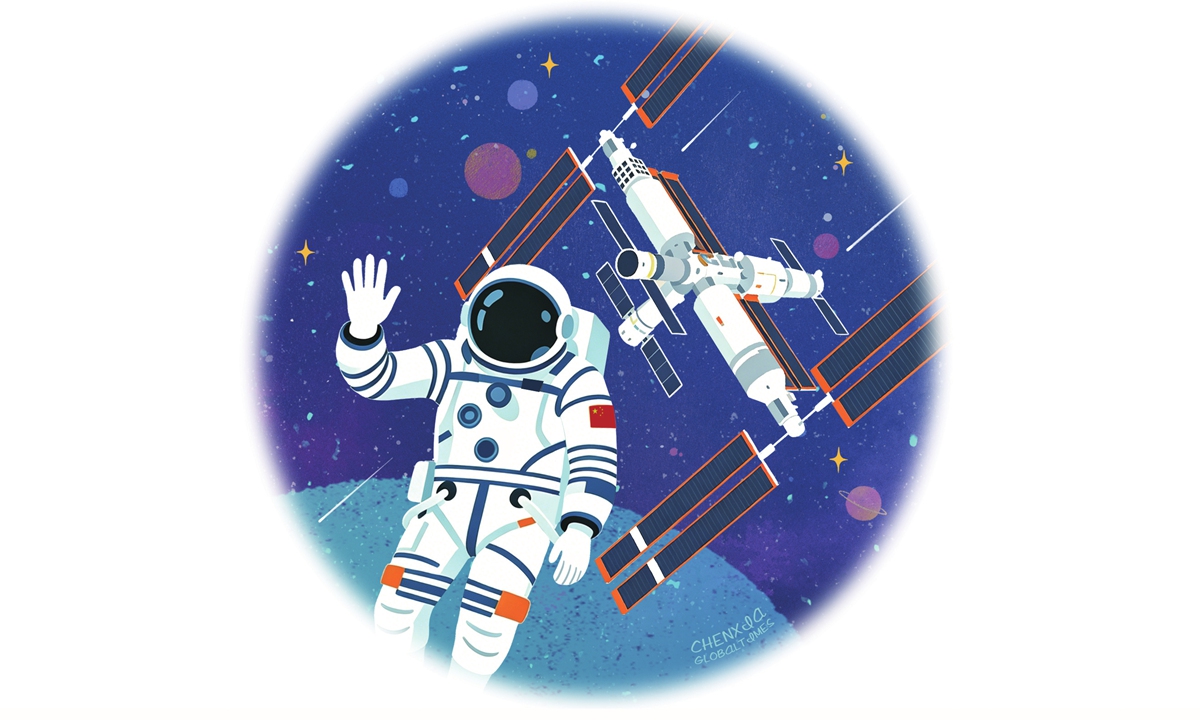
In the early hours of Monday morning Beijing time, a touching scene unfolded aboard China's Tiangong space station. The crew of Shenzhou-21 opened their "door" to welcome the incoming Shenzhou-23 team. Six astronauts posed together, capturing China's eighth family portrait in space.
Hours earlier, a Long March-2F carrier rocket had lifted Shenzhou-23 into the sky. The standout figure on this mission is Lai Ka-ying, the first astronaut from China's Hong Kong Special Administrative Region, who was selected as a payload specialist for the Shenzhou-23 spaceflight mission. Her journey to the Chinese space station marks a historic milestone that opens a new chapter in Hong Kong's involvement in China's national space program.
The Shenzhou-23 mission badge prominently features a Bauhinia flower on the left side, commonly known as the Hong Kong orchid. The international financial center is now making its mark in space science and technological exploration.
It's a perfect example of a two-way embrace. The nation has opened its space doors to Hong Kong, and Hong Kong's youth have responded with genuine enthusiasm and action.
From Gui Haichao, a Chinese astronaut who is China's first payload expert and comes from the remote county of Shidian in Yunnan Province, to Lai Ka-ying from the bustling international city of Hong Kong, the dream of sailing toward the sea of stars is being realized in China by people from vastly different regions and backgrounds. This vision of broader participation clearly does not stop at national borders; it continues to expand with greater openness, inviting the world to participate.
It was announced this April that two Pakistani candidates have been selected as the first foreign astronauts for China's space mission training. After completing all training and evaluations, one of them will participate in a space mission as a payload specialist, becoming the first foreign astronaut onboard the Tiangong space station.
This is far more than a symbolic gesture of international cooperation. It marks a significant shift in how space is being explored globally. For decades, space has been dominated by a handful of major powers, hindered by high technical barriers, resource restrictions, and geopolitical rivalries. China is changing that reality.
Reports indicate that scientific experiments from at least 17 countries - including Switzerland, Poland, Germany, and Italy - have been selected and installed aboard Tiangong.
In 2021, China and Russia jointly released the International Lunar Research Station Roadmap (V1.0) and the International Lunar Research Station Guideline for Partnership (V1.0), further opening the joint-venture to international cooperation.
Despite some geopolitical headwinds, China and Europe continue practical scientific collaboration on projects such as the SMILE satellite (Solar wind Magnetosphere Ionosphere Link Explorer), which successfully launched in May 2026.
In Latin America, China's space partnerships are expanding, particularly with Brazil through the CBERS Earth observation satellite program, as well as with Bolivia, Venezuela, Argentina, and others in satellite technology, launch services, and deep-space infrastructure.
China's "circle of friends" in space exploration is quietly growing - built not on exclusivity, but on inclusion; not on monopoly, but on sharing.
The ultimate romance of space exploration is not confined to distant galaxies; it also comes back to Earth, enriching our daily lives in small but meaningful ways - from the shoes on our feet to the water purification systems in our homes.
Observers also point to promising future applications. Lunar regolith 3D printing technology that could be used to construct buildings in extreme environments on Earth, deep-space laser communication systems capable of dramatically improving ground network resilience, and next-generation propulsion technologies that may lead to cleaner industrial burners.
When astronauts look back at our planet from space, they don't see national borders, race, or ideology. They see a single blue sphere suspended in the vast darkness. We are all in this together on this planet.
China understands this truth deeply. That is why, on its journey to the stars, it chooses to walk side by side with the rest of the world.
This is the unique romance of Chinese space exploration: It does not flaunt power or pursue monopoly. Instead, it is built on solid technology and a genuine spirit of inclusion. Quietly yet firmly, China is offering the world its most sincere and determined invitation.
RELATED ARTICLES