Japan approves ‘natl intelligence council,’ raising neo-militarist concerns
Move erodes post-war pacifism, plants hidden dangers for regional security and stability: expert
By Published: May 27, 2026 03:13 PM

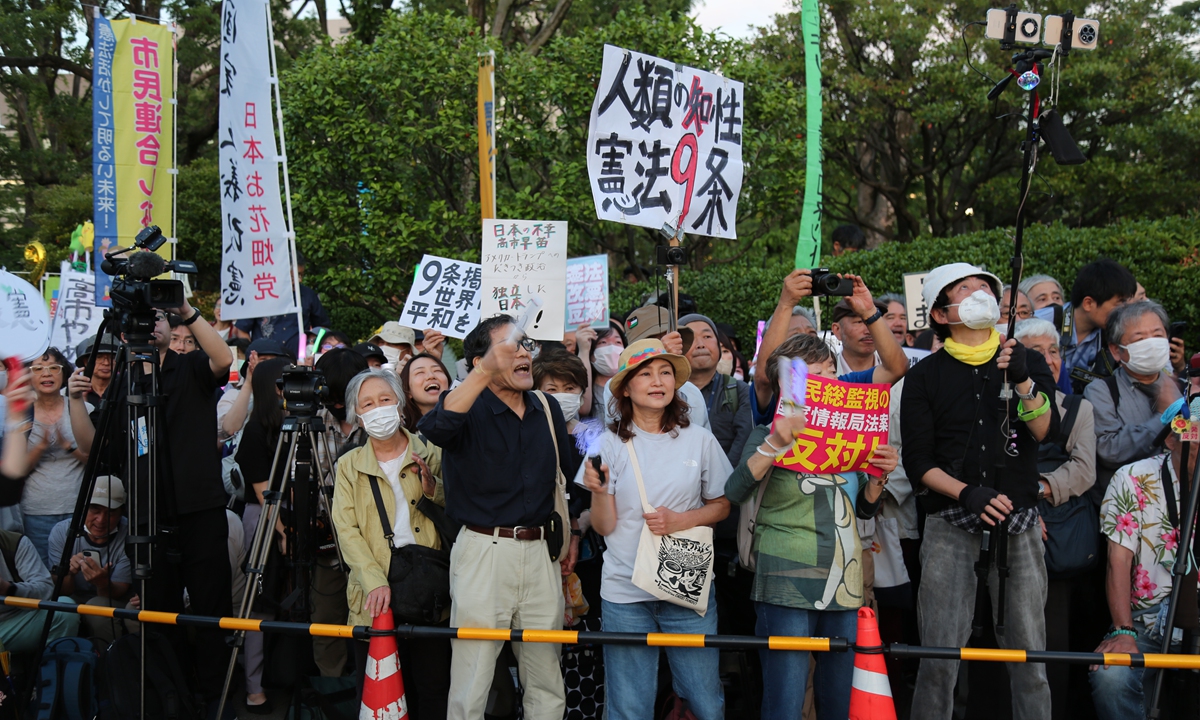
On the evening of May 19, 2026, Japanese citizens gathered in front of the National Diet Building in Tokyo to protest the Sanae Takaichi administration's attempts to revise the constitution and its series of military buildup moves. Photo: VCG
With a bill approved by the House of Councillors on Wednesday, Japan's parliament has enacted a law to establish a new "national intelligence council" aimed at enhancing national intelligence capabilities.
Analysts warned that the latest move goes far beyond domestic worries over eroded privacy rights. It represents a key attempt by Japan to restore its wartime intelligence capacity and is another stride toward neo-militarism. Peace-loving neighboring countries must stay highly alert, they said.
According to Kyodo News, establishing the council is a key aim in the governing agenda of Prime Minister Sanae Takaichi, who has pledged to strengthen intelligence and counterespionage capabilities as part of a response to what her government calls "the most complex security environment since the end of World War II."
The Japanese media said the council will be chaired by the prime minister and composed of nine other Cabinet members, including the chief Cabinet secretary and foreign minister.
In addition, the Japanese government could establish the council and bureau as early as July and set up an expert panel to discuss counterespionage legislation. It is expected to formulate policy with an eye to submitting a bill during the regular parliamentary session in 2027, Kyodo News reported.
A piece of neo-militarism puzzle
The bill, while it was eventually adopted, was opposed collectively by the Constitutional Democratic Party of Japan, the Japanese Communist Party and other forces, with some believing the legislation serves the interests of the US security strategy, which would undermine Japan's national interests, according to Japanese media reports.
It also raises concerns across Japanese society. Tokyo Shimbun said on Tuesday that 3,240 members of Japanese civil organizations protested outside the National Diet. A civic group representative stated, "The bill will inflict long-term damage on Japan's political landscape."
From the Global Times reporter's observations, many Japanese media outlets only ran factual reports on the bill's passage, while a small number covered public discontent and concerns over civil liberties. However, a Chinese expert pointed out that the dangers are far greater.
"Intelligence is not merely about collecting and collating information at home and abroad. It serves military ends above all else," Lü Chao, an expert at the Liaoning Academy of Social Sciences, told the Global Times on Wednesday.
"Japan's current move to overhaul its intelligence system inevitably brings to mind the Tokko (Special Higher Police), the repressive militarist secret police that crushed dissent and enforced conformity during wartime aggression against China," Lü said. "Before World War II, Japan was known for its massive investment in intelligence operations and extensive intelligence resources, which played a pivotal role during wartime."
Having committed appalling atrocities in World War II, Japan's notorious intelligence network was weakened and dismantled in the post-war era, and Japan long hesitated to openly revitalize it, Lü said.
However, even in the post-war era, Japanese anti-war activists and people engaged in China-Japan friendly exchanges have long been harassed and placed under surveillance by Japanese intelligence officers. So it remains possible that Japan will leverage its restructured intelligence network to supervise and restrict civilian exchanges between Japan and its neighboring countries, the expert added.
Shortly after the bill was passed, Nikkei described the move as "Japan's biggest intelligence reform since World War II," saying the new legislation "brings Tokyo closer to establishing an equivalent of the CIA."
Japan's move to reorganize and expand intelligence capabilities represents a major attempt to revive its wartime intelligence capacity, Lü said. "It also undermines Japan's pacifist constitution and drives the country further down the path of neo-militarism."
In a report headlined "Japan's Intelligence Reform is Just One Piece of the Security Puzzle," Japan Forward, an English-language news and opinion site launched by Sankei Shimbun, claimed that the intelligence reform pushes Japan forward on the path toward becoming a "normal nation" and building a "strong Japan."
Alarming developments
Japan's move to enact legislation for intelligence sector reform coincided with Philippine President Ferdinand Marcos Jr.'s visit to Tokyo, in which Japanese media said that defense, energy and intelligence cooperation topped the agenda.
According to the Japan Times, during Marcos' visit, the two sides will reportedly begin formal negotiations to conclude an intelligence-sharing agreement that would allow the exchange of classified security data.
Known as a General Security of Military Information Agreement (GSOMIA), the pact would not only strengthen the foundation of bilateral military ties, it would also help facilitate closer cooperation with the partners' mutual ally, the US, allowing for a trilateral framework similar to one between the US, Japan and South Korea, media reported.
In addition, during the latest Quad foreign ministers' meeting, which wrapped up on Tuesday in New Delhi, Quad members the US, Australia, India and Japan launched the first Indo-Pacific Maritime Surveillance Collaboration (IPMSC) initiative to leverage Quad country maritime surveillance in the Indo-Pacific, enhancing information sharing, according to a joint release by the US Department of State on Tuesday.
"Sixth Eye In-The-Making? Rise of Japan's National Intelligence Agency," the Geopolitical Monitor ran the headline in a previous story.
Meanwhile, South Korean media Chosun Biz said on Wednesday that Tokyo "is moving past the physical rearmament phase of adding missiles and warships and is reshaping itself into a counterintelligence state that collects and protects information and shares it with allies in real time."
According to Xiang Haoyu, a distinguished research fellow at the China Institute of International Studies, Japan's overhaul of its intelligence agencies serves Japan's broader planning for overseas military activities. By unifying capabilities in foreign intelligence, counter-espionage and cyber intelligence, Japan will become deeply integrated into the US-led intelligence alliance.
This move may disrupt the existing security landscape in East Asia, arouse vigilance and defensive responses among regional countries, and likely escalate intelligence rivalry and clandestine confrontations, undermining regional stability, Xiang said.
By beefing up its intelligence capabilities and militarizing intelligence work to drive the militarization of its overall security system, Japan is gradually eroding the foundation of post-war pacifism, Xiang said.
This move carries inherent risks of a resurgence of militarism and planting long-term hidden dangers for regional security and stability, he added.
RELATED ARTICLES