US and Iran exchange strikes amid mixed info on peace deal
Fighting-and-talking mode may continue as hostilities persist: analyst
By Published: May 29, 2026 12:26 AM

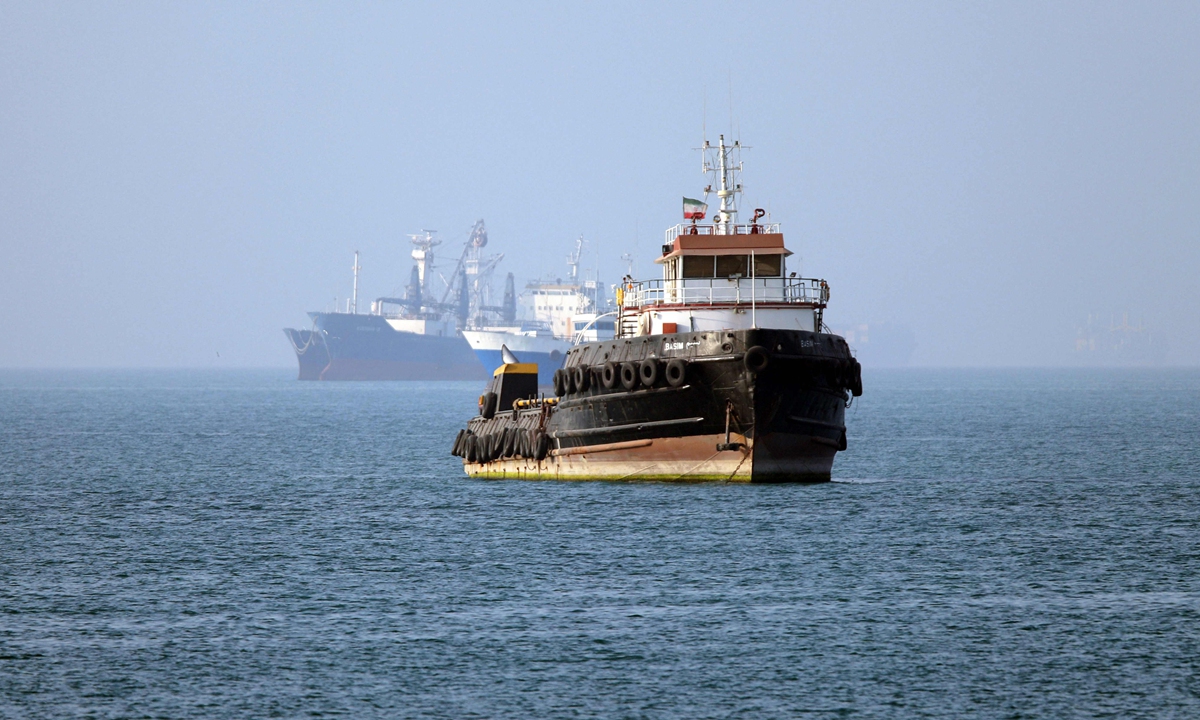
The Iran-flagged tugboat Basim sails near a ship anchored in the Strait of Hormuz off Bandar Abbas in southern Iran on May 4, 2026. Photo: VCG
Citing two US officials and regional source involved in the mediation efforts, US media outlet Axios claimed on Thursday that US and Iranian negotiators have reached an agreement on a 60-day memorandum of understanding to extend the ceasefire, but US President Trump has yet to give his final approval.
Before the latest development, fresh military frictions between the US and Iran have reportedly flared up again in recent days.
A Chinese analyst observes that the latest outbreak of clashes is rooted in deep-seated grievances and conflicting interests. The ceasefire was inherently precarious, he said.
War or peace
According to a statement carried by Iran's semi-official Tasnim news agency on Thursday, the Islamic Revolutionary Guard Corps (IRGC) said it struck an "American airbase" that it identified as the origin of the US "aggression" but did not say where it was located, per an Al Jazeera report.
The IRGC also said that any "aggression will not go unanswered," adding that further military actions will face a "more decisive" response, the media outlet reported.
Before the IRGC attack, citing US officials speaking on the condition of anonymity, the AP reported on Thursday that US Central Command forces shot down four Iranian one-way attack drones that "posed a threat" around the Strait of Hormuz. The US military also struck an Iranian ground control station in Bandar Abbas that was about to launch a fifth drone.
The US strike, according to Iran's Tasnim news agency, came after the IRGC confronted a US oil tanker trying to transit the Strait of Hormuz, citing military sources. The US Central Command claimed its latest strikes were "measured, purely defensive, and intended to maintain the ceasefire," Axios reported.
The latest exchange of fire marks the second such skirmish in 48 hours, said Axios. On Monday, US Central Command said that it conducted "self-defense strikes" in southern Iran to protect troops from "threats posed by Iranian forces," while Iran accused the US of committing a "gross violation" of the ceasefire, per the BBC.
The latest round of clashes stems from deep-seated disputes over core interests and a critical breakdown of mutual trust between the US and Iran, with frictions intensified most acutely over the pressing Strait of Hormuz issue, Liu Zhongmin, a professor at the Middle East Studies Institute of Shanghai International Studies University, told the Global Times on Thursday.
"They are right now in between this very dangerous zone of war and peace, and it is not in anybody's interest that this war continues," Kaja Kallas, the European Union's foreign policy chief, told media at a meeting of EU foreign ministers in Cyprus on Thursday, Al Jazeera reported.
Back-and-forth
Hours before the latest round of clashes, US President Donald Trump on Wednesday dismissed a report from Iranian state media saying that Iran and Oman would jointly manage shipping through the Strait of Hormuz as part of a peace deal, Reuters reported.
Earlier, citing Iran's state-run IRIB TV, several media outlets reported Wednesday that Iran has a draft of an initial, unofficial framework for a memorandum of understanding (MoU) with the US, which demands US military withdrawal and lifting of its naval blockade.
In return, Iran has committed to restoring commercial shipping through the Strait of Hormuz to pre-war levels within one month and managing ship traffic through the strait with Oman, the reports said, adding military vessels are not included in the agreement.
Similarly, Trump told media on Wednesday at a cabinet meeting that he was not yet satisfied on a deal with Iran, adding that the US was not discussing easing sanctions on it, Reuters reported.
"Nobody's going to control (the strait)," Trump told media on Wednesday. "It's international waters and Oman will behave just like everybody else or we'll have to blow them up. They understand that, they'll be fine," he said, per Reuters.
On the same day, the US Treasury announced that Iran's Persian Gulf Strait Authority, which was recently set up to manage requests for ships looking to transit the Strait of Hormuz, has been added to its Specially Designated Nationals sanctions list.
Chinese Foreign Minister Wang Yi on Tuesday called for the advancement of negotiations between the US and Iran, after he presided over a high-level open debate of the Security Council, Xinhua reported.
A longstanding issue cannot be resolved overnight, Wang said. However, every step forward in the negotiations brings more hope for peace, he said, adding that the earlier the conflict ends, the fewer civilian casualties there will be.
RELATED ARTICLES