Chinese, Brazilian top diplomats hold FM-level strategic dialogue in Beijing
Nations to deepen coordination amid rising protectionism: expert
By Published: Jun 02, 2026 12:33 AM

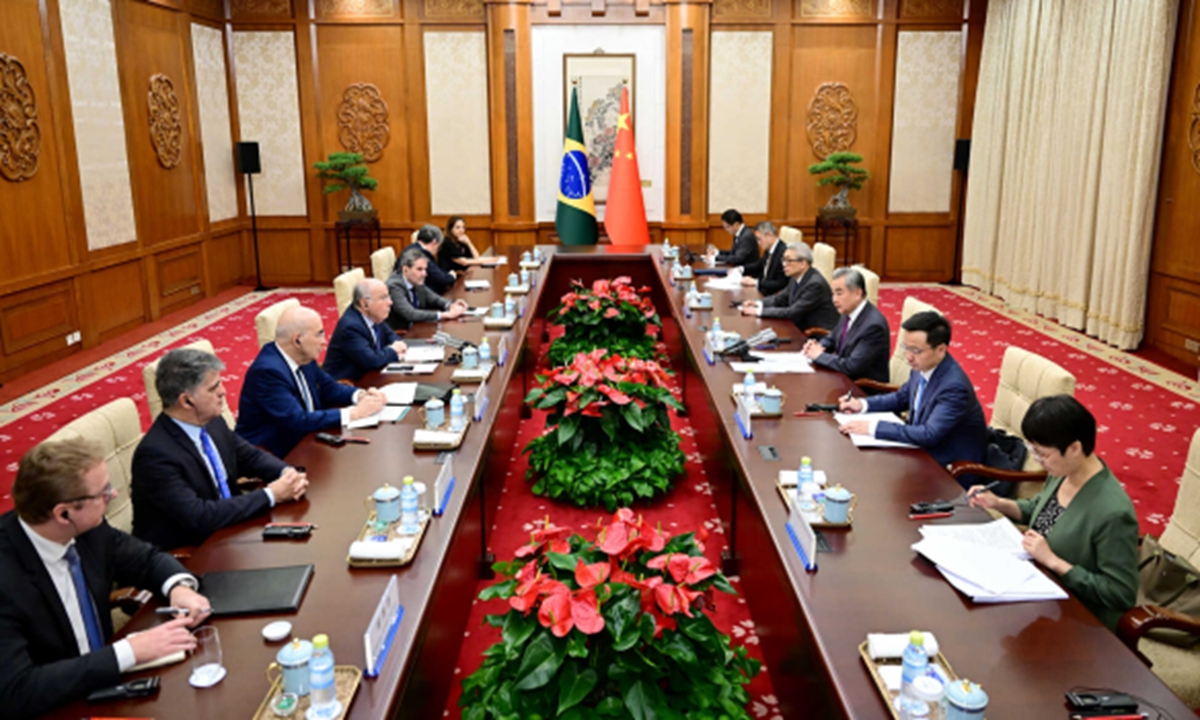
Photo: Chinese Foreign Ministry
China has always been a reliable friend to Latin American and Caribbean countries and stands ready to work with regional countries, including Brazil, to further deepen and expand overall China-Latin America cooperation, Chinese Foreign Minister Wang Yi said on Monday, according to Xinhua News Agency.Wang, also a member of the Political Bureau of the Communist Party of China Central Committee, made the remarks during the fifth China-Brazil Foreign Ministerial-Level Comprehensive Strategic Dialogue with Brazilian Foreign Minister Mauro Vieira in Beijing.
Wang said that in recent years, under the strategic guidance of the two heads of state, China-Brazil relations have become increasingly global, strategic and far-reaching in influence. "Practical cooperation across all fields has been steadily upgraded, and the two peoples have never been closer," Wang added.
Vieira stated that Brazil will always adhere to the one-China principle. He said Brazil looks forward to consolidating strategic mutual trust with China, deepening practical cooperation, cementing public support for bilateral ties, and achieving common prosperity, according to Xinhua.
Noting that both Brazil and China are important forces championing multilateralism and free trade, Vieira said Brazil is ready to work with China to enhance multilateral coordination, jointly advance the reform of the global governance system, uphold the authority of the United Nations, and promote international fairness and justice.
Vieira is paying a visit to China as the two major Global South countries and fellow BRICS members seek to strengthen strategic coordination amid rising protectionism. The visit is expected to include further discussions on their positions on safeguarding multilateralism, said a Chinese expert.
It is our hope that through the visit, China and Brazil will further consolidate political and strategic mutual trust, make continued progress in building a community with a shared future, demonstrate a sense of responsibility in promoting solidarity and cooperation among Global South countries, and contribute to world peace and stability, Chinese Foreign Ministry spokesperson Mao Ning said at a press conference.
The fifth China-Brazil Foreign Ministerial-Level Comprehensive Strategic Dialogue is scheduled to be held on Monday and Tuesday in Beijing. It is a mechanism for dialogue between the two countries and allows exchanges on global, regional and bilateral agendas, according to Brazil's news agency Agencia Brasil.
The Brazilian Foreign Minister will also visit the National Museum of China, which is hosting events marking the Brazil-China Cultural Year, according to Agencia Brasil.
Vieira's visit comes as major-country diplomacy draws growing attention following recent visits to China by the US and Russian leaders, reflecting Brazil's intention to deepen cooperation with Beijing amid intensifying global strategic competition, Zhou Zhiwei, an expert on Latin American studies at the Chinese Academy of Social Sciences, told the Global Times.
Economic and trade cooperation has long served as the ballast of China-Brazil relations, reflecting their closely integrated interests and strong economic complementarity. This mutually beneficial framework has underpinned the stable growth of bilateral ties and opened broad space for future cooperation, said Zhou.
On Sunday, Itamaraty, Brazil's Foreign Ministry, said on its official Portuguese-language X account that Vieira had arrived in Beijing. It noted in the posts that in 2025, bilateral trade reached a new all-time high for the 10th consecutive year, totaling $170.9 billion, while the trade balance for Brazil reached $29 billion.
The ministry also said that both countries are founding members of BRICS and its development bank, the New Development Bank, or NDB, which is headquartered in Shanghai, is currently headed by former Brazilian president Dilma Rousseff.
Brazil hopes to advance its reindustrialization agenda by deepening cooperation with China in infrastructure, manufacturing, production capacity, science and technology, while better aligning both sides' strengths in capital, technology, resources and market demand, Zhou said, noting that the two countries can also deepen industrial and supply-chain cooperation and expand collaboration in high-tech fields such as semiconductors, 5G/6G and communications.
"Unlike traditional North-South cooperation, China-Brazil South-South cooperation is more focused on technological complementarity and common development," the expert said. "This enables the two sides to better leverage their respective strengths and advance cooperation to a higher level and greater depth."
In March, Brazilian President Luiz Inacio Lula da Silva called China Brazil's "best partner" at the reopening of an automotive plant in Anapolis, Brazil, a project marking collaboration between Brazilian and Chinese companies, according to the Xinhua News Agency.
During the event, the production line for the Uni-T model, manufactured in partnership with Chinese automaker Changan, was launched. Lula praised the collaboration for bringing Chinese technology to Brazil and thanked the entrepreneurs involved, per Xinhua.
The visit also comes ahead of this year's BRICS summit, making policy coordination among member states particularly important. Amid complex geopolitical conflicts, rising protectionism, deglobalization and attempts to decouple and disrupt supply chains, BRICS members and major Global South countries need to strengthen communication, coordinate positions and discuss how to better respond to international challenges and promote stability, cooperation and development.
As two major Global South countries, China and Brazil's cooperation matters not only for their own development, but also for providing momentum and direction for broader Global South cooperation, and safeguarding multilateralism, Zhou said.
RELATED ARTICLES