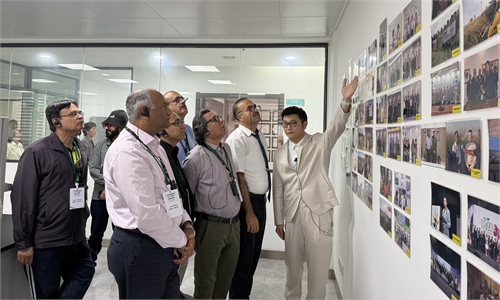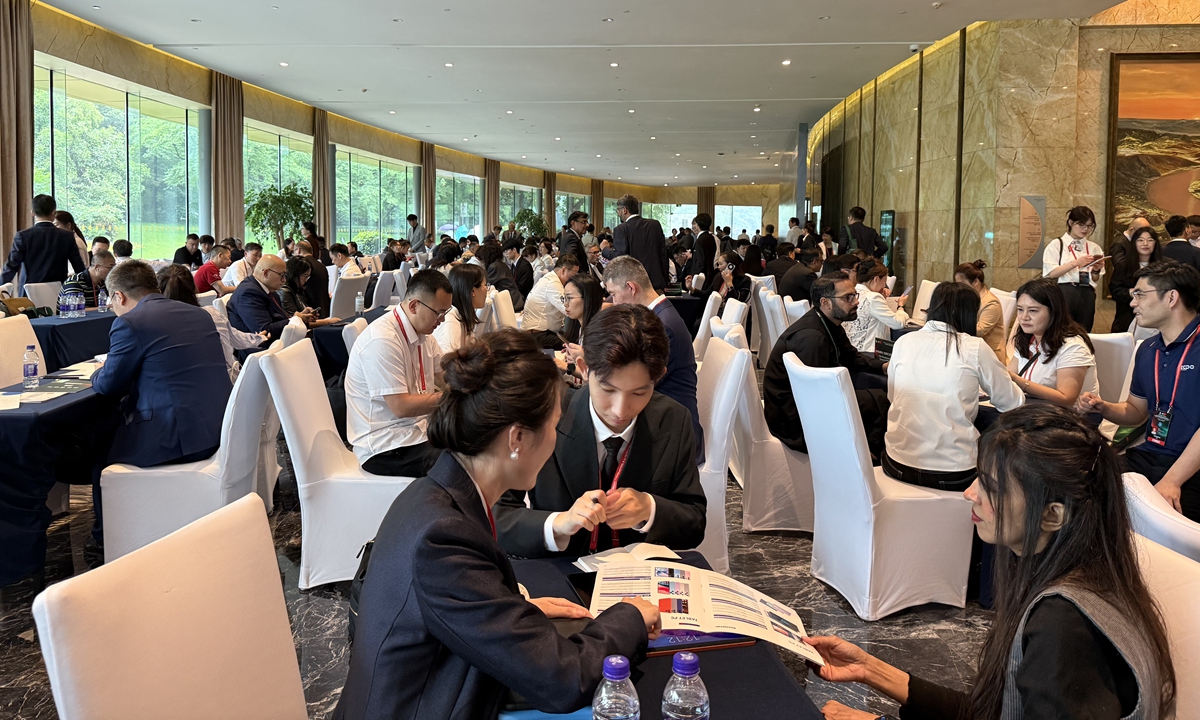
Chinese and Pakistani business representatives communicate during matchmaking sessions at the Pakistan-China B2B Investment Conference in Hangzhou, East China's Zhejiang Province, on May 24, 2026. Photo: Ma Ruiqian
"I need it!" A Pakistani agricultural business representative gave a thumbs-up while repeatedly praising a product showcased by a Chinese tech company. The product integrates digital spectral data collection, intelligent algorithm analysis, and automated detection processes, enabling rapid seed quality identification for agricultural enterprises. The Chinese company representative smiled and asked me to help translate: "What we bring to share with our 'iron brothers' is, of course, good stuff!"On May 24, inside the Pakistan-China B2B Investment Conference, the atmosphere was exceptionally vibrant. Representatives from more than 500 Chinese and Pakistani companies engaged in in-depth discussions on cooperation in areas such as information technology, telecommunications and agricultural modernization.
As a journalist covering the conference, amid the busy conversations, quick handshakes and the signing of MoUs, I witnessed a more grounded and human side of China-Pakistan cooperation. It was there, in these small but vivid moments, that I could see the two countries moving together toward a shared digital future.
"Now the entire global economy is undergoing digital transformation. We must keep pace with this new era, and China is one of the world's most advanced countries in digital technology. For the people of Pakistan, it is an honor to cooperate with Chinese companies and help promote Pakistan's digital development," said Adnan Aftab, a Pakistani tech entrepreneur.
In his speech at the B2B Investment Conference during his official visit to China, Pakistani Prime Minister Shehbaz Sharif outlined key priorities for both sides, calling for deeper cooperation in areas including agricultural modernization, the digital economy and artificial intelligence, so as to achieve complementary advantages and win-win outcomes.
Pakistan's digital development is underpinned by several structural advantages. First, the country has a large youth population. As the world's fifth most populous country, more than 60 percent of its population is under the age of 30, providing both a growing consumer base and talent pool for sectors such as software development, e-commerce and digital services.
At the same time, the Pakistani government has been continuously improving its digital economy policy framework. Through the establishment of Special Economic Zones and Technology Special Zones, it offers tax incentives and infrastructure support. It has also introduced competitive policies for R&D, exports and technology transfer, creating an enabling institutional environment for digital industry development.
In addition, Pakistan also enjoys a distinctive geographic advantage. Located at the crossroads of the Gulf region, China and Africa, it has strong potential to serve as a regional hub for digital trade, cross-border e-commerce and technology services.
Against this backdrop, policy alignment and industrial cooperation between China and Pakistan in the digital sector continue to deepen, enabling more efficient integration of technology, capital and talent, and providing strong momentum for Pakistan's digital transformation.
For Pakistan, such cooperation has clear practical significance. On the one hand, it helps enhance local manufacturing capacity and industrial value-added; on the other, it creates new opportunities for youth employment and entrepreneurship. In the context of rapid digital expansion, small and medium-sized enterprises are becoming a key node linking China-Pakistan cooperation.
On the Chinese side, this cooperation is also strategically significant. As digital technologies and manufacturing systems continue to expand outward, Chinese companies are strengthening their localization capabilities in overseas markets while achieving technological iteration and business model upgrades in new environments.
"Our company is based in Mianyang, Southwest China's Sichuan Province. When would be a convenient time for you to visit?" Even as I was about to leave, the Chinese and Pakistani entrepreneurs were still leaning over the exhibition table, immersed in discussion. Their conversation moved from the performance of the spectral detection system to payment arrangements before turning to plans for an in-person visit, filled with expectations for cooperation.
The author is a reporter with the Global Times. The article is originally published on Daily Sub News. maruiqian@globaltimes.com.cn
RELATED ARTICLES