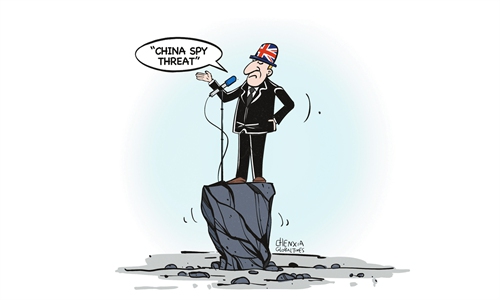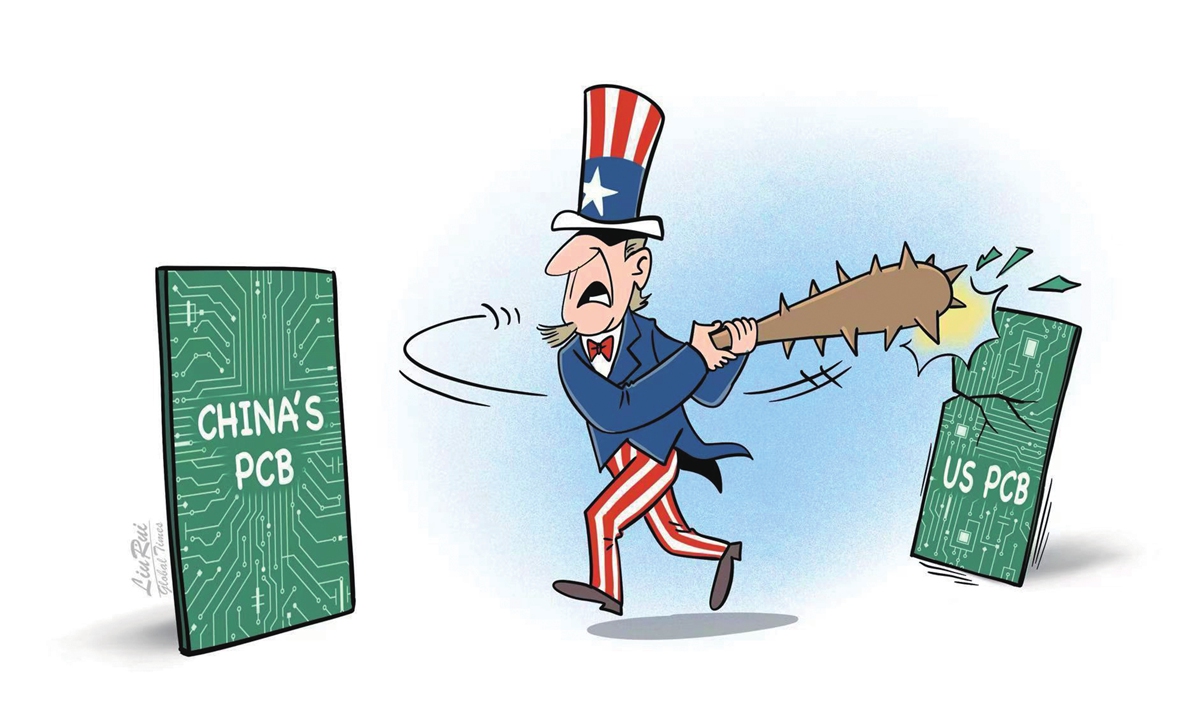
Illustration: Liu Rui/GT
The US is reportedly opening a new front in its ever-expanding crackdown on Chinese technology. This time, the target is not cutting-edge innovation, but a component found in nearly every electronic device: the humble printed circuit board, or PCB. And how it tries to crack down on this almost mundane target is all too familiar. According to a CNBC report on Wednesday, Chinese-made PCBs "raise national security concerns in US."
Specifically, this panic narrative comes in two familiar flavors. First, Washington points to industry data, claiming that some 60 percent of the world's PCBs come from China, while the share of US-made PCBs has collapsed from over 30 percent to a mere 4 percent. This in itself creates so-called "national security and supply chain risks," the US claims, according to CNBC.
Second, with the "risks" identified, the fear-mongering begins. In an interview with the CNBC, Mike Cadenazzi, US assistant secretary of war for industrial base policy, claimed that "chips, substrates, PCBs represent multiple avenues of attack for a potential malicious actor." Finally, comes the worst-case scenario: a compromised PCB could mean a "missile malfunctions in flight," Cadenazzi asserted, according to CNBC.
That certainly sounds alarming, yet there's one glaring issue: the claim is supported by absolutely no evidence; as is the case with similar assertions before, it is pure speculation, manufactured from thin air. If this risk is as serious as claimed, why is a senior US defense official broadcasting it to the entire world via the media, instead of quietly addressing it? Could this simply be another politically motivated attempt to crack down on yet another Chinese industry?
This playbook feels all too familiar. Whenever the US finds itself losing ground in open market competition, "national security" magically becomes the all-purpose master key to fix the problem.
Over the past few years, we've seen the same pattern with Huawei's 5G equipment and Chinese electric vehicles (EVs). As soon as China demonstrates serious capability in a sector, Washington elevates it to an "national security threat." The real anxiety, it seems, isn't about any potential "threat" from those products made in China, because there's no evidence of that; it's about China's rapid ascent in advanced manufacturing and supply chain integration. And Washington is simply expanding its targets - moving from high-end chips to the layers beneath them: packaging, substrates, and PCBs.
The US' declining PCB industry is the result of decades of its own industrial hollowing-out. High labor costs, chronic shortages of skilled workers, weak supply chain ecosystems, and intense global competition have made reshoring far more difficult than politicians admit, according to various reports. Ignoring the root cause of the problem while trying to rewind globalization with the magic words "national security" is simply naive.
The US' CHIPS and Science Act offered a cautionary tale. Despite hundreds of billions in subsidies aimed at reviving domestic semiconductor manufacturing, results have been underwhelming. New factories are delayed, costs are running far higher than expected, and many projects are struggling with labor shortages and skill gaps, according to media reports. The idea that the same approach will magically work for PCBs strains credibility.
For years, US companies happily reaped the benefits of China's low-cost, high-efficiency PCB industry. It helped fuel the boom in consumer electronics, powered the rise of AI, and to some extent, supported defense manufacturing. Now, suddenly, that same supply chain is portrayed as a "threat." When globalization serves the US' interests, it's embraced. When it doesn't, it becomes a security risk. The US plays this double standard game like a pro.
Reality keeps proving that protectionism doesn't bring down one's competitor as intended - it often accelerates the competitor's innovation. After the US government cut off Huawei's access to advanced chips in 2020, many Western analysts asserted China's 5G rollout would stall. Instead, China doubled its 5G base stations in 2021 and continues surging ahead. Not to mention the company has recently presented the Tau Scaling Law, marking a new direction in chip design.
At its core, this repeated stretching of "national security" has little to do with security. It's about clinging to a fading technological hegemony, protecting entrenched corporate profits, and slowing China's industrial rise by any means necessary. When a country begins to view another country's every progress as a threat, it reveals less about its strength than about its growing insecurity. The real problem isn't Chinese PCBs — it's a superpower afraid of fair competition.
True strength comes from open competition, not artificial walls. China's EV industry offers a compelling example: by welcoming fierce competitors like Tesla, it sparked domestic innovation and produced cars that now win on quality and technology in global markets. Sanctions don't bring dominance. The market does — but only if you earn it.
RELATED ARTICLES