The 114-Rafale gamble: Strategic anxiety behind India’s sky-high defense spending
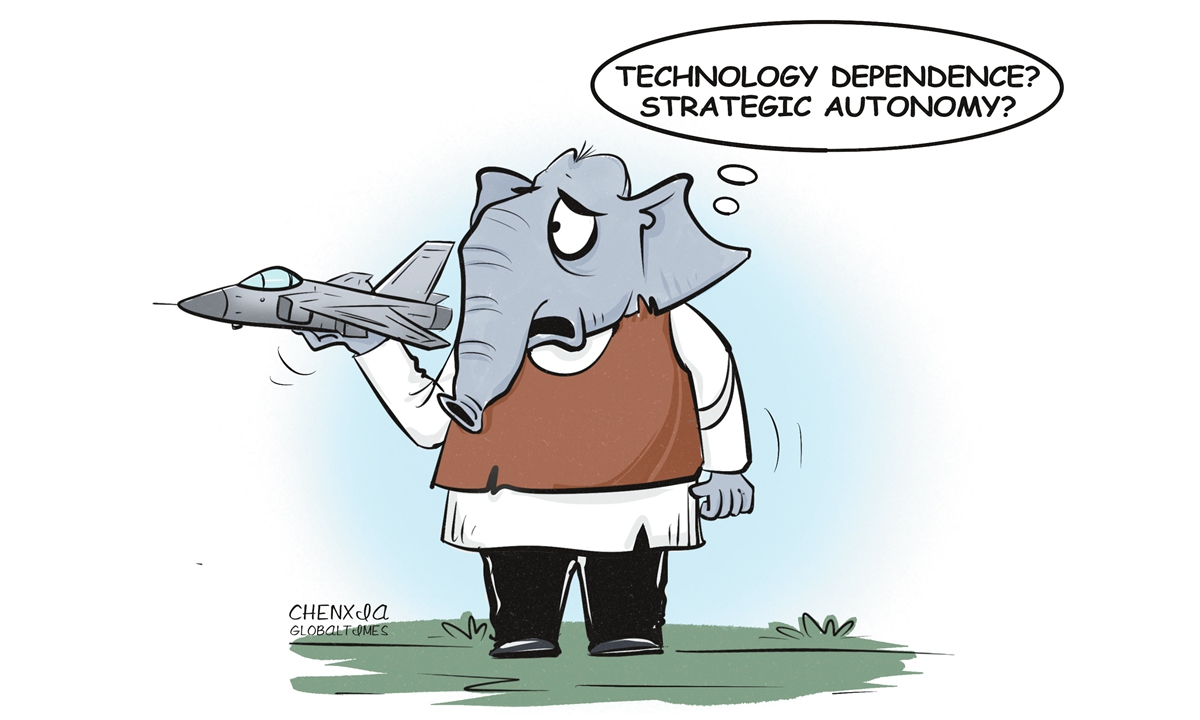
Illustration: Chen Xia/GT
Indian Air Force (IAF) Chief Air Chief Marshal Amar Preet Singh conducted a brief visit to France recently, amid emerging reports that New Delhi had formally submitted a procurement proposal to Paris for the purchase of 114 Rafale jets for 3.25 trillion rupees ($33.9 billion). As India's biggest defense procurement plan in history, the landmark deal lays bare New Delhi's strategic calculus amid intensifying major-power competition and its anxieties over achieving indigenous defense self-reliance.
While this arms deal may bolster the IAF's combat capability in the short run, India risks falling into a vicious cycle of overreliance on imports, stunted domestic defense development and strategic vulnerability over the long run - unless such procurements spur breakthroughs in indigenous military technology.
Moreover, any restructuring of the regional strategic balance will come with heightened security risks across the region. India's Rafale procurement essentially serves as a defense extension of its "multialignment" strategy. Historically, the IAF has long relied on Russian equipment. Yet since the Russia-Ukraine conflict broke out, Moscow's defense production capacity has been prioritized for frontline combat deployments, leading to a significant decline in exports and prompting India to accelerate the diversification of its weapons suppliers. From New Delhi's perspective, France's Rafale fighter jets not only offer the advantage of technology transfer with "no strings attached" but also help foster a more resilient and diversified defense supply chain.
A deeper intention lies in India's attempt to leverage diversified arms procurement to calibrate its balance of ties with major powers. On the one hand, by procuring the Rafale, India is deepening its "strategic partnership" with France; on the other hand, it continues to maintain defense cooperation with both Russia and the US. By using France as a bargaining chip, India can hedge against the dual uncertainties posed by Russian military equipment and the US' strategy toward India, while also demonstrating its pursuit of "strategic autonomy" in the great power rivalry.
Objectively speaking, behind this sky-high arms deal lies a concentrated eruption of multiple strategic anxieties.
For starters, such urgency stems from the shortage of fighter jets and the generational gap in combat capabilities. The IAF currently has only 29 squadrons at its disposal, far below the sanctioned strength of 42. As ageing fleets are steadily phased out, the capabilities gap among active-duty fighters will only widen. India therefore urgently needs 4.5-generation fighters like the Rafale, which feature networked combat capabilities and strong electronic countermeasures, to fill this void.
Second comes frustration caused by delays in indigenous fighter jet programs. Deliveries of India's indigenous Tejas Mk1A fighter have been delayed due to engine supply issues, leading to the embarrassing situation of "deliveries without engines." Meanwhile, the new-generation Tejas Mk2 and the Advanced Medium Combat Aircraft programs are behind schedule, forcing India to select the Rafale as a strategic interim solution. This paradox between import dependency and the struggling indigenous defense development reflects the challenges that the Modi government faces in implementing its "Made in India" strategy in the defense sector, exposing the shortcomings of India's military aviation manufacturing industry.
Third comes strategic anxiety over fighting on two fronts. Since the beginning of this century, the Indian military has based its planning on the need to respond to conflicts on two fronts, but the quantity and quality of its current fighter fleet are insufficient to deliver credible "dual-front deterrence." Though the IAF counts on the Rafale's precision strike capabilities and electronic warfare edge to outmatch Pakistan, vulnerabilities unveiled in last May's dogfight against the J-10CE have spurred urgent upgrades to the platform.
As a result, this procurement will significantly impact the military landscape of South Asia. The IAF's operational reach and deterrent power will be markedly enhanced. Meanwhile, the regional arms race will accelerate, and India's Rafale procurement may prompt Pakistan to seek more advanced equipment. This tit-for-tat procurement spiral will ratchet up South Asia's arms race and heighten risks of border skirmishes and conflict escalation.
As an age-old conundrum, India's persistent reliance on pricey foreign warplanes risks crowding out domestic fighter development, trapping it between technological dependence and its pursuit of strategic autonomy. Moreover, the whopping $33.9 billion outlay may crowd out spending on public welfare, sparking fierce domestic controversy in India over the "justification of costs."
The author is a senior research fellow of the National Strategic Institute at Tsinghua University. opinion@globaltimes.com.cn
RELATED ARTICLES