Bishkek’s new status: Why Kyrgyzstan’s election to the UNSC is a historic triumph
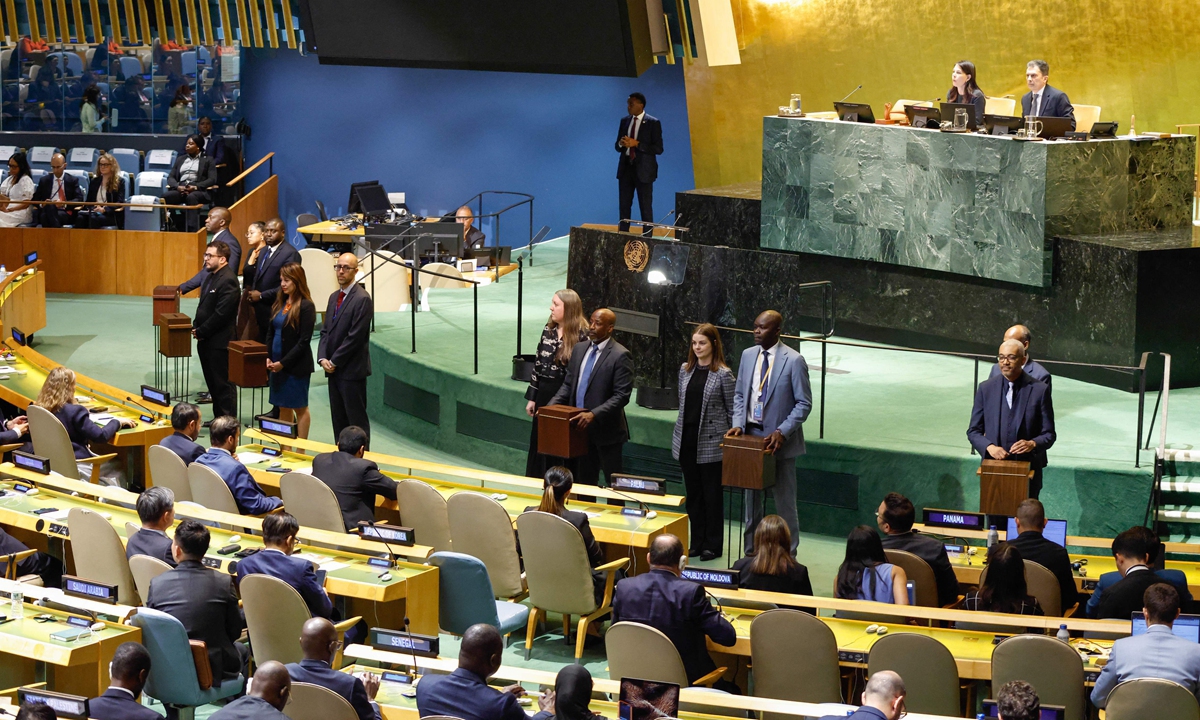
Ushers hold ballot boxes during a UN General Assembly meeting for the election of the non-permanent members of the UN Security Council at the UN headquarters in New York, US, on June 3, 2026. Photo: VCG
It is a historic triumph that few had anticipated, yet one that Kyrgyzstan had been steadily working toward for years. The country's election as a non-permanent member of the United Nations Security Council (UNSC) for the 2027-2028 term has brought renewed international attention not only to Kyrgyzstan but also to Central Asia as an increasingly important actor on the global stage.
By defeating the Philippines in the vote, Bishkek secured direct access to one of the world's most influential decision-making bodies. Leading experts and policymakers, speaking exclusively to media Kyrgyz Tuusu, have examined the underlying factors behind this diplomatic victory, assessed the significance of resolving long-standing border disputes, and addressed a critical question: Is Kyrgyzstan prepared to withstand the immense pressure that comes with participation in global governance?
A landmark victory in Kyrgyz diplomacy
June 3, 2026, will be remembered as a defining moment in the history of Kyrgyz diplomacy. For the first time since gaining independence, the Kyrgyz Republic was elected as a non-permanent member of the UNSC for the 2027-2028 term.
The results of the ballot at the UN General Assembly revealed a decisive outcome. Kyrgyzstan and the Philippines competed for the seat allocated to the Asia-Pacific Group. Bishkek received 142 votes, while Manila secured 49 votes.
Alongside Kyrgyzstan, Austria, Zimbabwe, Portugal, and Trinidad and Tobago were elected to the Council's new composition.
According to President Sadyr Japarov, one of the key factors behind Kyrgyzstan's success was its recent role in initiating the peaceful resolution of long-standing border issues with neighboring countries, thereby contributing significantly to stability in Central Asia.
At a time when territorial disputes and geopolitical crises continue to destabilize many regions of the world, Kyrgyzstan demonstrated its ability to resolve complex disagreements through dialogue and negotiation. This, the president said, helped earn the trust of the international community.
From observer to active participant
Domestic experts describe Kyrgyzstan's election as a transformative moment that elevates the country from the role of observer to that of an active participant in shaping the global agenda.
Political scientist and professor Orozbek Moldaliyev noted that membership in the UNSC provides substantial diplomatic advantages.
According to Moldaliyev, this status significantly enhances Kyrgyzstan's diplomatic standing, allowing the country to serve as a bridge in international relations while strengthening its global reputation.
It also creates a unique opportunity to elevate Central Asian issues to the highest international level, including participation in both open and closed consultations with major world powers.
The expert further emphasized that UNSC membership grants Kyrgyzstan a voice in approving peacekeeping missions, imposing economic sanctions, and authorizing the use of force - mechanisms that can be used to advance national interests responsibly within the framework of international law.
The diplomacy behind the victory
Political analyst Mars Sariev highlighted the complexity of the electoral process. In his view, Kyrgyzstan's victory was by no means guaranteed.
Competition with the Philippines was intense throughout the election. Traditionally, Manila has been regarded by Western permanent members of the UNSC - the US, the UK, and France - as a close and predictable partner, creating additional challenges for Bishkek.
However, Sariev argued that Kyrgyzstan's success ultimately resulted from years of consistent and strategic diplomacy.
Over time, Bishkek strengthened its engagement across Africa, Asia, and the member states of the Organization of Islamic Cooperation. The country succeeded in projecting the image of a state capable of serving as a mediator and facilitator of constructive dialogue among diverse groups of nations.
"There is a growing recognition in the West of Kyrgyzstan's unique role as the most politically open country in Central Asia," Sariev stated. "For many international partners, Kyrgyzstan represents an important example of how political competition, civil society institutions, and a multi-vector foreign policy can develop within the region."
"In this context, the 142 votes in support of Kyrgyzstan should be viewed not only as a diplomatic success for Bishkek but also as a manifestation of trust from countries of the Global South, the Islamic world, and a significant portion of the international community."
According to Sariev, Kyrgyzstan has effectively received a mandate to represent the interests of small and medium-sized states that value balance, dialogue, and adherence to international law during a period of increasing global turbulence.
A test of leadership and responsibility
Former prime minister Felix Kulov described the election as one of the country's most significant diplomatic achievements since independence and acknowledged President Japarov's role in launching the initiative two years earlier.
At the same time, he emphasized that UNSC membership would require Kyrgyz diplomats to demonstrate resilience in the face of inevitable geopolitical pressure.
Election to the UN Security Council is not merely a prestigious diplomatic success, Kulov noted. He added that it is a recognition that, over recent years, the country has built an extensive network of international relations and earned the trust of a substantial part of the global community.
A voice for Central Asia
Professor Kubat Sultanbekov of the Diplomatic Academy of the Ministry of Foreign Affairs said that defeating such a strong competitor as the Philippines reflects Kyrgyzstan's growing international authority.
He observed that the country's foreign policy has become increasingly active in recent years. The president has regularly participated in major international summits, while Kyrgyzstan has strengthened its image as a neutral state that avoids involvement in international conflicts.
According to Sultanbekov, Kyrgyzstan is increasingly viewed as a legitimate voice for Central Asia.
However, he stressed that maintaining a balanced foreign policy will be essential amid intensifying rivalry among major powers.
For Kyrgyz diplomacy, the challenge over the next two years will not simply be to participate in UNSC votes but to contribute a constructive agenda addressing climate change, transportation connectivity, and international security.
An examination of state maturity
Kyrgyzstan's election to the UNSC represents a landmark achievement that demonstrates how Central Asia is gradually transforming from an object of world politics into an increasingly influential participant in shaping it.
It constitutes both a vote of confidence and a demanding test of state maturity.
The 2027-2028 term on the UNSC will require exceptional professionalism, diplomatic precision, and resilience from Kyrgyzstan's foreign service.
If Bishkek succeeds in translating this elevated status into meaningful international initiatives - from glacier protection to advancing the interests of landlocked developing countries - Kyrgyzstan may emerge from this two-year period as a nation with a significantly expanded global role, capable of contributing to the architecture of a more just and balanced international order in the twenty-first century.
The article was first published on Kyrgyz Tuusu in the Kyrgyz language. opinion@globaltimes.com.cn
RELATED ARTICLES