Illustration: Chen Xia/GT
Editor's Note:Recently, some observers have pointed out that in today's Europe, political discourse and the assertion of principles increasingly occupy center stage, sometimes at the expense of long-term strategic thinking. As a result, Europe is becoming increasingly dominated by "normative politicians" rather than "strategists." The Global Times invites Chinese and European scholars to discuss whether this trend exists and the reasons behind it.
Zhao Junjie, a senior research fellow at the Institute of European Studies at the Chinese Academy of Social Sciences
When discussing the most influential strategists in post-World War II Europe, Jean Monnet, undeniably the central figure in European integration history, and Konrad Adenauer, one of the founding fathers of the European Community, are unquestionably among the most prominent. Other notable figures include Charles de Gaulle, a fierce advocate of European sovereignty, Helmut Schmidt, one of founding fathers of euro, and Jacques Chirac, who championed a comprehensive partnership with China. These leaders have made extraordinary contributions to Europe's integration, prosperity, and stability.
However, times have changed. Looking at today's European political landscape, few can compare with these historic figures. The decline of traditional European establishment parties and the surge of far-right populist parties reflect a profound lack of genuine political strategists in contemporary Europe.
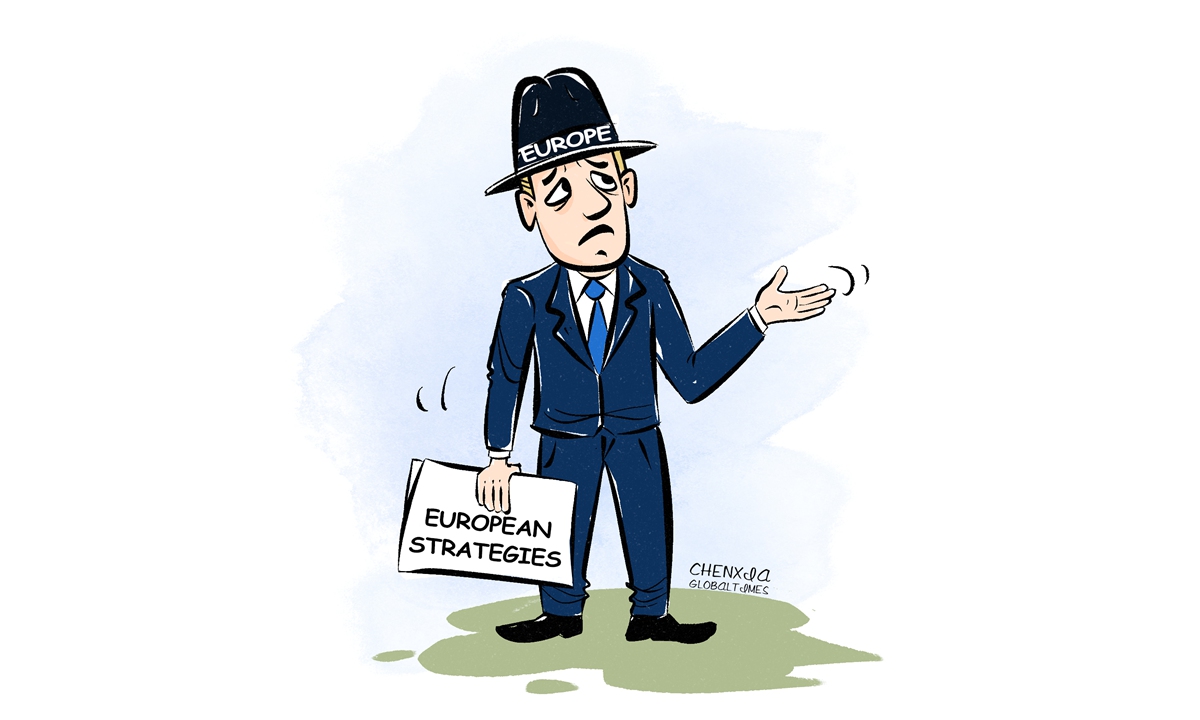
As "strategic politicians," de Gaulle and Schmidt were adept at handling core European interests, security, and power issues. In contrast, today's European politicians often fall into a closed loop of decision-making. They are more concerned with ideological self-interest, short-term political gains, and narrow strategic security, often neglecting the vital interests of the broader public and pragmatic development needs. Europe's so-called "normative politicians," such as European Commission President Ursula von der Leyen, EU High Representative Kaja Kallas, and former German foreign minister Annalena Baerbock, excel at articulating principles. However, they lack the ability to look beyond surface issues or to address deeper, underlying challenges. Their focus is more on moral rhetoric and rule-setting to constrain other nations than on developing a genuine strategic vision.
Under their leadership, Europe's relations with Russia have worsened, and its relations with China have experienced setbacks. Europe faces declining manufacturing, sluggish economic growth, stagnating technological innovation, frequent energy crises, and high inflation. The reality behind the rule-based political figures in power reflects the changing political ecology of Europe. After WWII, Europe's security depended heavily on the US, and energy supplies relied on Russia. With no existential pressure, this stable environment gradually shifted the focus and judgment of European politicians, pushing them toward normative politics and value-based rhetoric.
The combined effects of Europe's electoral system, external dependence, fragmented sovereignty, and a multi-layered bureaucratic system essentially lock the space for "strategic politicians" to grow. As a result, Europe is now increasingly dominated by politicians who prioritize stability over vision. The continent faces systemic crises that are difficult to resolve, providing opportunities for far-right populist parties to rise to the core of national power.
Stephen Kinzer, a US political analyst, has drawn a particularly embarrassing conclusion for Western politicians: The West is languishing without great leaders. If this situation persists, it will have a profoundly negative impact on Europe's future revival and development.
Raffaele Marchetti, director of the Center for International and Strategic Studies at Luiss University, Italy
The emergence of an EU international project was marked by a clear stance: the decline of traditional strategic thinking and its replacement by a normative approach. Historically until WWII, European states operated according to Realpolitik principles, governed by national interests and structural deterrence. In the post-WWII era, however, and especially in the last 30 years, the leadership of the EU has prioritized the export of values, legal frameworks, and moral imperatives. Although this stance aimed to position Europe as a moral authority, it generated a strategic vacuum that left the continent unprepared to face a fragmented multipolar world.
This normative focus did not emerge from a vacuum but was a direct consequence of American influence. In the post-WWII era, Washington actively "encouraged" Europeans to concentrate on the civilian dimension of their statecraft, especially in countries like Germany and Italy. Under NATO's protective umbrella, Europe was pushed to delegate hard defense, leaving the global strategic dimension almost entirely in the hands of the Americans. This implicit agreement allowed Europe to prosper as a regulatory civilian power, but it also atrophied its ability to formulate autonomous and independent geopolitical thought.
A normative approach dictates that international relations should be guided by ethical standards and human rights. European politicians have long celebrated this identity of a "civilian power," influencing others through economic integration rather than military coercion. This strategy worked in the post-Cold War era. However, with the return of intense geopolitical competition, leadership has begun to question its normative frameworks as a substitute for strategic calculation.
Such reliance on value-driven rhetoric has blinded politicians to structural realities. Strategic thinking requires an objective assessment of adversaries' capabilities and geographic constraints. Conversely, a purely normative vision divides the world into rule-abiders and rule-breakers. By framing complex conflicts as moral clashes between democracy and autocracy, Europe often precluded pragmatic diplomacy, reducing its own flexibility of action. Furthermore, prioritizing norms over strategy has created vulnerabilities in the energy, defense, and industrial sectors.
To navigate an unstable global environment, European politicians are reconsidering their normative approach and are in the process of a "rediscovery" of the geopolitical dimension. Norms and laws do not defend themselves without the backing of material power. Rebalancing European statecraft requires defining clear, vital interests, investing in hard defense capabilities, and understanding the world as it is, rather than how Europe wishes it to be.
Pierre Picquart, an expert in geopolitics and human geography from the University of Paris-VIII
What distinguishes a true strategist from an ordinary political leader? A strategist does not merely defend ideas or formulate principles. He or she defines a vision, sets objectives, mobilizes the necessary skills and resources, and seeks above all to achieve concrete results.
Major European figures of the 20th century, such as de Gaulle and Schmidt, were judged primarily by their ability to meet the challenges of their time. Their legitimacy rested not only on their convictions but also on their capacity to transform those convictions into tangible achievements. Strategy is not simply about knowing where one wants to go; it is also about finding the means to get there.
One reason for the lack of strategists in Europe may lie in the combination of three trends: the growing technocratization of politics, which often favors management over strategy; the dominance of short-term thinking driven by media pressure, social networks, and electoral cycles; and the dilution of responsibility within increasingly complex decision-making processes, where it has become more difficult to identify those capable of carrying and sustaining a long-term vision.
People ultimately expect concrete answers to their concerns: employment, security, innovation, economic development, quality of life, and confidence in the future. In the long run, the credibility of a policy depends more on its ability to solve problems than on its ability to describe them.
The challenge for European leaders of the 21st century is to cultivate leaders capable of combining vision, pragmatism, and responsibility. The true strategist is not the one who speaks best about the future, but the one who succeeds in building it.
Sevim Dagdelen, Member of the Federal Executive Board and Foreign Policy Spokesperson of the Bündnis Sahra Wagenknecht
The crisis of the EU is also a crisis of its leadership. Certain European decision-makers prioritize the interests of US oligarchs and US investment funds. A prime example is the US-EU trade deal, which is disadvantageous for European industry and enshrines competitive advantages for the US.
In Europe, we are now dealing with a comprador bourgeoisie that acts as a willing agent of foreign corporations and US interests. At the urging of the US, this political class is systematically working to destroy relations with China in the long term. The goal: to further promote US oligarchs and position Europe as a mere economic and political appendage of the US.
Everything points to the preparation of an EU economic war against Beijing - to secure additional market share for the US and geopolitically cement Europe's status as a vassal. Only a break with the US and NATO, which serves as "a platform for projecting American power," as its Secretary General Mark Rutte put it, can truly stop this development. The US is expanding the global battlefield in order to at least slow its impending decline.
In this gambit, the EU's top politicians are merely the pawns - sacrificed like in chess to improve the US position.
RELATED ARTICLES