Global scholars gather in Athens for the Second World Conference of Classics
China-Greece civilizational dialogue sets model for mutual exchanges
By Published: Jun 11, 2026 12:19 AM

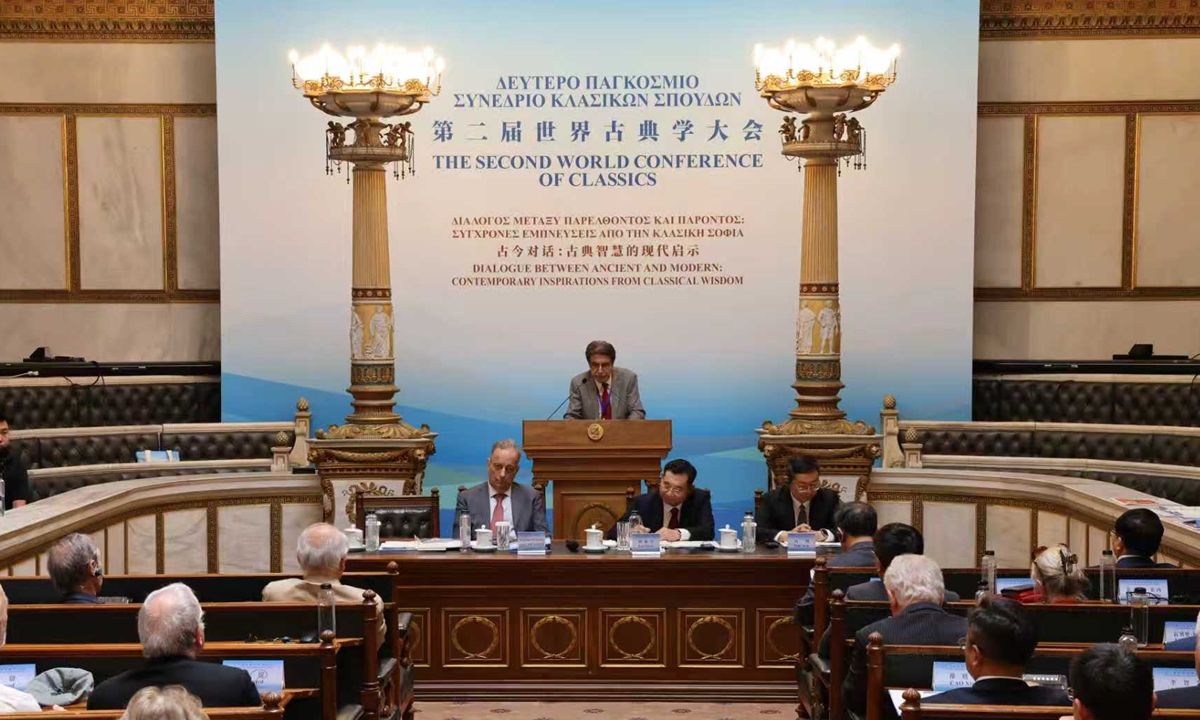
People attend the Second World Conference of Classics in Athens, Greece on June 9, 2026. Photo: Han Bingchen/People's Daily
The Second World Conference of Classics opened in Athens, Greece on local time Tuesday, with discussions focused on issues related to classical civilizations and promoting academic exchanges and consensus-building in global classical studies, the Xinhua News Agency reported.
A gathering of over 200 scholars, diplomats and media representatives from across the globe, the two-day event was themed "Dialogue Between Ancient and Modern: Contemporary Inspiration from Classical Wisdom."
Scholars noted that in hosting the conference's first overseas iteration following its debut in Beijing in 2024, the Athens gathering stands as a powerful embodiment of China's earnest practice of the Global Civilization Initiative (GCI). It further cements the China-Greece civilizational dialogue as a model for equal exchanges and mutually beneficial progress among diverse global civilizations.
Wednesday also marked the International Day for Dialogue Among Civilizations.
Chinese Foreign Ministry spokesperson Lin Jian said at a regular press briefing on Wednesday that three years ago, President Xi Jinping put forth the GCI, highlighting the need for civilizations to live together in harmony. Establishing the International Day for Dialogue Among Civilizations is an important step to implement the GCI.
Ancient wisdom
George Katrougalos, former Greek foreign minister, told the Global Times on Wednesday that the Second World Conference of Classics arrives at a moment when the international community urgently needs the methodological wisdom that classical civilizations offer.
It is believed that classics, as a modern academic discipline, originated in Europe. It originally emerged as a discipline within the Western intellectual tradition, generally referring to the reading and study of the texts and literature of ancient Greece and Rome, per Xinhua.
Lou Lin, an associate professor of classical studies at the Renmin University of China, noted a striking proactive shift in this year's conference theme.
After attending the event in Athens, Lou told the Global Times that unlike the Beijing session's focus on the link between classical civilization and the modern world, the Athens edition emphasizes humanity's active pursuit of ancient wisdom to tackle contemporary challenges.
"Such a shift reflects not only the complexities of current global affairs, but also a broader, more inclusive vision for bridging ancient heritage and modern reality," Luo said.
Bai Gang, professor of classical studies at Fudan University in Shanghai, who also attended the conference, told the Global Times that classical traditions are never relics confined to the past, but timeless spiritual assets capable of guiding and reshaping present and future human development.
Bai recalled that the conference's opening ceremony, featuring keynote speakers from Greece, China, the US, Egypt and Russia, embodies a diverse and inclusive academic perspective that breaks free from single-civilization research paradigms.
Initiative in action
Since the inaugural World Conference of Classics was held in Beijing in November 2024, related departments and institutions of China and Greece have worked closely to implement the outcomes of the first conference and build networks to promote exchanges and dialogue in classical studies, Xinhua said.
The fruitful China-Greece civilizational collaboration extends far beyond academic conferences. The two nations have jointly launched a civilization exchange center, established a China School of Classical Civilization at Athens, carried out joint archaeological projects, and staged integrated China-Greek theatrical performances. Ongoing joint archaeological project, cultural exhibitions and academic dialogues have continuously enriched bilateral exchanges, enabling the two ancient civilizations to radiate new vitality through mutual learning, the People's Daily reported on Wednesday.
Scholars interviewed by the Global Times highlighted the inherent resonance between Chinese and Greek classical philosophies. Greek virtue ethics and Confucian benevolence, Plato's spiritual transcendence and Chinese self-governance philosophies all converge on the ultimate question of "how humans ought to live." Such inherent compatibility lays a solid foundation for the GCI's core spirit of inclusive dialogue and shared progress, they said.
Dario Famularo, an Italian sinologist from Sichuan International Studies University in Chongqing, told the Global Times that the GCI transcends Eurocentrism and cultural relativism, reviving marginalized classical concepts of cosmopolitanism to advocate mutually understanding global interactions.
Australian sinologist Gary Sigley echoed that the GCI provides an open, future-oriented modern framework for classical studies, guiding scholars to transcend civilizational hierarchy and focus on shared human challenges.
Wang Xianhua, dean of the School of Humanities at Shanghai University of Finance and Economics, explained that the GCI represents the creative transformation of Chinese traditional wisdom. It elevates classical studies from passive textual interpretation to active exploration of contemporary solutions, urging academia to understand modern society through classical heritage.
After visiting ancient sites in Athens, including the Acropolis, Lin Zhimeng, professor of philosophy at Zhejiang University, said he could feel the GCI is no longer an abstract concept, but has taken on tangible form on this historic land.
RELATED ARTICLES