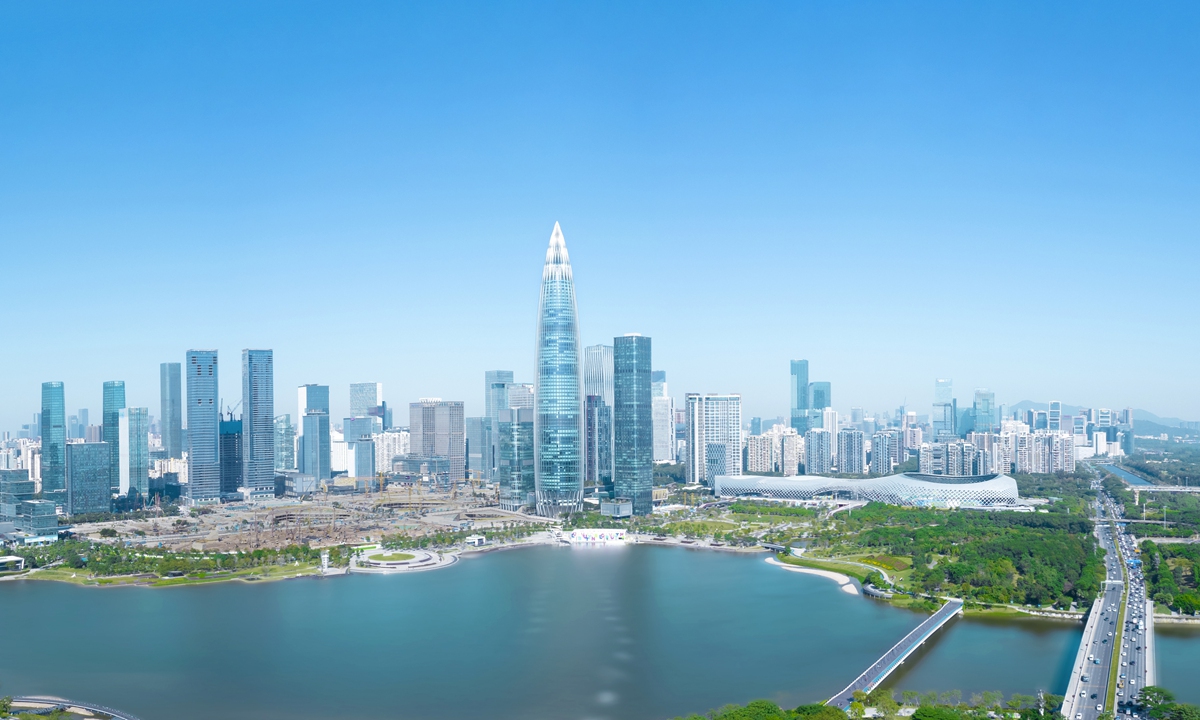
Skyline of Qianhai area in Shenzhen, South China's Guangdong Province Photo: VCG
A weeklong visit to Shenzhen during the 2025 China Hi-Tech Fair has reshaped my perception of modern China.Far from the one-sided, biased stereotypical narratives prevalent in Western media, this once humble border fishing village has evolved into a cutting-edge futuristic smart city that leads global technological innovation and low-carbon urban development. It boasts a mature green low-carbon urban ecosystem, a complete and resilient industrial supply chain, and human-centric intelligent tech services that integrate into daily life.
More than just China's world-famous manufacturing hub and hardware base, Shenzhen serves as a tangible, real-world prototype of future urban life that the Western public has long failed to recognize and understand.
What struck me most instantly and profoundly during my trip was Shenzhen's one-of-a-kind green and intelligent urban environment. Standing beside a busy eight-lane arterial road in central Shenzhen during evening rush hour, I witnessed an almost surreal urban scene: continuous streams of buses, private cars and electric scooters glide silently past in an orderly flow.
This unique and soothing urban soundtrack stems entirely from Shenzhen's full-scale popularization of electric vehicles across all travel scenarios. This bold green transformation has turned this fast-growing megacity into one of the world's quietest, cleanest and most eco-friendly major cities, vividly embodying the sustainable low-carbon blueprint for the future of global urban development.
Widely known as China's "Silicon Valley," Shenzhen hosts global tech giants including Huawei, Tencent, BYD and DJI, and dominates a dominant share of global electronic component manufacturing.
China has bid farewell to the single and low-end role of "the world's factory." A host of powerful homegrown tech brands such as Phytium and Loongson displayed self-developed cutting-edge products that fully rival and even outperform mainstream Western counterparts, vividly reflecting China's solid independent breakthroughs in key core strategic tech fields.
The most tangible embodiment of Shenzhen's future-oriented technology lies in its diverse people-oriented smart life scenarios, which turn distant sci-fi concepts into accessible daily reality.
During my one-week stay, I experienced the city's mature drone delivery services independently operated by Meituan. At Shenzhen Talent Park, I scanned a QR code on my phone to order meals from multiple catering brands, and drones delivered fresh food to designated intelligent pickup stations in just 15 minutes. So far, Shenzhen has launched nearly 50 stable low-altitude delivery routes, with a clear plan to roll out more than 1,000 commercial low-altitude routes in the future, taking the lead in maturing and popularizing the global low-altitude economy.
Beyond its dazzling technological achievements, Shenzhen's safe and user-friendly urban life further highlights its outstanding modern civilization and humanistic temperature. All local taxis and public transport vehicles are fully electric, with extremely low travel costs, and they are always kept clean. In addition, portable real-time AI translation devices widely used in the city effectively break down language barriers, enabling smooth and convenient cross-cultural communication for foreign visitors.
As Shenzhen prepares to host the high-profile 33rd APEC Economic Leaders' Meeting in November 2026, this trailblazing futuristic city stands as the most vivid witness to China's modern development achievements. Backed by continuous high-intensity talent cultivation, a complete industrial system with full-chain supporting capabilities and sustained iterative technological innovation, Shenzhen has taken the lead in many future urban development fields that Western countries are still exploring.
While Western economies frequently rely on unilateral sanctions and trade barriers to suppress innovation and globalization, China adheres to openness, inclusiveness and win-win cooperation. For European countries, actively engaging in pragmatic collaboration with China is the only rational choice to keep pace with the multipolar global future. The gentle birdsong echoing Shenzhen's modern urban landscape is exactly the sound of the future. It is time for the West to abandon outdated prejudices, view China's development objectively and embrace the new trends of global progress.
The author is the editor-in-chief of the Nordic Times in Sweden. opinion@globaltimes.com.cn
RELATED ARTICLES