US, Iran send mixed signals on deal after rounds of twists and turns
By Published: Jun 15, 2026 12:07 AM

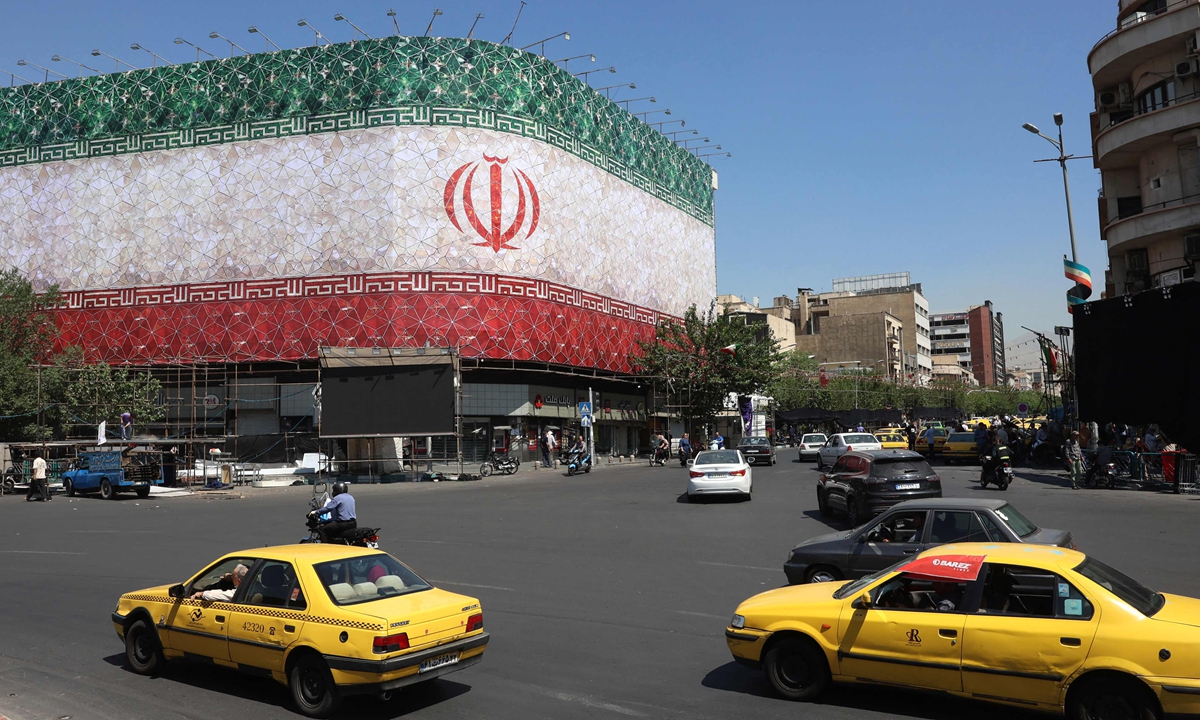
Vehicles drive past a building flying the Iranian flag at Enghelab Square in Tehran, Iran, on June 14, 2026. Photo: VCG
A US-Iran deal to stop the fighting seems to be taking shape after several rounds of twists and turns. Yet over the weekend, Washington and Tehran offered different timelines for signing any agreement, sending mixed signals about whether a deal is truly within reach.
Trump, who has asserted many times throughout the war that the countries are on the verge of an agreement, said on Saturday morning on Truth Social that a deal was "scheduled to get signed" Sunday and that the Strait of Hormuz, a key global oil and gas transport route, would open soon after, according to NPR.
In response, Iranian foreign ministry spokesperson Esmaeil Baghaei said he did not think a finalized pact would happen so soon. Baghaei told Iranian state media Saturday: "It will not be tomorrow." But he added: "The possibility of this happening in the coming days cannot be ruled out," NPR reported.
Prime Minister Shehbaz Sharif of Pakistan, a mediator in the negotiations, said in an early morning post on X, "We are closer to a peace deal than ever before." A finalized peace deal was "likely expected in the next 24 hours," he said.
Pakistan will facilitate a virtual signing ceremony between the US and Iran as part of ongoing efforts to support regional peace and stability, sources familiar with the arrangements told Xinhua on Sunday.
The ceremony is expected to be conducted through a simple video call, with Pakistan connecting both sides for the event, Xinhua reported.
The sources said no visits or travel by officials are planned, adding that the process will be a straightforward virtual signing ceremony. However, the sources said they could not confirm whether the ceremony would take place on Sunday or at a later date.
Common consensus
For weeks, the US and Iran have appeared to be nearing a deal that would bring an end to a war that began when the US and Israel launched strikes on Iran at the end of February. Iran has since imposed strict controls over the Strait of Hormuz, a vital waterway through which roughly 20 percent of the world's oil passed before the war.
A ceasefire deal was reached in mid-April, but the two sides have since exchanged intermittent fire, with strikes escalating this week even as diplomacy inched forward.
At this stage, the US and Iran appear to share a common interest in reaching a ceasefire, though for different reasons, Li Haidong, a professor at China Foreign Affairs University, told the Global Times on Sunday.
Washington is eager to bring the conflict to a close as domestic concerns grow over the strategic costs of a prolonged war, Li said. Iran, meanwhile, is increasingly wary of the economic, social and security toll that continued fighting could inflict.
Yet translating that shared interest into a durable agreement remains a formidable challenge. Both sides need to find a settlement that can be presented as politically acceptable at home and abroad, while Washington and Tehran continue to differ over the terms and sequencing of a ceasefire, Li said.
As early as Friday, the US and Iran signaled that an agreement to end their war was close, with a senior US administration official saying both sides had agreed on a text and that Washington expects to sign an initial deal in the coming days, per Reuters.
Iranian Foreign Minister Abbas Araqchi said that changes were still possible, but the tentative agreement showed his country had emerged stronger from the conflict.
"Iran is the winner of the war with the US," he said on state television, according to Reuters.
While there were minor differences in the details, the proposals broadly offered Tehran much of what it has sought, with Trump appearing to secure little beyond the reopening of the strait, which Iran closed after the US and Israel strikes in February, Reuters reported.
Moreover, Iran is now exercising a more cautious attitude toward reaching deal with US. Abbas Aslani, senior research fellow at the Center for Middle East Strategic Studies, told Al Jazeera that Iran's negotiating team has been shaped by past experience into taking a more cautious approach in its dealings with the US.
That's because the US has attacked Iran twice since last year during past negotiations, he said, referring to the 2025 12-day war and the war that began in February.
Israel factors
The possible peace deal has alarmed Israel.
Israeli Prime Minister Benjamin Netanyahu is scheduled to hold a security cabinet meeting on Sunday evening, according to domestic media reports, after Trump announced that the US and Iran will sign a memorandum of understanding tomorrow to reach an end to the war.
Senior Israeli officials quoted in a Channel 12 report earlier this evening said the terms of the MOU "endanger Israel's security interests," and that Washington agreed to Tehran's "main conditions."
Israel's efforts to influence or disrupt the US-Iran negotiations primarily involve a combination of military action, political pressure, strategic signaling and the creation of regional instability, said Liu Zhongmin, a professor at the Middle East Studies Institute of Shanghai International Studies University, noting that on the military front, Israel has often chosen to launch military operations at critical moments in US-Iran diplomacy, seeking to create turmoil and establish new facts on the ground that could complicate or undermine the negotiating process.
The Israeli military has released a statement on its latest attack on the southern suburbs of Lebanon's capital, Beirut. It claimed hitting a Hezbollah command center used by group to plot against Israeli citizens and forces operating in southern Lebanon, Al Jazeera updated on Sunday evening.
And soon after that, the Lebanese group, per the Al Jazeera, claimed its fighters Israeli "vehicles and soldiers in the southwestern outskirts of the town of Majdal Zoun with volleys of rockets". The attack was in response to Israel's "ceasefire" violations, the group said, adding it was conducted at 12:30am on Sunday.
The news service noted that Israeli attack on Beirut "could be a huge setback" for the deal between Iran and the US as the situation in Lebanon is an integral and central part of the potential peace deal.
Trump said no further attacks should be carried out by Israel in Lebanon, nor by any party, including Hezbollah, against Israel and that a regional peace deal, including for Lebanon, is close, while urging all parties to stand down, Xinhua reported on late Sunday night.
Israel sees regime change in Iran as the ultimate objective of the war, while the Trump administration's priority is to prevent the conflict from becoming a prolonged drain on American resources and political capital, Wang Jin, an associate professor at the Institute of Middle Eastern Studies at Northwest University in Xi'an, told the Global Times.
That divergence has exposed a fundamental divide. The key question, Wang argued, is whether Washington can impose limits on Israeli actions, or whether Israeli security concerns will continue to shape the contours of US policy toward Iran.
RELATED ARTICLES