Art education supports Xizang’s development by nurturing cultural roots and aesthetic spirit
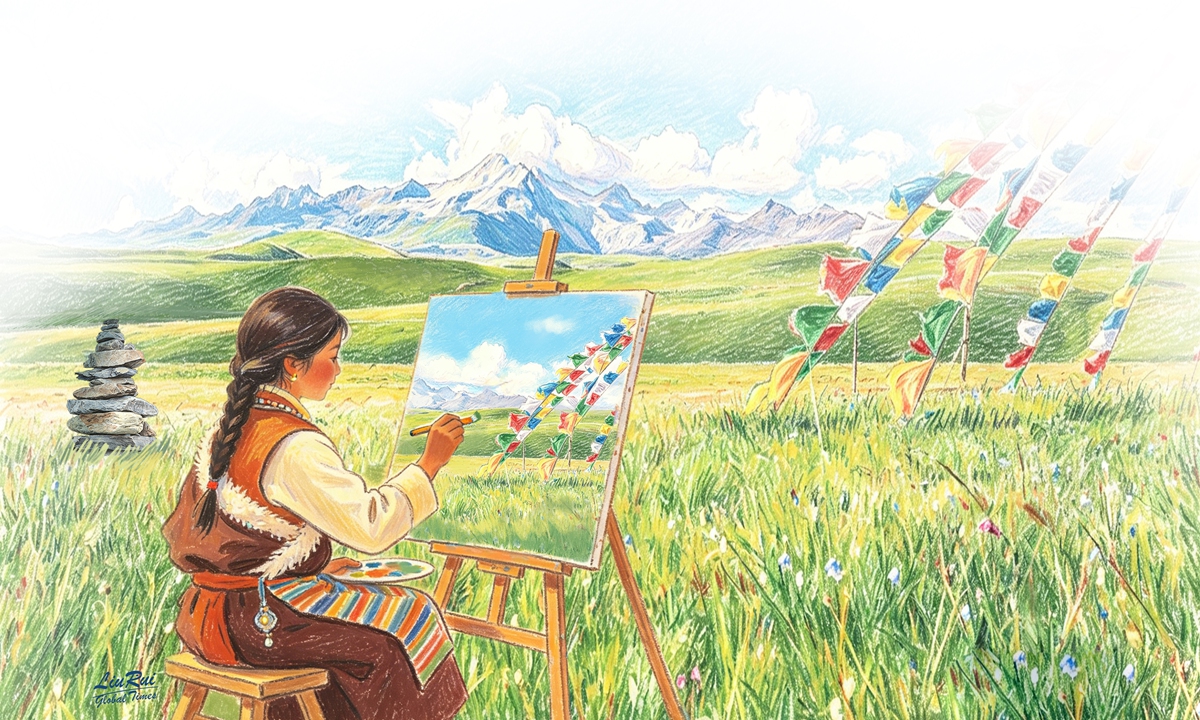
Illustration: Liu Rui/GT
Editor's Note:National support for Xizang's development has yielded remarkable achievements. Over the decades, numerous volunteers from across the country have come to Xizang, making indispensable contributions to the autonomous region's growth. Their efforts focus on various fields such as education, healthcare and infrastructure. Despite harsh conditions, these volunteers persevere in their roles, writing chapters of endeavor on the snowy plateau. Each diary they have penned serves as a vivid testament to the building of the Chinese national community. Against this backdrop, the Global Times launches the "My Xizang Diary" series, presenting firsthand reflections from these dedicated volunteers. This is the sixth installment of the series.
By Yang Pengxin
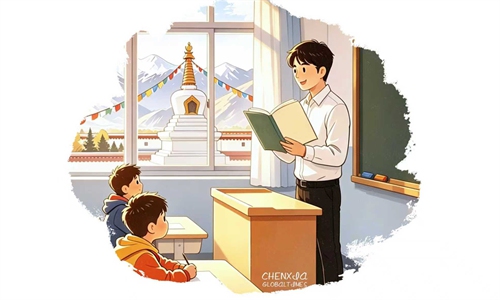
Before becoming a middle school art teacher at Xi'an Gaoxin No.5 School, I traveled to Lhasa, the capital city of Southwest China's Xizang Autonomous Region, in 2025 to take part in a teaching internship in Lhasa Ali Senior High School. This experience - teaching on the plateau more than 3,000 kilometers away - not only became a precious and unforgettable chapter in my professional life, but also profoundly reshaped my understanding of art education.
During my time teaching in Lhasa, I met many children who grew up at the foot of snow-capped mountains. They see endless peaks and fluttering prayer flags every day. They are familiar with Tibetan-style architecture and immersed in local customs and traditions. Blessed with such a unique environment, they possess an innate sensitivity to local landscapes and ethnic culture. However, they rarely use a paintbrush to record the beauty around them.
Due to limited educational resources, they have not received systematic art training and do not know how to express the beauty they see or the emotions they feel through drawing or handicrafts. For them, a structured art class is both new and unfamiliar.
Teaching on the plateau comes with many challenges: low oxygen levels, intense ultraviolet radiation and differences in daily customs. Yet, whenever I stood at the podium and saw the children gazing at their paintbrushes with curiosity in their eyes, I had only one thought: to help them truly experience the joy of art.
Drawing inspiration from students' daily lives, I broke free from rigid, formulaic classroom art teaching routines and explored the distinctive cultural heritage of the Tibetan regions. Together with my students, I integrated aesthetic education into plateau life, enabling them to cultivate a strong sense of cultural identity and pride through their own creative creations.
In class, we thoroughly unpack the vivid hues and totemic symbolism of Tibetan opera masks, gaining insight into the vivid folk tales and profound cultural lineage behind these artifacts.
Through hands-on creation such as cardboard modeling and clay sculpting, they engage directly with the essence of this intangible cultural heritage, breathing new life into age-old traditional culture with their own hands. Moving beyond textbooks, students began to observe their surroundings: the shifting light on snow mountains at dawn and dusk, the layered movement of prayer flags, and the distinctive lines of Tibetan architecture. Through immersive observation and creation, they learned to use art as a medium to depict their homeland and express their deep love for it.
I believe art has no single correct answer. There is no need to be constrained by rigid techniques or the pursuit of perfection. I encourage them to experiment freely and put brush to paper without fear, pouring their love for their hometown and hopes for the future onto the canvas. Structured art classes have brought tangible changes to the children on the plateau. The youngsters have begun to observe life proactively and voice their inner thoughts fearlessly, learning to interpret the mountains, rivers and local scenery of their homeland through their unique aesthetic lens. Through consistent artistic creation, the children have grown increasingly confident and free to embrace their instincts. They have gradually developed the ability to think independently and innovate bravely.
The transformation of my student Zhuoga deepened my understanding of the transformative power of aesthetic education. Zhuoga comes from a pastoral area in the Ali region. Shy and reserved by nature, she always sat quietly in the corner of the classroom. She never dared to share her thoughts and unique aesthetic perceptions. One day after class, I sat with her and talked to her. We flipped through picture albums, and I guided her little by little to discover the beauty all around her. With constant encouragement and gentle guidance, she gradually opened up. She plucked up the courage to pick up a brush and start to paint. Her works lack polished technical craft, yet brim with the sincerest emotions; every brushstroke holds her longing for her hometown.
A few days later, she whispered to me that she hoped to become an art teacher someday, return to her native Ali region and teach painting to more children living on the grasslands. At that moment, I realized that volunteer teaching is never a one-sided sacrifice. I light up the children's dreams with paintbrushes, while the children's sincerity and passion continuously nourish my own growth.
A single art class may be brief, and a paintbrush may be ordinary, but planting the seed of art in a young heart can nurture a lifelong pursuit of beauty - a force strong enough to transcend mountains and distance.
Compared to academic subjects, art education nurtures the spirit on a deeper level. By integrating the natural landscapes, intangible cultural heritage and local customs of Tibetan regions into the classroom, it instills a sense of beauty and love in students. It enables them to stay rooted in their homeland while aspiring toward the future, cultivating a new generation equipped with cultural depth, aesthetic awareness and innovative capacity for the development of Xizang.
Not staying in Xizang as a long-term teacher after graduation remains a personal regret. Yet this experience has become one of the most valuable assets of my life. The snow mountains, clear winds, sincere children and meaningful classroom moments have helped me understand the responsibility and significance of young teachers supporting education in Xizang. The children's purity and growth have also taught me that the essence of aesthetic education lies in inclusion, companionship and guidance - respecting each child's unique sense of beauty and individuality.
Art education support in Xizang is never a one-way contribution, nor is it an endpoint. It is a new starting point for the continuation of art education in frontier regions. With countless acts of dedication passed down over time, a sustainable force for the development of aesthetic education will take root, allowing the spirit of art to flourish across the snow land.
The author is an art teacher at the Middle School Division of Xi'an Gaoxin No.5 School. opinion@globaltimes.com.cn
RELATED ARTICLES