‘We have to always be on the lookout for bargains and discounts:’ US resident on inflation
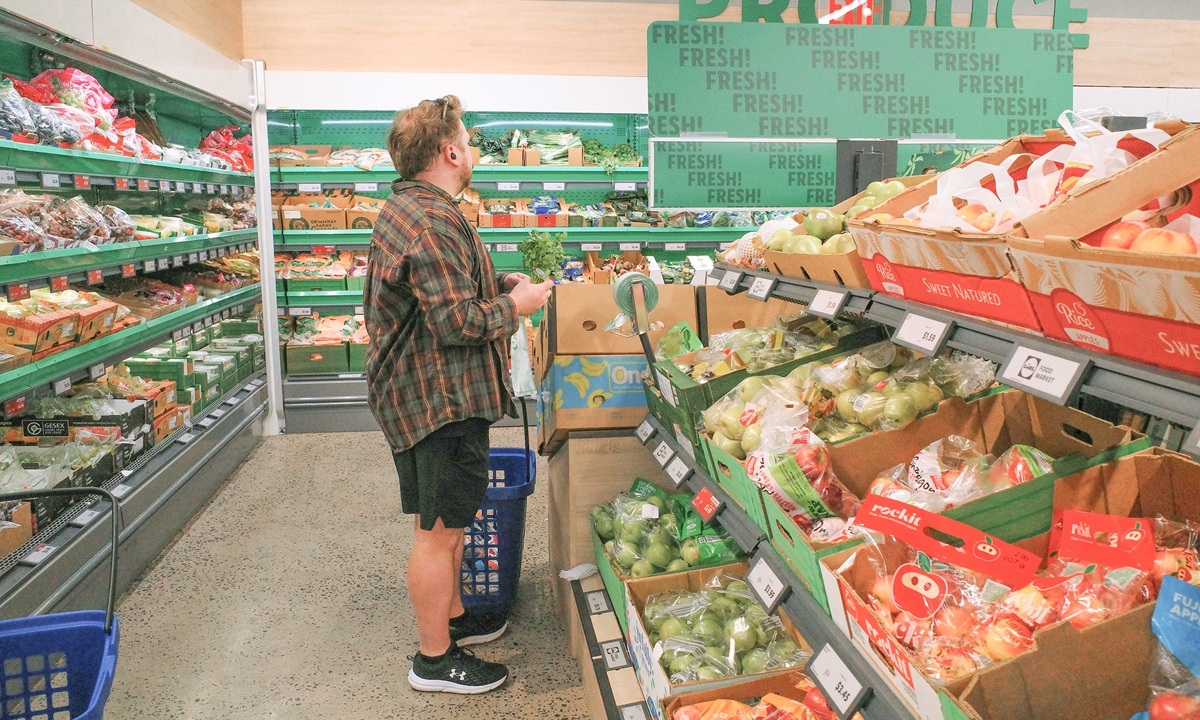
A customer shops at a supermarket in the Crown Heights neighborhood of the Brooklyn borough in New York City, the US on May 1, 2026. Photo: VCG
Editor's Note:
Even though the US just announced that a peace deal has been reached with Iran to end the war and that the memorandum of understanding with Iran has been "all signed," confidence in the US remains in doubt. Last week's US inflation numbers in May came in at their highest in three years. While policymakers talk percentages and interest rates, and economists debate the causes, behind those numbers are real people. In a recent I-Talk show, Global Times (GT) reporter Wang Wenwen spoke to Christy Franklin (Franklin), a resident of the US state of Wyoming, who opened up about how these price hikes have affected her daily life.
GT: Can you give us some specific examples of how inflation affects your daily life?
Franklin: We have a family of four - me, my husband and two children. We have the needs for us and for them. Every increase hurts us. The two major inflation issues are gas and groceries. Gas, before the Iran war, was only $3.99 a gallon. Now it's over $5. That makes it hard on us, as my husband's commute to work is 60 miles.
Then the groceries. Three months ago, grocery shopping for two weeks would cost around $250. However, a few days ago I went grocery shopping and spent $350 on the same items. I noticed the prices had increased, and I don't see as many sale items as there used to be. I don't see many discounts on vegetables, and I've seen an increase in prices from 50 cents to $1 on some of the vegetables. Healthy foods are hard to afford, unfortunately, and the price of junk food like potato chips is increasing too. Even before the Iran war, prices were increasing, but now it just seems to be getting worse.
My son needs a new bike, and that will cost $200. I have to put money aside for that. Recently, as my lease was about to expire, I was constantly worried that my landlord might increase the rent by $500 to $2,000. However, I was extremely relieved when he decided not to increase the rent, which has really helped us.
GT: US Treasury Secretary Scott Bessent maintained that the inflation surge triggered by the Iran war will be a "short-term blip." The US and Iran have electronically signed a memorandum of understanding aimed at ending the war. Are you positive about it?
Franklin: Definitely not. I've not seen anything changing right now, so it's definitely going to be long-term. I'm very skeptical that the deal will go smoothly. Even if the war stops right now, it's going to take months for things to go back to normal. There is an article saying that economists said it would take at least a year for things to get back to normal.
GT: History shows that wars tend to drive up prices. The US has either launched or gotten involved in many wars. What do you think about the reality that ordinary people are the ones who pay the price?
Franklin: My country keeps on going into these wars, and it never seems like it will ever get back to normal. Every time they enter another conflict, inflation increases. It makes it worse for us. We do pay the price. Inflation has gone up, but the wages of my husband and I have not increased at all. I've talked to some other people, and their wages have remained the same. The cost of living has certainly affected people, as some people are struggling to make ends meet. I'm lucky that we are managing, but some people are working paycheck to paycheck, with no savings. We have some savings for an emergency, but that's it. These conflicts do affect ordinary people. One of my neighbors wanted to get a new lawn mower. He kept on saying, "I can't afford one unless it goes on sale." That's just one example of how people are holding off on spending because they can't afford to spend on the extra things like a lawn mower, extra clothing or appliances.
When it comes down to it, this is all about greed. It's the wealthy wanting to get more money, and they don't think of how it affects us. Even corporations don't care; otherwise, if they did, they would increase wages. They have the budget for it, but they don't do it. There is definitely something wrong with the system here, and capitalism is the cause of it. The corporations control the government instead of the government controlling the corporations.
GT: What suggestions would you give to the US government to solve the inflation problem?
Franklin: First, they need to stop these endless wars and conflicts. Second, they need to lower the tariffs. The tariffs are terrible. Third, they just need to stop sending our tax money overseas. We need it here. Stop sending our money to arm Israel. I'm really against that. They don't have money to fix the roads here. There was a project here, and they were supposed to fix this highway; however, by the time they fixed half of it, the money had run out.
Our tax money needs to stay here and not go overseas. It needs to help the infrastructure here and help the people here. My mom is retired and has social security, but they're taking from our social security. What is going to be left when we retire? Nothing.
GT: If inflation remains at a high level in the next few years, do you think the US system will be able to fix it?
Franklin: It definitely doesn't work with my eyes. We need a big change. I'm not sure how that's going to come about, as the current system doesn't work anymore. I think the rich people are getting richer and the poor people are getting poorer, and the middle class is disappearing. My family is considered lower middle class, but I feel that, with all this inflation, we're going into the poorer side. We can't afford to travel and get extra things, and we have to always be on the lookout for bargains and discounts. I'm very pessimistic. What we need is less capitalism and more socialism.
RELATED ARTICLES