Meloni-Trump photo row escalates, revealing deeper European-US rift, change in transatlantic relations: observers
By Published: Jun 21, 2026 02:40 PM

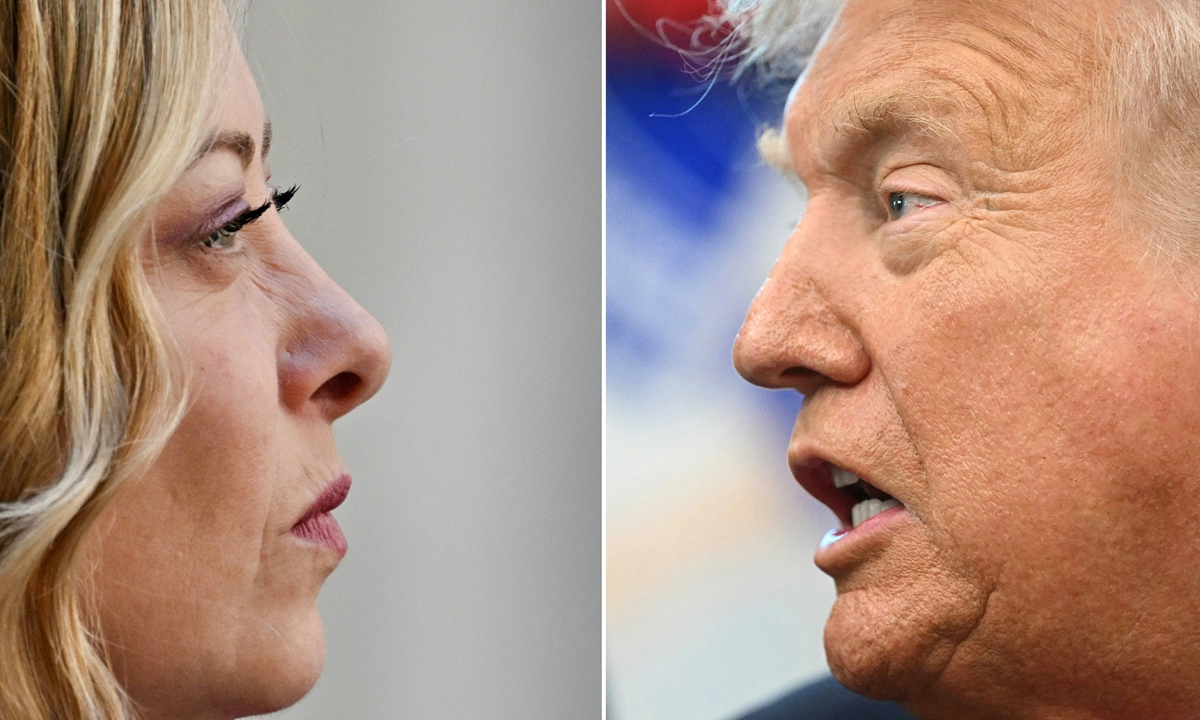
This combination of file pictures shows Italian Prime Minister Giorgia Meloni and US President Donald Trump. Phot: VCG
A single photograph - or, more precisely, a disputed story about who "begged" for it - has turned into the most public rupture yet between US President Donald Trump and Italian Prime Minister Giorgia Meloni, who were once seen as natural ideological allies on the Western right.
The dispute deepened in the latest round of public exchanges between the two leaders, as Meloni, on Saturday local time in Rome, sharpened her break with Trump, telling him to "focus on his own popularity" after he repeated on Truth Social his claim that she had repeatedly sought a photograph with him at the recent G7 summit in France.
Meloni rejected the remarks as "continuous and senseless attacks," defended Italy's refusal to allow the use of Italian bases or runways for US military operations linked to the Iran conflict, and insisted that Italy remains a sovereign country governed by existing agreements.
The strong reaction from the Italian side shows that the Meloni government is finding it increasingly difficult to accept the hierarchy embedded in the current US diplomacy, some Chinese observers reached by the Global Times on Sunday noted. It also marked a deeper change in transatlantic relations, they said.
The quarrel erupted after Trump, peaking in a telephone interview with Italy's La7 television channel, claimed that Meloni had "begged" him for a photograph during the recent G7 summit in Evian-les-Bains, France. According to Italian media accounts of the interview, Trump said he was not obliged to take the picture but agreed because he "felt sorry" for her. Meloni's response was immediate and unusually personal. In a video posted on social media, the Italian prime minister said Trump's remarks were "totally invented," adding that she was "frankly astonished." Then came the line that quickly dominated Italian headlines: "Neither I nor Italy ever beg."
Reuters reported on local time Saturday that underscoring how much Trump's comments have angered Meloni's government, Italian Foreign Minister Antonio Tajani pulled out of a visit to the US next week. A US-Italy business conference scheduled for Monday in Miami was also called off after Tajani cancelled his visit, the Italian embassy said.
The US State Department did not respond when asked about Tajani's cancelled trip, per the Reuters report.
The scene had an almost theatrical quality: a leader who had once invested heavily in her relationship with Trump now standing before Italians to deny that she had sought his favor, the AP reported. "Certain things deserve an immediate response," Meloni said, according to media reports of her video remarks. She questioned why Trump behaved in such a manner toward allies and said it "was a shame he doesn't show the same resolve toward the enemies of the West, toward the enemies of the US," the AP reported.
Trump did not retreat. On Saturday he doubled down on Truth Social, again saying that Meloni had repeatedly sought a photo with him and suggested that she wanted to repair relations with Washington to improve her standing at home. Reuters reported that Trump also criticized Italy for not allowing the US to use Italian bases or runways in connection with the conflict with Iran, calling the refusal a logistical problem for Washington.
Trump initially misspelled Meloni's first name as "Gigiorgia," according to Reuters and Italian media. Trump wrote "Italian Prime Minister Gigiorgia Meloni…" and "He misspelled her first name in the initial post, which he later corrected," AP reported.
Meloni's second response was sharper still. Writing in English on Instagram, she dismissed Trump's "continuous and senseless attacks," rejected the idea that her popularity depended on his friendship, and told him to focus on his own ratings rather than hers. She also defended Italy's position on military bases, stressing that their use is governed by existing agreements and cannot be changed at will. "As long as I am prime minister," she said, Italy would remain a sovereign nation.
Chen Hong, Director of the Country and Region Studies Institute at the School of Foreign Languages, East China Normal University, told the Global Times that the controversy appears on the surface to revolve around a disputed photo opportunity, but in fact reflects a deeper change in transatlantic relations.
Trump tends to personalize alliance relations and use personal influence to highlight US dominance, he noted. But in the current European political environment, such an approach is increasingly likely to trigger backlash, especially against the backdrop of Washington bypassing Europe and unilaterally pushing military action against Iran.
European dimension
The dispute also drew support for Meloni from elsewhere in Europe. Spanish Prime Minister Pedro Sánchez said after an EU summit in Brussels on Friday, that he had expressed "all my solidarity" with Meloni at the European Council, describing Trump's remarks as an attack that was "neither political nor personal."
Belgium's Defense Minister Theo Francken was even more direct, writing on X that "the insults from the White House need to stop" because they "divide the West and achieve nothing," and adding that Washington should "leave @GiorgiaMeloni alone."
Jiang Feng, a senior researcher at Shanghai International Studies University and president of the Shanghai Regional Studies Association, told the Global Times that the episode reflected a broader shift in Europe's attitude toward the US.
European leaders, he said, are adjusting their approach on the basis of realism, moving away from an almost one-sided emphasis on values-based strategic alignment with Washington toward a more pragmatic, transactional mode of cooperation.
European governments are increasingly judging their ties with Washington case by case, weighing their own interests and dignity. Europe still objectively depends on the US in many areas, Jiang said, citing the war in Iran, but it [Europe] has also come to realize that the US is not always able to get its way.
Europe has neither the capacity nor the willingness to completely break away from the US. However, more and more European countries are unwilling to continue accepting a condescending American style of leadership, Chen said. That is why a dispute on social media could quickly evolve into a political event involving national dignity, alliance relations and Europe's strategic positioning.
Dramatic turn
The episode marks a dramatic turn in a relationship that, not long ago, seemed politically useful to both leaders. Meloni had been portrayed in Washington as a European conservative who could speak Trump's language while still dealing with the European Union and NATO. The Washington Post described her as having once been labeled Europe's "Trump whisperer." But the same report noted that the war in Iran had turned that friendship into a liability for her.
From Meloni's personal political perspective, Chen said the incident has also offered her an important political opportunity. Over the past few years, Meloni has been seen as one of the European right-wing leaders closest to Trump. In the early phase of Trump's return to power, this identity was once viewed as an important advantage for Italy in gaining access to US policy resources and influence. But as the US administration continues to pursue an "America First" agenda and adopts a transactional attitude toward European allies, that closeness has begun to produce negative effects.
Reuters offered a similar reading, describing the transformation as one from "Trump whisperer" to "Trump basher." The report noted that tensions had already been building before the G7 photo dispute, especially over Italy's position on the Iran conflict and Rome's reluctance to be drawn into US military operations. In April, Reuters reported that Trump had publicly rebuked Meloni after she criticized his remarks about Pope Leo XIV, another moment that strained the image of ideological harmony between the two leaders.
Italian media treated the clash not simply as a diplomatic embarrassment, but as a test of national standing. Sky TG24 highlighted Meloni's declaration that "Italy does not beg" and documented the wave of reactions from Italian political leaders. Corriere della Sera focused on her reply to Trump's renewed attacks, particularly her insistence that Italian sovereignty and existing military agreements must be respected. RaiNews emphasized Trump's suggestion that Meloni wanted to be "friends again," while also noting the symbolic awkwardness of his initial misspelling of her name.
Some Italian commentary went further, portraying the episode as a degradation of diplomacy itself. La Repubblica columnist Stefano Bartezzaghi wrote that the Trump-Meloni exchange resembled "kindergarten" behavior rather than statesmanship.
US media also saw the clash as more than a personal feud. Axios described the dispute as a social media "war of words" between the "one-time friends," adding that close allies are increasingly willing to split with him.
Li Haidong, a professor at China Foreign Affairs University, told the Global Times that Europe's dissatisfaction with the US is moving from the surface to a deeper level.
While the current dispute is being expressed through verbal clashes between Italian leader and the US president, the deeper reason is that European countries increasingly believe the US no longer has sufficient capability, resources or commitment to provide the security guarantees Europe needs, Li said.
European countries are realizing that they can better safeguard their own security only by relying more on themselves and by strengthening coordination among European states, Li said.
RELATED ARTICLES