Illustration: Xia Qing/GT
Editor's Note:
For many foreign observers, China's everyday life presents a series of fascinating phenomena. In this special commentary series, "The Logic of Chinese Governance through Daily Life," the Global Times addresses three core inquiries about China frequently raised by the international community: Where does Chinese people's trust in the government come from? How is the baseline of social welfare secured? And how is social order maintained from the bottom up? Through the eyes of expats living in China, this series aims to explore the "ground reality" of Chinese governance.
--------------------------------
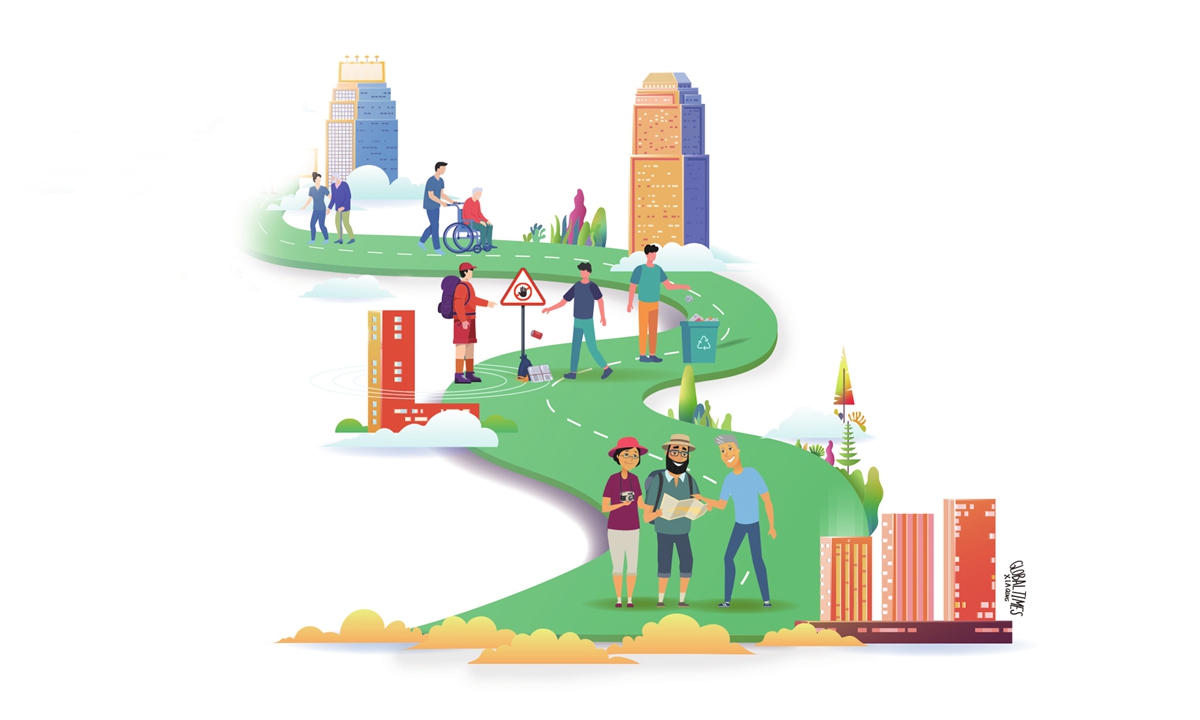
A stranger in need, or a confused tourist in China, in parks, in residential neighborhoods or even on the streets may encounter active citizens - often elderly - who will proactively step up and ask, "Who are you looking for?" "What's wrong?" or "Do you need help?" They will scold young people who litter, will help lost children find their parents, and will intervene when they see a suspicious stranger.
This behavior is a mix of being helpful and maintaining order. If you are well behaved and need help, such elderly people are there to support you. But if your behavior is out of the ordinary, they may approach or even scold you if you look harmless, or call for security guards or even the police if they find you intimidating.
In the individual case, although the latter can be annoying, it is the legal right of Chinese citizens. Here's the point: Bottom-up democracy means the local people decide what problems they report and to which level. Any European or American traveling to China always notices just how few police they see in the streets. Hardly ever do we hear wailing sirens. This is self-governance in Chinese: Local people in the streets maintain order by themselves, and can call for support if needed.
The boundary of such self-governance is the law, so these volunteers can't demand anything unwarranted from passersby. But they can legitimately demand that law enforcement check the validity of permits.
The topic of bottom-up governance in China is rarely discussed because Western narratives prefer to present Chinese citizens as passive subjects in a top-down system. Chinese self-presentation often prefers to focus on the result of maintaining order, rather than on the processes of supervision. But everyone knows that social order doesn't happen without enforcement, so the bottom-up management of society in China is really worth looking at more closely.
By comparison, citizen supervision and civil courage in Europe are a fine line, where the accusation of "spying on your neighbor" is quickly launched if anyone scolds others for bad behavior, or calls the police on them. Therefore, the Chinese system of self-management needs to be embedded in the cultural context of the three-generation family, and the village as an extended family, which is so very different from the hyper-individualist worldview prevalent in the West.
When people live in social settings where grandparents naturally take care of children after school, while parents work and look after both children and the elderly in the evening, everyone in society agrees that public safety, peace and tranquility are very high goods that need to be maintained.
While it may seem odd to Western minds that people without any formal or state-given authority should tell others what to do or what not to do, the "mass line" has remained a core governing practice of the People's Republic of China from the very day of its founding. Rather than an authority "from above" sending its police to control the people, let the people manage themselves, and report to authorities if there are troublemakers.
This reporting can have different ways too: In the short term, or in the case of urgency, it can mean calling the police to get professional help against a threat; in the long term, it can mean talking to local authorities to suggest changes, for example, in traffic control, neighborhood management or even legal regulation. These suggestions are then collected and aggregated by local offices, and if a similar complaint keeps reappearing, it will be reported upward and eventually changed.
This process takes time and isn't perfect, of course. Nor does a complaint from one viewpoint mean that a change is possible. First, there needs to be an assessment from all sides, as one person's freedom may be another person's nuisance. But the principle of collecting inputs from bottom-up voices and improving things at the lowest level possible is very much practiced in China and visible all the time.
I can count dozens of intersections in my neighborhood that have been adjusted in various ways over just a few years, based on feedback and police observation of traffic, to improve traffic flows.
Engaging people in maintaining order doesn't just work like an auxiliary police force, it works by opening people up for the need to maintain order, to the ultimate benefit of everyone. Public order is a constant task for everyone, not a state-vs-people topic in China.
The author is the founder of Buchmann CultureTech (Shanghai) Co Ltd. He is based in Shanghai. opinion@globaltimes.com.cn
RELATED ARTICLES