Cervantes Institutes build bridges between Chinese and Hispanic suspense literatures
Cervantes Institutes build bridges between Chinese and Hispanic literatures

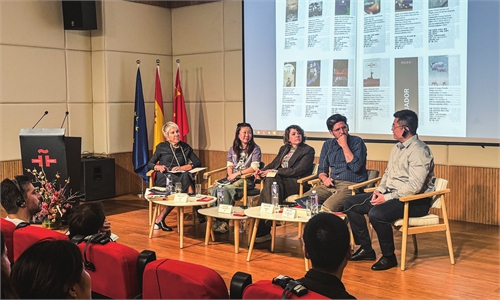
Argentine writer Guillermo Martínez (2nd from right) and Chinese author Na Duo (right) at a dialogue at the Instituto Cervantes in Shanghai on June 23, 2026 Photo: Courtesy of the Instituto Cervantes in Shanghai
The Instituto Cervantes in Shanghai staged a dialogue session between Argentine writer Guillermo Martínez and renowned Chinese author Na Duo on Tuesday in Shanghai. The dialogue was dedicated to exploring the various forms of crime, mystery, and suspense literature in the Hispanic and Chinese worlds.Moderated by contemporary Chinese mystery and thriller author Chunshen Nüjun and Salvador Marinaro, an Argentine visiting professor at Fudan University in Shanghai, the discussion lasted almost an hour and a half. Speaking from four different perspectives, the panelists shared their views on the traditions of the crime genre, as well as the points of convergence between two distinct ways of crafting plots that challenge the readers.
Isabel Cervera, director of the Cervantes Institute in Shanghai, told the Global Times in a written interview that "Crime fiction explores some of humanity's deepest questions - truth, fear, memory and justice. By bringing together Guillermo Martínez and Na Duo, this encounter demonstrates how literature can transcend languages and borders, creating meaningful dialogue between Chinese and Spanish-speaking cultures. It reaffirms literature as a shared language and storytelling as a powerful bridge between our societies."
Na Duo is one of the most popular authors of suspense fiction in China. Known for novels that combine mystery, psychological elements, and seemingly supernatural phenomena, he has helped revitalize the suspense genre for a new generation of Chinese readers.
A former customs official and newspaper reporter, Na Duo began writing science fiction anonymously online. Encouraged by positive feedback from readers, he resigned from his government post to join the media industry and eventually saw his works officially published. His subject matter has also shifted from early science fiction to realistic crime and suspense writing that focuses on the complexities of human nature.
Guillermo Martínez is one of the most prominent voices in contemporary Spanish-language literature, and has more than five books being translated into Chinese. A formally trained mathematician and now an internationally acclaimed writer, he has built a unique body of work in which logic, intellectual puzzles, and crime intrigue intertwine with profound reflection on knowledge and truth.
An alumnus of the University of Buenos Aires with a deep background in mathematics, Martínez wrote "The Oxford Murders," during his postdoctoral research at Oxford; at the age of 43, he weighed the competing demands of scientific research and literary creation and ultimately transitioned to a full-time writing career, though he has never completely severed ties with mathematical research, believing that mathematical logic provides a source of rational nourishment for his literary work.

Argentine writer Guillermo Martínez (center) and He Jiahong (right), a professor of law at the Renmin University as well as a mystery writer at a dialogue session during the BIBF in Beijing on June 21, 2026 Photo: Courtesy of the Cervantes Institute in Beijing
Martínez also had another dialogue in Beijing on June 21 during the Beijing International Book Fair (BIBF) this year, with He Jiahong, a professor of law at the Renmin University as well as a mystery writer. The session was jointly hosted by the BIBF and the Cervantes Institute in Beijing.Talking about the significance of this dialogue, Inma González Puy, director of the Cervantes Institute in Beijing, told the Global Times that the session offered a comparison of two contemporary traditions of the mystery novel. While Martínez - whose works have been widely translated into Chinese, making him the most translated and published living Argentine author in China - explores logical, philosophical, and mathematical enigmas, He Jiahong (known in Spanish for his novels featuring lawyers and investigators, three of which have been translated) incorporates a legal and social perspective on present-day China.
The discussions highlighted how both authors use mystery as a vehicle to reflect on truth, justice, and the uncertainties of the human condition, thereby building bridges between Chinese and Hispanic literatures, she said.
For warming up, clips from the film adaptation of Martínez's novel "The Oxford Murders" were screened before the dialogue session; as mathematical propositions and philosophical debates unfolded alongside clues to the murder, the audience were quickly immersed in an atmosphere of mystery and deduction.
The dialogue also explored how specific academic disciplines inform the creation of suspense fiction. As cross-disciplinary creators, Martínez and He Jialong analyzed the logic of crime writing from the perspectives of mathematics and law, respectively.
Martínez shared the story behind his creative journey. While he was passionate about literature and philosophy in his youth, his decision to study mathematics was somewhat unexpected; he later discovered a shared logic among the mathematician's process of proof and deduction, the detective's gathering of clues, and the judge's verification of evidence. He also candidly noted that he is not a traditional detective novelist. Rather than focusing on the thrill of solving a puzzle, he prefers to use the case as a vehicle to explore the duality of human nature - highlighting that ordinary people harbor secrets and anyone could potentially become a suspect.
With eight years of farming experience under his belt and a long-standing career dedicated to teaching and researching criminal investigation and the law of evidence, He Jiahong deconstructed the narrative mechanics of suspense novels by applying the principles of criminal investigation, namely "when, where, what took place, what subject, who, how and why."
The professor and writer also highlighted common pitfalls in the genre. While sensational cases may attract readers, the resolution must be logically consistent, he said.
"Relying on supernatural elements or fantasy to wrap up a plot deviates from the fundamental nature of crime suspense literature."
RELATED ARTICLES