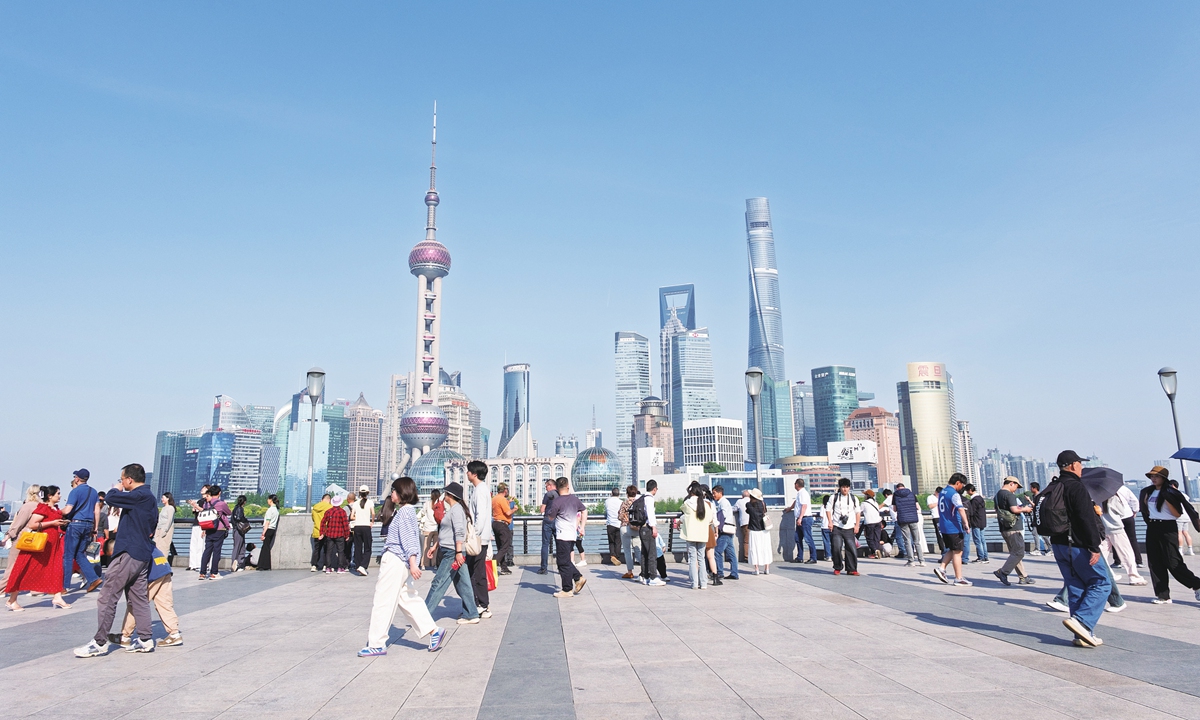
A scene of the Bund, Shanghai on May 1, 2026 Photo: VCG
Editor's Note:
The year 2026 marks the 105th anniversary of the founding of the Communist Party of China (CPC). For over a century, the CPC has united and led the Chinese people in writing the most magnificent chapter in the millennia-long history of the Chinese nation. From the days when Edgar Snow broke through blockades to reach Yan'an to the present day exploration of Chinese modernization that has charted an entirely new path, a growing number of people around the world are asking: What does China's path mean for the rest of humanity? The Global Times invites Chinese and foreign observers to unpack this question. This is the second installment of the series.
Xin Ming, a professor at Beihang University
Since the mid-20th century, China has painted the most modern and beautiful picture on a blank canvas, establishing a socialist country with the people as the masters of the country.
While some Western countries are mired in political polarization, social division, and inefficient governance, China has achieved the two great miracles of rapid economic growth and long-term social stability.
Against this backdrop, an intriguing phenomenon has emerged in the international public discourse: An increasing number of Western scholars have begun to seriously examine "why China is different."
To find the answer to this question and understand "China's governance," one must first understand the "China's system" behind it, and grasp where the superiority of China's system lies and how it is manifested.
First, China adheres to a people-centered institutional stance. For a large country like China with a population of more than 1.4 billion, the institutional design must enable the vast majority of Chinese society to understand, utilize and exercise their rights and powers within it. China has established and consolidated the system of a socialist state governed by a people's democratic dictatorship that is led by the working class and based on an alliance of workers and peasants. It has also built the system of people's congresses, the system of CPC-led multiparty cooperation and political consultation, and the systems of regional ethnic autonomy and grass-roots democratic self-government. This institutional arrangement is designed to ensure that the people enjoy broader and more substantive rights and freedoms, and to guarantee their extensive participation in national and social governance.
Second, China holds institutional values of fairness and justice. The country's system is people-centered, ensuring that the people are the masters of the country. Its underlying institutional logic is the logic of labor and the logic of the people. Aiming at common prosperity and allowing the people to share the fruits of reform and development, China's system places the realization of social fairness and justice in a more prominent position. It comprehensively employs various means to properly coordinate interest relations across all sectors of society. While allowing some regions and individuals to prosper first, it consistently focuses on ultimately achieving common prosperity for all.
Third, China possesses an institutional mechanism of focusing resources on major initiatives. As China's national systems and governance system continue to improve and develop, the notable advantage of concentrating resources to accomplish major undertakings has become increasingly prominent. The internal mechanism and operating model of China's system determine that it can forge a powerful unified will and organizational strength. It organizes and mobilizes resources from economic, political, social, and other sectors, enabling the nation to pull together in times of trouble and align from top to bottom.
Currently, the international community closely monitors China's Five-Year Plans for National Economic and Social Development, an institutional arrangement that exemplifies concentrating resources to accomplish major tasks under strategic guidance. While many countries possess national development plans, very few can effectively execute them to achieve tangible results because many plans in those countries remain confined to paper, with unaccomplished targets routinely rolled over into the next cycle. In contrast, a major advantage of China's system is that it not only consistently formulates various plans, but also ensures they are always successfully realized.
Fourth, China's system is characterized by an institutional inclusiveness of fully mobilizing all positive factors. While adhering to the primacy of distribution according to work, Chinese society must unleash the vitality of all production factors - including labor, knowledge, technology, management, and capital - and allow all sources of social wealth to flow fully.
Take China's basic socialist economic system as an example. It not only embodies the superiority of the socialist system, but also adapts to the developmental level of social productive forces in the primary stage of socialism in China, representing a great creation of the Party and the people. Throughout its continuous development and refinement, China's system fully demonstrates its open and inclusive character. It never closes itself off; instead, it insists on rationally drawing on all outstanding achievements of human civilization, learning from the strengths of others, and practicing inclusiveness.
While absorbing and borrowing the institutional experiences of others, China consistently stands firm on its own national conditions and integrates these experiences dialectically. This ensures that the leadership of the CPC, the people's status as masters of the country, the socialist system of laws, and socialist public ownership become the "general illumination" within China's system. This light determines what China's comprehensive set of institutions can and should do, thereby building a powerful and effective institutional guarantee for "China's governance."
Evandro Menezes de Carvalho, a visiting professor at the Macao Polytechnic University
The year 2026 marks the 105th anniversary of the CPC. Few political organizations in modern history have exercised such a profound influence on the destiny of a nation. What makes this anniversary particularly interesting, however, is not only the CPC's longevity but the renewed attention it is receiving from scholars around the world.
Over the last decade, an intriguing shift has taken place in international academic and policy circles. Increasingly, foreign researchers have begun asking a question that was once often overlooked or dismissed: Why is China different?
The question emerged not from ideology but from observation. For decades, many analysts assumed that China's development would eventually follow the trajectory of Western modernization. Some predicted that economic growth would inevitably produce political convergence with Western institutions. Others believed that the country's size, diversity and rapid transformation would generate instability. Yet history unfolded differently.
China entered the 21st century as one of the world's major economic powers, while maintaining social stability and political continuity on a scale rarely seen in contemporary history. Hundreds of millions of people have been lifted out of poverty. Infrastructure has expanded at an unprecedented pace. Scientific and technological capabilities have advanced dramatically. At the same time, the country preserved a degree of social cohesion that many developed societies have struggled to maintain. This reality has forced many observers to reconsider long-held assumptions. Rather than asking when China would become more like the West, a growing number of scholars are now trying to understand why it followed a different path. Part of the answer lies in the way China approaches governance itself.
In many countries, public debate tends to focus on isolated problems. Economic difficulties are discussed in terms of fiscal adjustments, pension reforms, interest rates or public debt. Social challenges are frequently addressed through new legislation. Each issue is treated separately, often within the constraints of electoral cycles and political competition. China's approach has generally been different. Economic development, social stability, technological innovation, environmental protection, public services, cultural development and national security are viewed as interconnected dimensions of the same national project. Policymaking, therefore, seeks to coordinate multiple objectives simultaneously rather than addressing them one at a time.
This perspective can be observed throughout China's modernization process. Infrastructure development was not treated merely as a construction policy but as an instrument to reduce regional disparities and create conditions for future growth. Poverty alleviation was linked to transportation, education, healthcare, industrial policy and local governance. Environmental goals became integrated into economic planning rather than remaining separate from it. The pursuit of what China now calls "common prosperity" reflects the same effort to balance growth with social development. Such an approach requires long time horizons. China's Five-Year Plans are perhaps the most visible expression of this practice, but they represent only part of a broader culture of planning and results-based evaluation. Major national goals are often pursued over decades rather than electoral terms. This continuity has enabled successive generations of policymakers to work within a relatively stable strategic framework while adapting to changing circumstances.
At the same time, understanding contemporary China requires looking beyond institutions alone. The country's political culture did not emerge in a historical vacuum. Ideas such as social harmony, collective responsibility, national unity and the moral obligations of governance have deep roots in Chinese civilization. These traditions continue to influence how many Chinese citizens and policymakers understand the relationship among the state, society and development.
The growing interest in China also reflects broader transformations in the international system. The world is becoming increasingly multipolar. As a result, the assumption that modernization follows a single path has become more difficult to sustain. Different societies are searching for solutions that reflect their own histories, cultures and developmental priorities. China's experience does not provide a universal formula. Chinese leaders themselves frequently emphasize that each country must find a path suited to its own conditions. Nevertheless, China's achievements have become too significant to be explained away as an exception and too substantial to be ignored.
The significance of the CPC's 105th anniversary, therefore, extends beyond the history of a political party. It invites reflection on a broader question confronting governments worldwide: How can societies achieve development, stability and effective governance amid profound economic, technological and geopolitical change? The growing number of scholars studying China is not necessarily searching for a model to replicate. They are trying to understand a historical experience that challenges many established assumptions about modernization and governance. In that sense, the question "Why is China different?" has become much more than an academic inquiry. It has become one of the defining questions of our age.
RELATED ARTICLES