Green attractions: Three-North Shelterbelt Forest Program turns Bashang Grassland into booming tourist destination
Green attractions
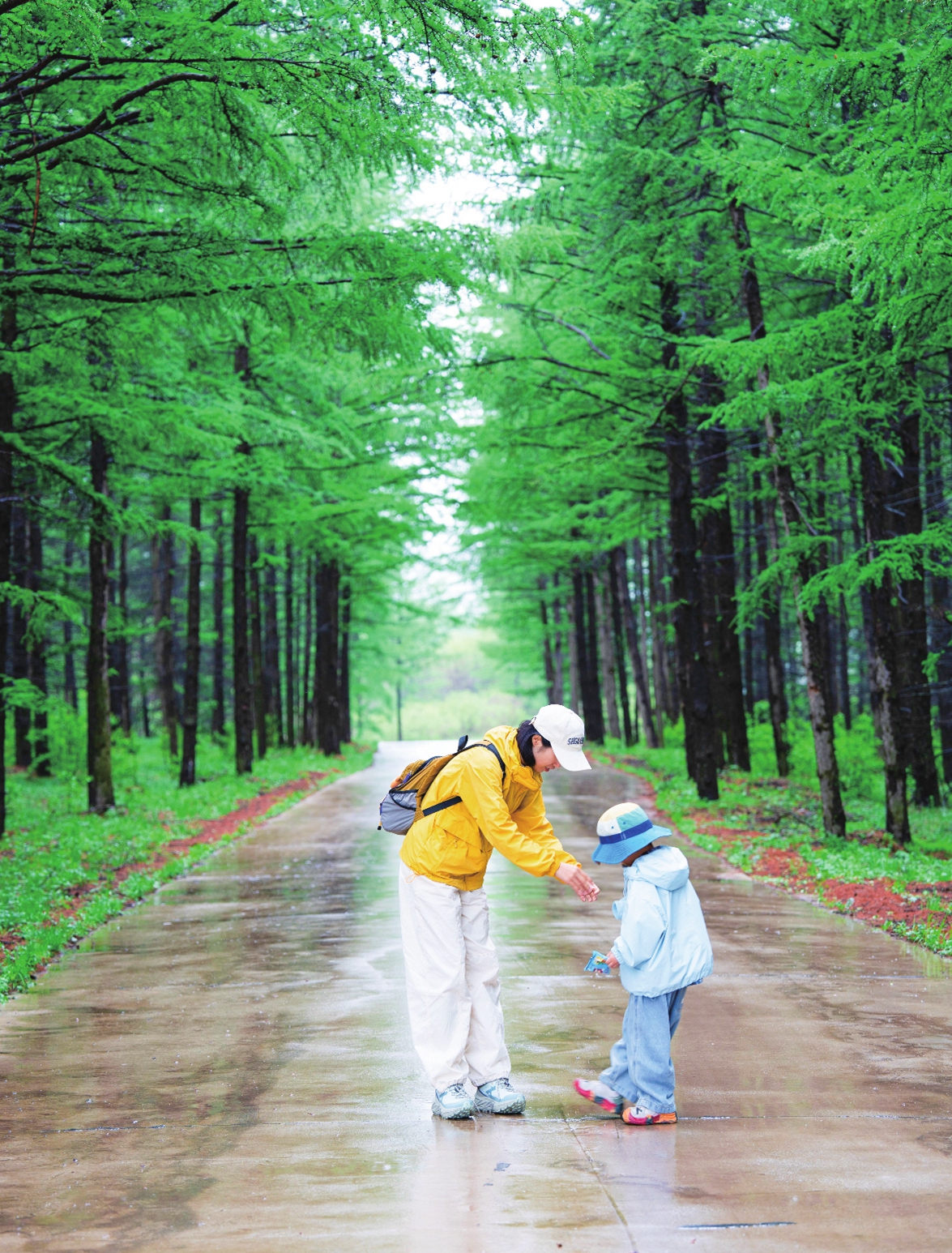
You Xiang, a tourist from Beijing, and her child visit the Qiansongba forest farm in the Fengning Manchu autonomous county, North China's Hebei Province, on June 20, 2026. Photo: Courtesy of You Xiang
Lush forests now blanket the rolling hills of the Qiansongba forest farm in the Fengning Manchu autonomous county, North China's Hebei Province. In summer, the mountains and grasslands merge into a vast expanse of green, drawing visitors seeking cool weather, sweeping landscapes and a respite from city life.During this year's Dragon Boat Festival holidays, the Bashang grassland in the county, welcomed another surge of tourists. The area has already turned into an attraction for many tourists on short trips. According to local media, the region received about 8 million visitors in 2025 alone.
Among them was You Xiang, a tourist from Beijing who had traveled to Bashang with her child during the festival. You told the Global Times that, compared with heavily commercialized attractions, she preferred this destination as it retains natural character while offering both forest and grassland scenery, a combination that is increasingly rare within easy reach of Beijing.
Few visitors, however, realize that the forests surrounding the famous Bai Li Skyroad scenic area are themselves the product of decades of ecological restoration under China's Three-North Shelterbelt Forest Program. The larch and spruce plantations visitors stroll through today were originally planted as protective forests to combat desertification and restore fragile ecosystem.
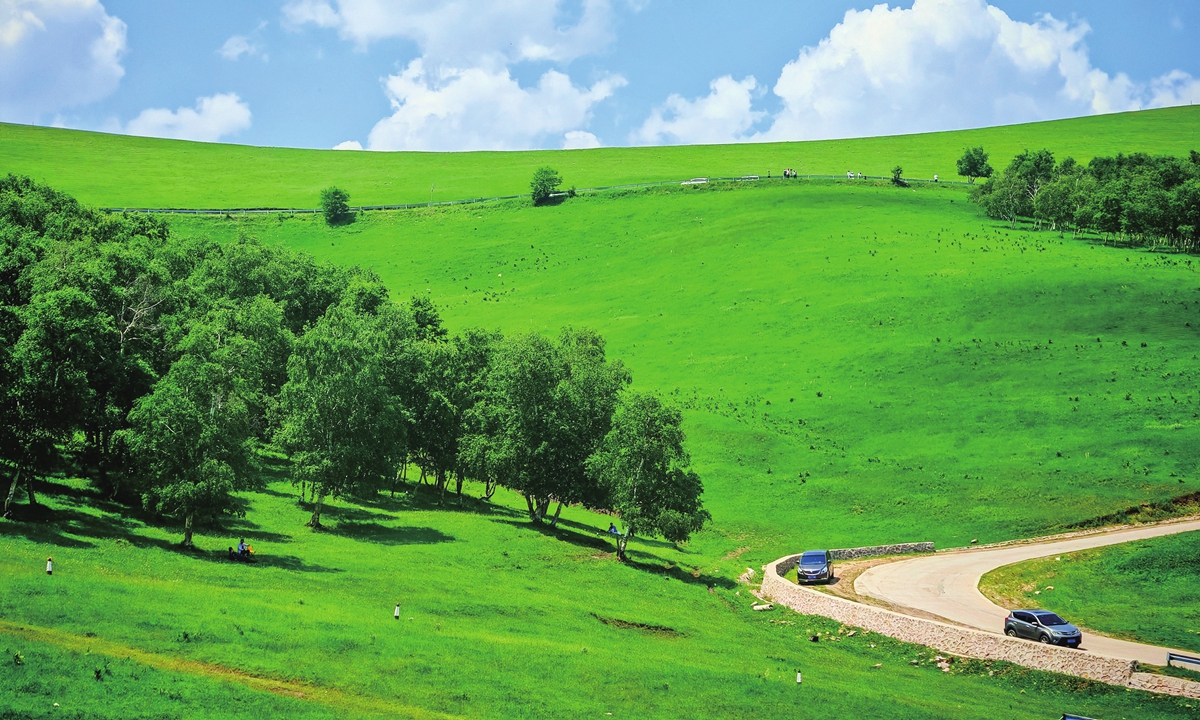
The beautiful grasslands of Fengning Bashang, North China's Hebei Province Photo: VCG
Expanding forestsOn a hillside overlooking the Qiansongba forest farm, forest ranger Wang Jinliang climbed a gentle slope to inspect a stand of spruce saplings planted three years ago.
Although the trees have grown slowly in the harsh highland environment, many stand more than a meter tall. Beneath the surface, their extensive root systems are quietly anchoring the sandy soil.
"Spruce develops strong roots and is excellent for stabilizing sand," Wang said. "You can see how firmly they're growing." However, the landscape looked very different a little more than a decade ago.
Wang recalled that back then, vegetation was sparse. Whenever the wind picked up, sand would blow straight into residents' courtyards. The turning point came with a large-scale afforestation campaign kicked off by the province in 1999.
Amid these ambitious efforts, Qiansongba has emerged as a flagship project.
Over the past nearly 20 years, Qiansongba forest farm has planted 1.2109 million mu (about 80,726 hectares) of forests, reducing land affected by desertification and soil erosion by nearly 1.5 million mu.
Approved in September 1999, the forest farm began with a pioneering team of just 13 people, who arrived in Datan Township that autumn to launch what would become a decades-long restoration effort, local media reported.
The early years were anything but easy. The newly established forest farm struggled with shortages of funding, manpower and available land, while conflicts frequently arose between tree planting and traditional grazing, Wang said.
He noted that after consulting forestry experts and coordinating with local governments, Qiansongba introduced an innovative shareholding afforestation model.
Resolving tensions with herders proved equally challenging. Staff members, from the director to frontline forest rangers, were each assigned responsibility for more than a dozen households. They spent their days helping drive livestock off newly planted hillsides and their evenings visiting families one by one, explaining the long-term ecological and economic benefits of afforestation while encouraging a transition from free grazing to enclosed livestock breeding, Wang recalled.
Only around 2010 did the situation begin to substantially improve. Wu Baoyong, director of the project center under Fengning's forestry and grassland bureau, noted that restoration measures were tailored to different landscapes.
On mountain slopes, artificial afforestation was combined with degraded forest restoration. Wang told the Global Times that planting densities were set at 74 and 42 trees per mu respectively, using nine different species combinations, including mountain cherry with Chinese pine and elm with forsythia. In valleys below, engineers constructed seven check dams to reduce erosion and retain water, creating a more comprehensive, three-dimensional ecological restoration system.
As the environment gradually recovered, nearby villages began witnessing another transformation. In Erdaohezi village, growing tourist numbers encouraged residents to dismantle sheep pens and convert their homes into guesthouses, opening a new chapter of green development.
The Bashang Plateau, once known for its fragile ecosystem and relentless wind erosion, has steadily evolved into both an important ecological barrier protecting the Beijing-Tianjin region and one of northern China's emerging nature tourism destinations.

You Xiang and her friend watch the sunset at Bai Li Skyroad in the Fengning Manchu autonomous county, North China's Hebei Province, on June 20, 2026. Photo: Courtesy of You Xiang
Ecological developmentEcological restoration continues to expand. The Hongshishan village project, part of an ecological restoration program launched in 2023, covers more than 10,200 mu. It has become a model project demonstrating the high-quality implementation of the Three-North Shelterbelt Program in Fengning, according to the Forestry and Grassland Bureau of Hebei Province.
Standing atop the Bashang grassland, one can see dense forests now stretch toward the horizon alongside rows of wind turbines and solar panels.
The coexistence of ecological restoration and renewable energy reflects another stage of the region's transformation.
In 2024, construction progressed steadily on the Chengde Fengning integrated wind-solar hydrogen storage project, a renewable energy base with an installed capacity of one million kilowatts.
A representative from China Suntien Green Energy Corp told the Global Times that the company's wind and solar projects in Fengning generated 2.837 billion kilowatt-hours of electricity in 2024. Compared with conventional coal-fired power generation, the output saved an estimated 865,300 tons of standard coal while reducing carbon dioxide emissions by about 1.62 million tons, the representative noted.
According to local ecological and environmental authorities in Chengde, the city is advancing 60 major clean-energy projects this year, representing total investment of 66.88 billion yuan ($9.71 billion). The portfolio includes 40 wind and solar projects with a combined installed capacity of 5.68 million kilowatts, four pumped-storage projects totaling 6.4 million kilowatts, and 16 energy-storage projects capable of storing 11.16 million kilowatt-hours of electricity.
Together, they are forming an integrated clean-energy system in which wind, solar and energy storage reinforce one another.
For visitors arriving today, Bashang offers cool forests, endless grassland and spectacular views above the clouds. Yet beneath the picturesque scenery lies a story decades in the making, one in which trees planted to hold back sandstorms have reshaped both the landscape, and local livelihoods, Wu said.
RELATED ARTICLES