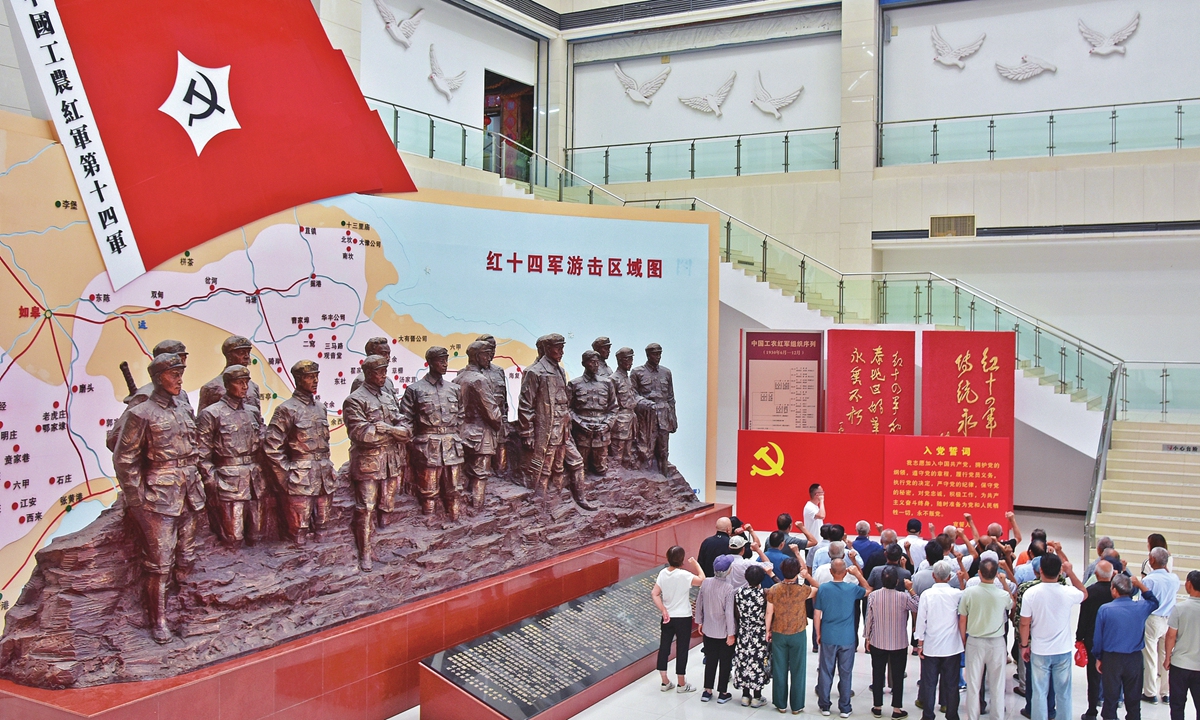
CPC members reaffirmed their commitment to the Party by reciting the admission oath in Rugao city, East China's Jiangsu Province on July 1, 2026, which marks the 105th anniversary of the founding of the CPC. Photo: VCG
Editor's Note:This year marks the 105th anniversary of the founding of the Communist Party of China (CPC). Over the past century and more, the CPC has carried forward its revolutionary traditions while forging new achievements in response to the demands of each era. Anchored in its enduring mission to serve the people, the CPC has demonstrated a remarkable capacity for self-reform, an indomitable fighting spirit and an open, adaptive mind-set that enables it to navigate changes and steer the nation forward.
On this significant occasion, the Global Times (GT) presents this special series of interviews with international scholars. Through their diverse lenses, global observers have contemplated the journey of this century-old party - its enduring historical legacy, its governance logic and its dynamically evolving role in an ever-changing world.
In the third installment of the series, British author and independent political commentator Carlos Martinez (Martinez) shared his views on the CPC's fighting spirit with GT reporter Xia Wenxin.
GT: As the Communist Party of China (CPC) marks its 105th anniversary, it stands as one of the longest-governing political parties in modern history. Looking back at this journey, how do you evaluate the role of the fighting spirit in helping the CPC navigate historical crises and constantly adapt to changing eras?
Martinez: I think that, for the CPC, the fighting spirit is closely related to the dialectical core of Marxism: the recognition that development happens through contradiction, that nothing valuable arrives without meaningful effort, and that a serious revolutionary party has to identify the principal contradiction of each period and work to resolve it. Struggle, in this sense, is not a mood; it is a method.
This is not a recent slogan grafted onto the CPC; it runs right through its tradition. Fighting spirit is not just about heroic individual will; it is also about the conviction that even an immovable obstacle yields to patient, collective, intergenerational effort - once the masses are mobilized to do the digging.
That method is exactly what has allowed the CPC to survive and adapt over a century in which so many of the other revolutionary projects of its generation were defeated. Consider the sheer range of conditions it has had to navigate in the last century; that the People's Republic did not collapse was not luck. It was the product of a party willing to struggle on every level.
GT: The primary targets of the CPC's fighting spirit are often internal - such as deeply entrenched corruption, vested interests and structural economic imbalances. In your view, how has the CPC used its philosophy of "struggle" to overcome institutional inertia and continuously renew itself?
Martinez: In the long term, the hardest enemy for any governing party is not an external rival but its own tendency toward complacency, capture and decay. In thousands of years of Chinese history, dynasties have risen and then rotted from within. The CPC is unique in having made the prevention of decay an explicit, never-ending task - what it calls self-reform. Self-reform is how the CPC answers the oldest question in Chinese statecraft: how to escape the historical cycle of rise and decline. Its answer is to never stop struggling, and never let up on its fighting spirit in order to improve and to better represent the interests of the people.
GT: The CPC often highlights that its historical milestones were forged through "struggle." However, Western political discourse routinely misinterprets this term as blind confrontation or zero-sum factional power struggles. As an international scholar, what do you see as the fundamental difference between the CPC's philosophy of "struggle" and the Western political understanding of conflict?
Martinez: In mainstream Western political discourse, "struggle" is heard as either factional power-play - the war of all against all inside a ruling clique - or as zero-sum confrontation between states, one side's gain being the other's loss. Neither captures what the CPC means.
The philosophical root of the Chinese usage is the unity and struggle of opposites - the dialectical proposition that contradiction is the motor of all development, and that the point of struggle is to resolve a contradiction and move to a higher synthesis, not to annihilate an opponent. The primary "adversaries" in this vocabulary are not people but conditions: poverty, backwardness, corruption, inequality, ecological degradation, foreign domination. To "struggle against poverty" is the literal organizing principle of a campaign like the one described above. Even internally, the aim of the CPC's self-struggle is renewal and unity, not the liquidation of factions for its own sake.
Therefore, the fundamental difference is this. The Western frame treats conflict as terminal - a contest with a winner and a loser. The CPC's dialectical frame treats struggle as productive - the means by which contradictions are worked through toward a higher unity. One is a logic of domination; the other is a logic of development.
GT: As China stands at the gateway of its 15th Five-Year Plan and moves toward the Second Centenary Goal, the country is facing a new landscape of high-tech self-reliance, green transition and complex external pressures, among other challenges. In your view, how will the CPC's fighting spirit be tested on these new "battlefields"?
Martinez: The 15th Five-Year Plan and the march toward the Second Centenary Goal of 2049 will test the "spirit of struggle" in a way the poverty campaign did not, because these are battlefields where the opponent pushes back hard and in real time.
The most obvious is high-tech self-reliance. The US has openly made the containment of China's technological rise a strategic priority - tariff wars, sanctions, export controls, the chip blockade, "decoupling." The struggle here is to convert external pressure into the spur for indigenous innovation - to do under sanctions and containment what was once done with imported technology.
The second is the green transition. The "struggle" dimension is that this has to be done while still raising living standards and completing industrialization - managing the contradiction between development and ecological limits rather than pretending it away, as the West largely does by offshoring its emissions.
Third, there are the domestic challenges: demographic aging, regional and urban-rural disparities, the real-estate and local-debt overhang, and the unfinished work of common prosperity - ensuring that high-quality growth actually narrows inequality rather than widening it. And all of this proceeds under conditions of encirclement.
Ultimately, however, the test on these new battlefields is the same test the CPC has passed before, in a new form: Whether it can keep identifying the principal contradiction of the period and mobilizing society to resolve it, without either capitulating to external pressure or abandoning the peaceful, people-centered and win-win character that has defined Chinese modernization. On the record of the last 105 years, I would not bet against the CPC and the Chinese people surmounting these new challenges.
RELATED ARTICLES