Ability to combine tangible co-op and governance dialogue will elevate China-Kazakhstan ties

Illustration: Liu Rui/GT
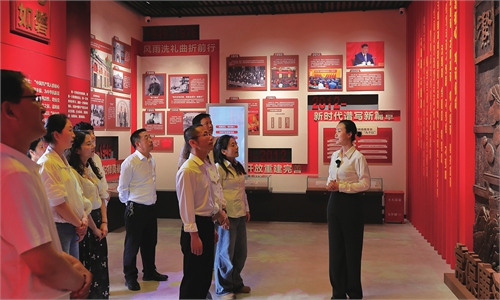
The recent China-Kazakhstan expert seminar on state governance, held in Astana to mark the 105th anniversary of the founding of the Communist Party of China, offers a useful lens through which to view the evolving architecture of bilateral relations. While the event itself focused on technical questions of governance, planning and institutional reform, its deeper significance lies in how it reflects a maturing partnership that is increasingly anchored not only in trade and transit, but also in ideas, standards and models of development.A central feature of contemporary China-Kazakhstan relations is the convergence of long-term development strategies. China's emphasis on high-quality development, technological upgrading and green transition is mirrored by Kazakhstan's own agenda of political and institutional reforms, economic diversification and the creation of a more open, accountable state. Both sides view long-term planning not as a purely technocratic exercise, but as a mechanism to align national priorities, coordinate regional development and ensure continuity of policy across political cycles.
Economic cooperation continues to serve as the core engine of bilateral relations. At the same time, the structure of cooperation is diversifying. In parallel, both sides are starting to expand cooperation in higher value-added sectors: digital economy, artificial intelligence, e-commerce, modern agriculture and green energy. These emerging domains, highlighted in expert discussions, point toward a more knowledge-intensive and innovation-driven phase of partnership.
Beyond bilateral dynamics, China-Kazakhstan ties are increasingly shaped by the broader regional and global context. Central Asia's growing geopolitical and geo-economic relevance - at the intersection of East-West and North-South corridors - creates both opportunities and responsibilities for the two countries.
In the global arena, China's proposals on global development, security and governance, alongside its advocacy of multilateralism and sovereign equality, intersect with Kazakhstan's own long-standing support for peaceful diplomacy, regional stability and constructive engagement.
Equally significant is the growing weight of human-centric and knowledge-based dimensions of the partnership. Academic exchanges, joint research projects, think-tank dialogues, media cooperation and youth programs are gradually complementing the more visible economic and political pillars. These channels help to reduce stereotypes, improve mutual understanding and build long-term trust between societies. In this regard, seminars like the one in Astana represent not isolated events, but part of a broader trend toward institutionalized, regularized and multi-level interaction.
Looking ahead, the trajectory of China-Kazakhstan relations will be influenced by how effectively the two countries can synchronize their respective modernization strategies, manage external uncertainties and translate political trust into practical outcomes. Several factors will be critical.
First, maintaining a clear long-term vision that integrates economic, social, technological and environmental priorities will help ensure that cooperation remains resilient and forward-looking.
Second, strengthening institutional mechanisms, whether in trade, investment, transport, digital governance or people-to-people exchanges, will be essential to move from ad hoc projects to systemic, scalable partnerships.
Third, both sides will need to pay close attention to the social dimension of cooperation. Ensuring that joint projects contribute to local development, create quality jobs, protect the environment and respect community needs is vital for the sustainability and legitimacy of the partnership.
Fourth, deepening mutual understanding of each other's governance approaches, constraints and domestic debates will help manage expectations and avoid misinterpretations, especially as both countries navigate intensive reform agendas at home.
Ultimately, the significance of the Astana seminar lies less in any single statement and more in the fact that such a gathering could take place and is likely to be repeated in different formats. As both countries move through critical phases of their development, the ability to combine economic cooperation, connectivity, and intellectual exchange will define the depth and durability of their relationship in the decades to come.
The author is director of the China Studies Center in Kazakhstan. opinion@globaltimes.com.cn
RELATED ARTICLES