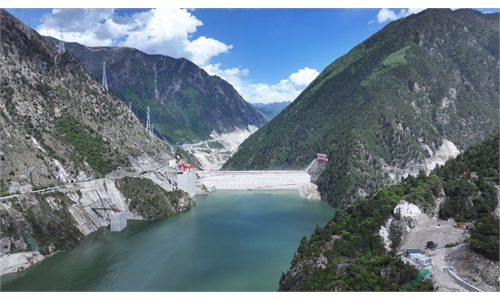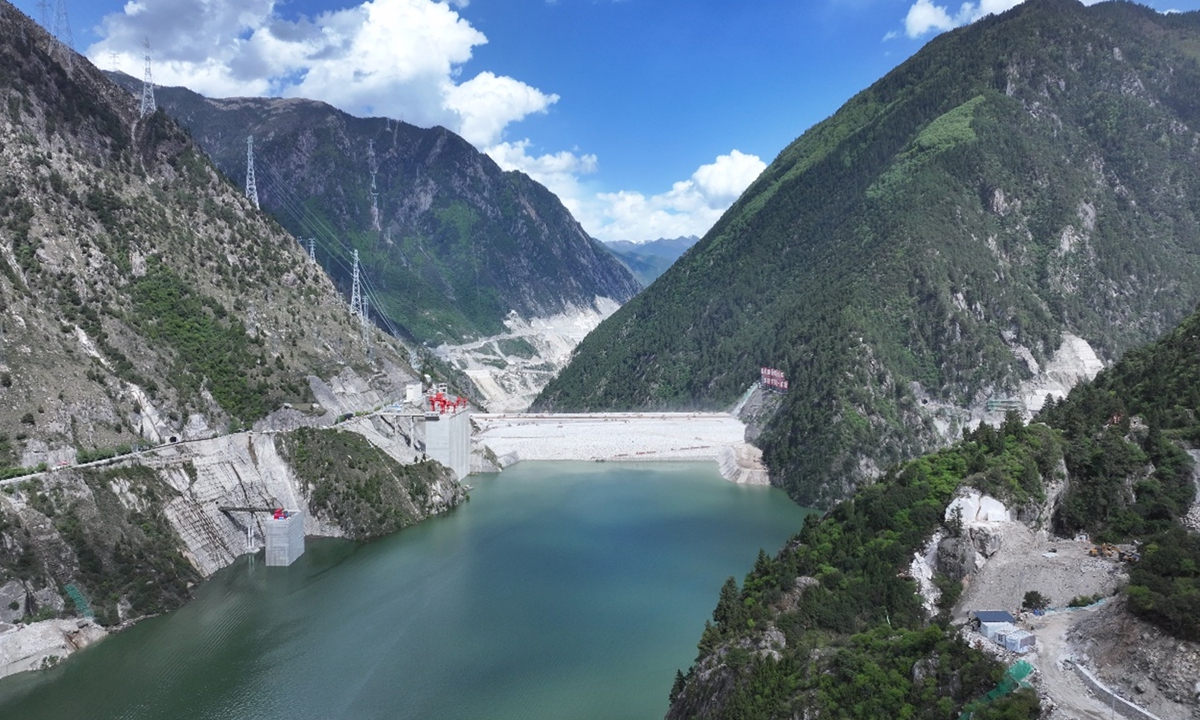
The Shuangjiangkou hydropower project in Southwest China's Sichuan Province Photo: POWERCHINA Chengdu Engineering Corporation Limited
The second generating unit of the Shuangjiangkou Hydropower Station in Southwest China's Sichuan Province, home to the world's tallest dam, has officially begun commercial operation, achieving the project's goal of bringing two units online within half a month and marking a major step toward the full commissioning of the world-class hydropower project, CCTV News reported on Monday.
The Shuangjiangkou Hydropower Station, a key national energy project, serves as the controlling reservoir and leading hydropower station on the upper reaches of the Dadu River. The project has set multiple world and domestic engineering records, featuring China's highest in-situ stress underground powerhouse of its kind, the world's largest-capacity hydraulic hoist, the largest cross-section spillway tunnel in a hydropower project, and the world's largest variable cross-section vortex shaft currently under construction, the Science and technology Daily reported.
Designed primarily for power generation, the station has a total installed capacity of 2 million kilowatts and is expected to generate an average of 7.7 billion kilowatt-hours of electricity annually.
With a total reservoir capacity of 2.9 billion cubic meters and annual regulation capability, the project is expected to increase dry-season power generation at downstream cascade hydropower stations by 6.6 billion kilowatt-hours each year while reducing carbon dioxide emissions by approximately 7.18 million metric tons annually, equivalent to the annual emissions of more than 1.5 million passenger vehicles, as calculated based on the US Environmental Protection Agency (EPA)'s annual vehicle CO₂ emissions estimate.
As additional generating units are brought into operation, the project will further expand the installed capacity of clean energy in the Dadu River basin, enhance power grid's peak-shaving and frequency regulation capabilities in Sichuan, and strengthen flood control along the upper reaches of the Yangtze River.
On June 26, the station's first generating unit was successfully connected to the grid, marking the start of power generation at the major national clean energy project and providing fresh support for the development of Southwest China's clean energy supply system and the country's carbon peaking and carbon neutrality goals, the Xinhua News Agency reported.
Following the commissioning of the first unit, the installed capacity of hydropower and new energy projects is now around 15 million kilowatts, delivering more than 60 billion kilowatt-hours of clean electricity annually to support the high-quality development of the Chengdu-Chongqing economic circle, Xinhua reported.
The Shuangjiangkou Dam is a gravel-core rockfill dam with a maximum height of 315 meters, making it the tallest dam in the world. More than 46 million cubic meters of earth and rock materials were used in its construction. if the material were formed into a wall measuring one meter in length, width and height, it would be long enough to circle the Earth's equator once, local media Sichuan Daily reported.
The hydropower units operate across a maximum hydraulic head variation of 80 meters, while the project has a maximum flood discharge head of 250 meters, both ranking among the highest in the world, according to Science and Technology Daily report.
Global Times