Corporate shift exposes cracks in US’ China tech strategy
By Published: Jul 15, 2026 09:18 PM

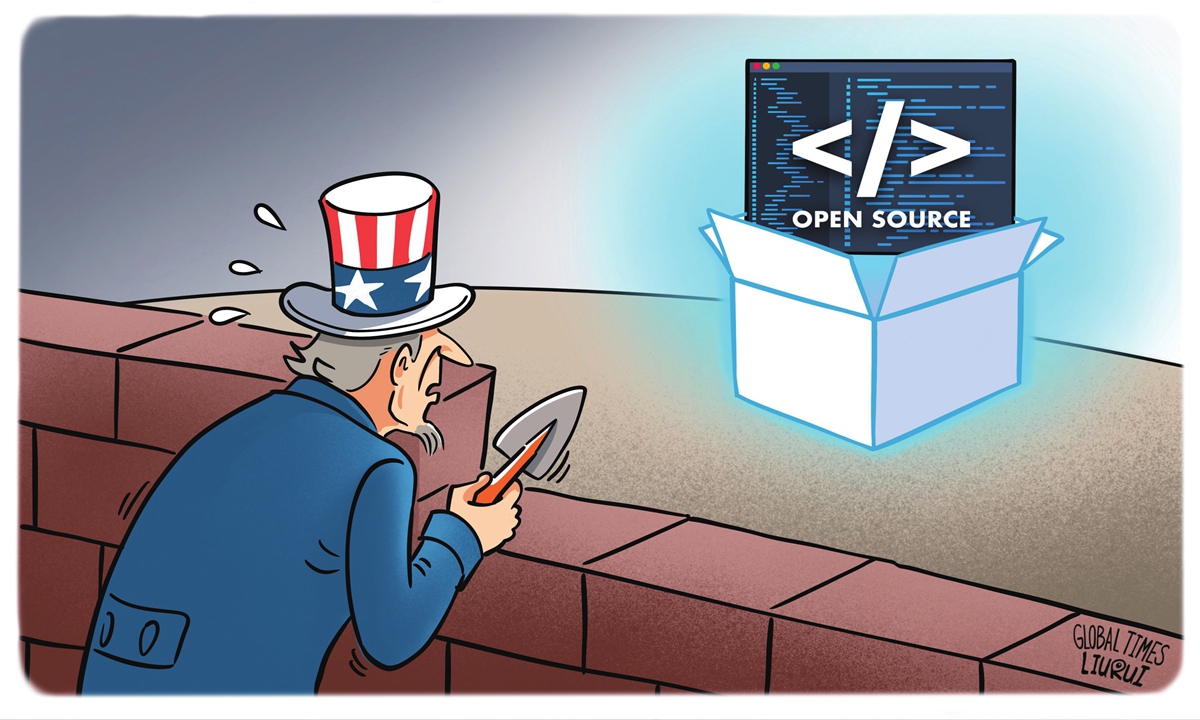
Illustration: Liu Rui/GT
This Friday, the 2026 World AI Conference and High-Level Meeting on Global AI Governance will be held in Shanghai. Just days before it, I came across what appeared to be a minor business item in the Financial Times - yet it turned out to be something far more consequential.The report described how a growing list of Western companies - DoorDash, Siemens and Airbnb - have adopted AI tools built in China, drawn by models that are cheaper, increasingly capable and, in some cases, easier to run on their own infrastructure.
The reasons are simple: Chinese AI models are much cheaper, their performance is now so close to American models that most users can't tell the difference, and because they are open-source, companies can easily customize them to fit their specific needs.
Taken one by one, none of these changes seems dramatic. But it points to something worth saying plainly: The technology containment architecture Washington has spent years building against China is showing structural cracks.
Over the past few years, the US' high-tech defenses against China have rested on two pillars. One is hardware - chips, lithography equipment, 5G base stations. The other is software and algorithms, above all, the AI models themselves.
For this second pillar, Washington hoped to replicate the logic that worked for hardware: turn advanced models into a scarce resource that could be choked off, much like a chip supply chain, and make the entire world choose the American model.
The trouble is that a chip is a physical object. Each one is manufactured, each one is shipped and each one can be stopped at a customs checkpoint or a factory gate.
An AI model is different. Once it is trained and its weights are released, it becomes a digital file. There is no checkpoint you can set up on the internet to keep a file out of China, and no way to claw it back once hundreds of thousands of servers around the world already have a copy.
Hardware containment relies on physical scarcity. What was software containment supposed to rely on? Only one thing: keeping a clear performance advantage over everyone else.
As long as American models were meaningfully better, companies would keep choosing them without needing to be told to. But DeepSeek and Z.ai have narrowed that gap to something most enterprise users barely notice. This is not companies taking a political side. It is the finance department doing arithmetic.
What makes this more striking is the timing. This shift toward Chinese models has happened precisely during the period of the tightest restrictions.
That is a counterintuitive but important fact: External pressure has not broken China's AI industry - it has forced that industry to get genuinely better. Containment was supposed to make the other side fall behind due to a lack of resources. What actually happened, however, was closer to the opposite: Scarcity forced the invention of a more resource-efficient path.
Hardware: China accelerates. Open software: models become global.
The endgame was to grind China's AI industry down through sustained pressure, causing it to fall irreversibly behind. That has not happened either.
What has happened instead is that an entire alternative technology stack has matured, from a rough early version into something genuinely competitive.
Put differently, this was conceived as a zero-sum contest with two possible winning conditions - and neither has held up. Containment did not fail because it was poorly executed. It failed because of a category error at its foundation.
What Washington really needs to figure out about AI is not how to lock China out or slow it down, but to accept that neither approach was ever truly possible. Once it accepts this reality, it can start thinking about the bigger picture.
The US excels in AI model innovation and funding. China shines in rapid, cost-effective deployment. Together, they can make AI globally accessible.
If the US and China can find a way to keep competing while still cooperating, and to keep cooperating without giving up on competition, the changes will not be limited to the industrial fortunes of the two countries. It will be the pace at which AI is adopted and developed worldwide. That, in this contest, is the prize actually worth pursuing. This has been China's consistent position, which has always been communicated to Washington.
The author is a senior editor with the People's Daily and currently a senior fellow with the Chongyang Institute for Financial Studies at Renmin University of China. dinggang@globaltimes.com.cn. Follow him on X @dinggangchina
RELATED ARTICLES