Photo: Courtesy of Moonshot AI
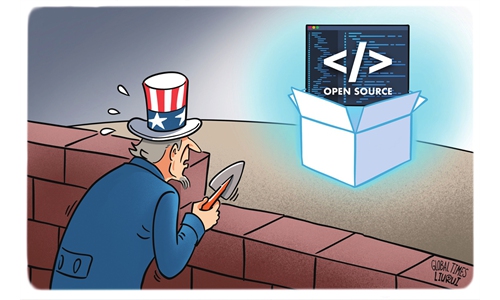
The success of China's large language model Kimi K3 has rattled some people. Dean Ball, OpenAI's head of strategy and a former White House senior advisor on AI, published a lengthy post on social media, accusing open-source large models such as Kimi of being "strategic blindness," "behind," and claiming that "very few people would pay" for them. Even worse, he openly declared that the US government only needs agencies to issue soft law suggesting that "there may be backdoors in Chinese AI models" and "it needn't be that well justified," which would be enough to create regulatory panic and suppress competitors.
Although Ball's remarks represent personal views, they still reflect the frustration and anger of US monopolists in the face of competition. This attitude is emblematic. The US' various attempts in recent years to contain and suppress China's technological development are, at their root, driven by exactly this mentality. What they fear is that developers around the world will rely on Chinese open-source models to innovate and forge a new path different from the American model. In their logic, only their own expensive subscription services represent "progress," while making advanced models freely available to the world somehow becomes "shortsightedness." Behind such rhetoric lies the arrogance of hegemony: Only we are entitled to stand at the top of the pyramid, while everyone else should simply keep paying rent. As open-source sharing begins to shake the foundations of their competitive moat, their instinct is to weld the gate shut.
Even more disgraceful is Ball's explicit call for the US government's intervention. Is there any professional integrity expected of a technology leader? Rather than competing through better code and algorithms, he appears to be inviting McCarthyism back into the technology sector and replacing innovation with the stick of hegemonic power. That will do nothing to advance US technological leadership. Instead, it reveals what truly worries them. What they fear is not a "China threat," but the collapse of their own narrative, as the attention and creativity of capital and developers are steadily shifting toward the open-source community.
Far from restoring OpenAI's reputation, Ball's remarks have drawn widespread criticism on overseas social media platforms. Some analysts have argued that Kimi K3 could represent a major turning point for the AI industry, which is "potentially negative for Anthropic and OpenAI while being net positive for essentially every other company in the world." Open source is not only a scientific ethos for the digital age, but also an inevitable trend for the sustainable development of the global AI industry. The more anxious people like Ball become, the more they prove exactly that.
RELATED ARTICLES