What does the sustained buzz among Taiwan youth over a Chinese painting-inspired dance drama indicate?: Hai Feng
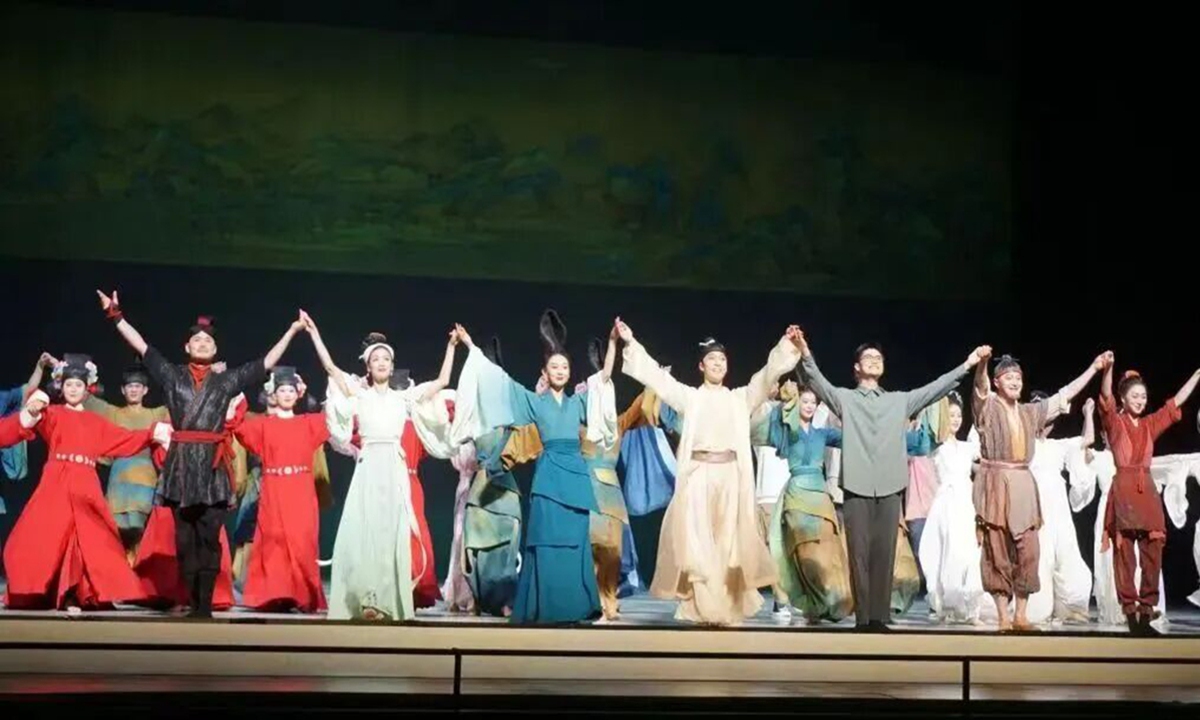
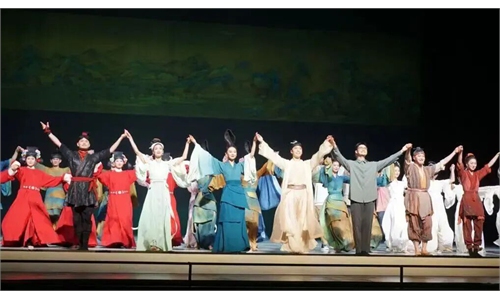
The dance drama Only This Green makes its Taiwan region debut on July 2. Photo: Xinhua
From July 2 to 5, the poetic dance drama Poetic Dance: The Journey of a Legendary Landscape Painting, also known as Only This Green, delivered seven sold-out performances in Taipei, where tickets remained extraordinarily hard to come by even after additional shows were staged. What is even more thought-provoking is that more than 10 days after the performances concluded, the drama's popularity across Taiwan has not faded, and intense discussions continued to surface on social platforms, with an overwhelmingly positive overall tone. Some shared their awe-inspiring experiences at the venue, some reshared classic clips of the drama, some expressed regret over failing to secure tickets and others directly called for the production team to "bring the show back to Taiwan as soon as possible."This is not merely the "residual warmth of a popular show," but a cultural phenomenon worthy of serious attention. Poetic Dance: The Journey of a Legendary Landscape Painting did not just become a hit; it won widespread acclaim among young people on the island of Taiwan. It was not a fleeting trend, but a work that continues to fuel ongoing discussion long after the curtain fell. This fully demonstrates that the appeal of fine traditional Chinese culture to young people on the island is not only genuinely real, but also far stronger than many had imagined.
In recent years, the Democratic Progressive Party (DPP) authorities have persistently manipulated "desinicization." They have continuously narrowed the civilizational concept of "China" into a pragmatic political notion, and deliberately severed historical ties and diluted cultural lineage in an attempt to estrange the younger generation from Chinese culture. Yet, the sustained buzz generated by Poetic Dance: The Journey of a Legendary Landscape Painting among youth on the island of Taiwan directly proves that this set of manipulations has failed. Politics can engineer a temporary narrative trend, but it cannot sever the cultural resonance surging in the blood. It can compress narrative space, but it cannot erase the deep-seated national identity embedded in people's hearts.
The fundamental reason why this poetic dance drama can touch young Taiwan people lies in culture itself. Truly vibrant Chinese culture never requires heavy-handed lecturing or forced indoctrination. As long as it is presented through an appropriate medium, it speaks for itself and touches the human heart. Drawing inspiration from the ancient masterpiece A Panorama of Rivers and Mountains, Poetic Dance: The Journey of a Legendary Landscape Painting reinterprets the profundity, elegance and vastness of Chinese aesthetics through modern stage language. Grand landscapes, Song Dynasty aesthetics, artisan spirit and Oriental artistic conception have been transformed through modern, aesthetically pleasing audio-visual expressions into a cultural experience that young people actively accept, sincerely embrace and spontaneously share. Young people may not necessarily approach the production through the lens of grand narratives from the outset; instead, they are first awed by its beauty, moved by its emotion, and captivated by its atmosphere, naturally arriving at a deeper cultural resonance in the end.
The breakout success of this dance drama among young people on the island of Taiwan shows that the younger generation on the island has not completely severed ties with Chinese culture as some had envisioned. On the contrary, when Chinese culture presents itself in an exquisite, modern, and tangible form, it triggers a strong resonance among them. A compatriot from Taiwan commented online that had it been before last year, this production might not have received such an enthusiastic response on the island; today, however, young people are not only discussing it, but discussing it positively, to the extent that "flocking to this show has turned into a fashion trend." This indicates that something within society of the Taiwan island is undergoing a quiet shift. When young people begin to spontaneously pursue, positively spread and publicly identify with Chinese cultural symbols, its significance far transcends the artistic work itself.
On Monday, Taiwan's United Daily News published an editorial titled "Poetic Dance: The Journey of a Legendary Landscape Painting and Dear You mirror the dilemma of Taiwan's cultural policy," pointing out with sharp precision that the Taipei Palace Museum was originally Taiwan's finest cultural calling card. However, in recent years, the DPP has deliberately removed Chinese elements, cutting 5,000 years of Chinese culture into a so-called "400-year history of Taiwan." Under this mind-set, those in power hold little interest in Palace Museum artifacts imbued with rich Chinese cultural imagery, and therefore it is impossible for them to produce works like Poetic Dance: The Journey of a Legendary Landscape Painting. This assessment hits the nail on the head. Taiwan does not lack cultural resources; rather, certain people have voluntarily relinquished its deepest, most unique and most competitive cultural roots.
From this perspective, the immense popularity of Poetic Dance: The Journey of a Legendary Landscape Painting on the island is, in a sense, a direct reality-check response to "desinicization." Compatriots on both sides of the Taiwan Straits belong to the same Chinese nation; they jointly developed the vast territory of the motherland, jointly wrote the glorious history of China, jointly created the splendid Chinese civilization, and jointly nurtured the great national spirit. Precisely because of this, the conviction that "the territory cannot be divided, the country cannot be destabilized, the nation cannot be separated, and the civilization cannot be interrupted" is not merely a political principle, but a historical, cultural and national logic.
The sustained popularity of Poetic Dance: The Journey of a Legendary Landscape Painting among young Taiwan people today confirms at least three indisputable facts. First, Chinese culture remains the deepest shared language and spiritual bond connecting compatriots on both sides of the Straits. Second, young people in Taiwan have not lost their sensitivity to or identification with Chinese culture; on the contrary, they are reconnecting with and spreading Chinese culture in their own way. Third, any deliberate cultural severance will ultimately prove no match for a civilizational lineage that has endured for thousands of years.
As more and more young people in Taiwan come to genuinely cherish works like Poetic Dance: The Journey of a Legendary Landscape Painting, this in itself demonstrates that on the island of Taiwan, the roots of Chinese culture remain, the soul of the Chinese nation remains and the deepest connection across the Straits remains- a bond that no force can ever sever.
RELATED ARTICLES