Passing the torch across 105 years: Bilingual narrator bridges cultural divides, shares early days of CPC with the world
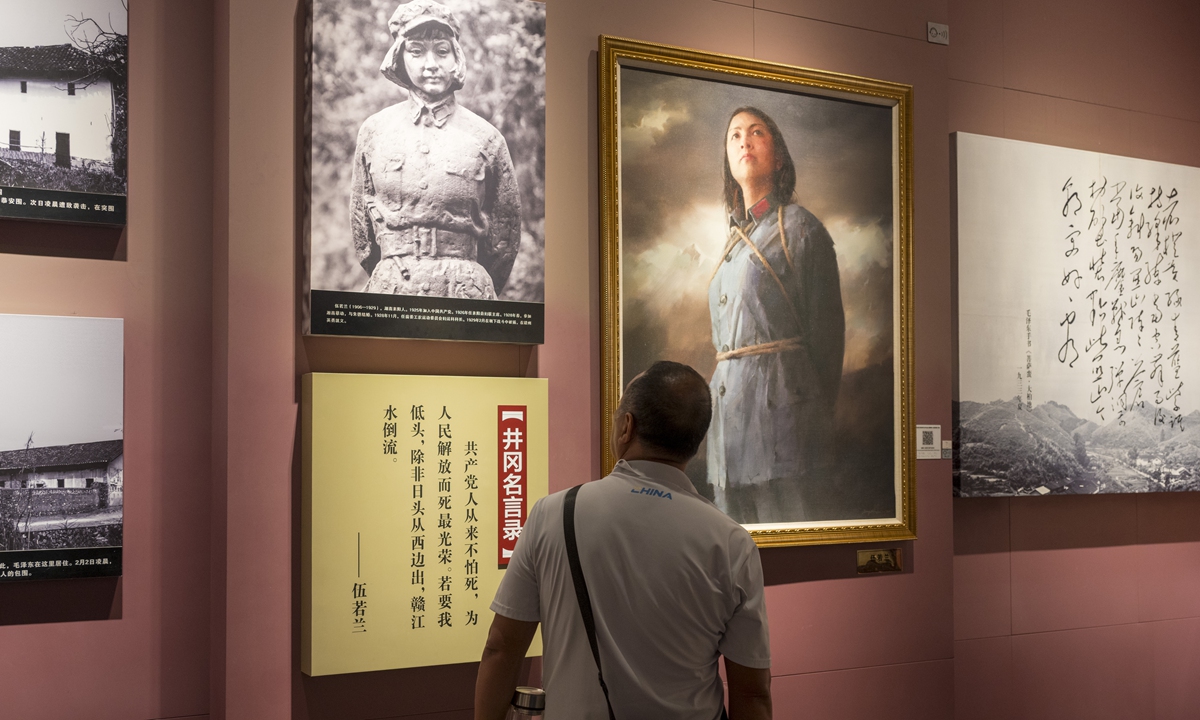
A tourist looks at the collections on display at the Jinggangshan Revolution Museum in East China's Jiangxi Province on July 5, 2026. Photo: VCG
Editor's Note:
As the Communist Party of China (CPC) marks its 105th founding anniversary, the Global Times launches a special series focusing on young Party members who are "honorer," "striver" and "torchbearer" that inherit ideals, shoulder responsibilities and carry forward the spirit of the Party in their own ways, showing how faith continues to be passed on from generation to generation.
This installment tells the story of "torchbearer" Mao Haofu, Deputy Secretary-General of the Jinggangshan Spirit Lecture Group, and the first bilingual narrator of Jinggangshan Spirit in East China's Jiangxi Province. He was awarded the title of model worker of Jiangxi Province this year.
In the Jinggangshan Revolution Museum in East China's Jiangxi Province, a familiar scene often greets visitors: a young man in formal attire speaks fluent English to international visitors who have traveled far to learn more about the place, the cradle of the Chinese revolution. It was here, back in 1927, that the CPC founded its first rural revolutionary base and embarked on the path to encircle cities from the countryside.
The young man is Mao Haofu, who was born in Jinggangshan in 1989 and holds a master's degree in finance earned in the UK. But now, he is Jiangxi's first bilingual narrator dedicated to tell the story of the Jinggangshan Spirit - standing firm in convictions, working hard, seeking truth from facts, daring to break new roads, relying on people and fighting for victories. Familiar with the tales behind every revolutionary relic, he has become a walking encyclopedia of the Jinggangshan Spirit.
From an overseas-educated finance postgraduate to a torchbearer of the red legacy, Mao has been dedicated to ensure the Jinggangshan Spirit resonates not only at home but across oceans, reaching audiences around the globe.
Inheriting grandpa's torch
When asked about his career shift from finance to narrator, Mao Haofu speaks of his grandfather Mao Binghua, widely known as "the foremost narrator of the Jinggangshan Spirit."
"In the 1960s, my grandfather answered the call to support the development of old revolutionary base areas and came to Jinggangshan. He took part in establishing the Jinggangshan Revolution Museum," Mao Haofu told the Global Times.
During the museum's founding, his grandpa led groundbreaking work including collecting cultural relics, gathering historical records and interviewing descendants of the Red Army. "My grandpa devoted half his life to Jinggangshan, forging an unbreakable bond with this sacred red land," Mao Haofu said.
The Jinggangshan Revolution Museum was built to commemorate Jinggangshan Revolutionary Base. It is the first local museum of revolutionary history in China and is listed among the first batch of 83 national first-class museums.
To Mao Haofu, his grandfather turned his back on a comfortable life in the provincial capital and headed for Jinggangshan, volunteering to share the Jinggangshan Spirit for no less than five decades. Mao Binghua received more than 260 honors in his lifetime, including the outstanding Party member, national ethical role model and the May Day national labor medal.
"My grandfather's dedication to the revolutionary cause, reverence for red history and unwavering commitment to fulfilling his mission left an indelible mark on me. Having grown up surrounded by this red heritage, I felt a seed took root deep in my heart. That seed became my core motivation to walk away from my established career in finance, return to Jinggangshan and carry forward the work of telling red stories. It drove me to pick up the baton and inherit this legacy," Mao Haofu told the Global Times.
In 2016, Mao Haofu quit his job in provincial capital Nanchang and returned to Jinggangshan.
Speaking to world
After coming back, Mao Haofu noticed a situation. "As the cradle of China's revolution, Jinggangshan regularly hosts high-profile foreign visitors, including overseas journalists and diplomats. Also, a growing number of international travelers come here hoping to understand this chapter of CPC history. Yet cultural gaps and language barriers stand in their way," Mao Haofu told the Global Times.
He recalled a specific moment. "During the centenary of the CPC in 2021, after a group of well-prepared foreign journalists finished the full tour, they still asked me what the Jinggangshan Spirit actually means during our closing discussion."
"I found this regrettable. It made me realize there was an obvious gap in the international communication of Jinggangshan's red culture. That was when I decided to dedicate myself to overseas exchanges and bring Jinggangshan's stories to audiences abroad in a more vivid and accessible way," he said.
To deliver authentic, touching narratives, Mao Haofu has delved into massive CPC historical documents. When translating and polishing every detail, he carefully weighs grammar, semantics, sentence structure, context and tone, striving to make profound red history resonate deeply with foreign visitors, rather than remaining as distant written records.
He has also built a professional red publicity team to diversify his presentation methods. "The team offers vivid, immersive cultural experiences, including sharing heartfelt red family letters and teaching revolutionary songs. Every session ends with an interactive Q&A segment, reserving ample time for in-depth exchanges and sincere dialogue with foreign guests," Mao Haofu told the Global Times.
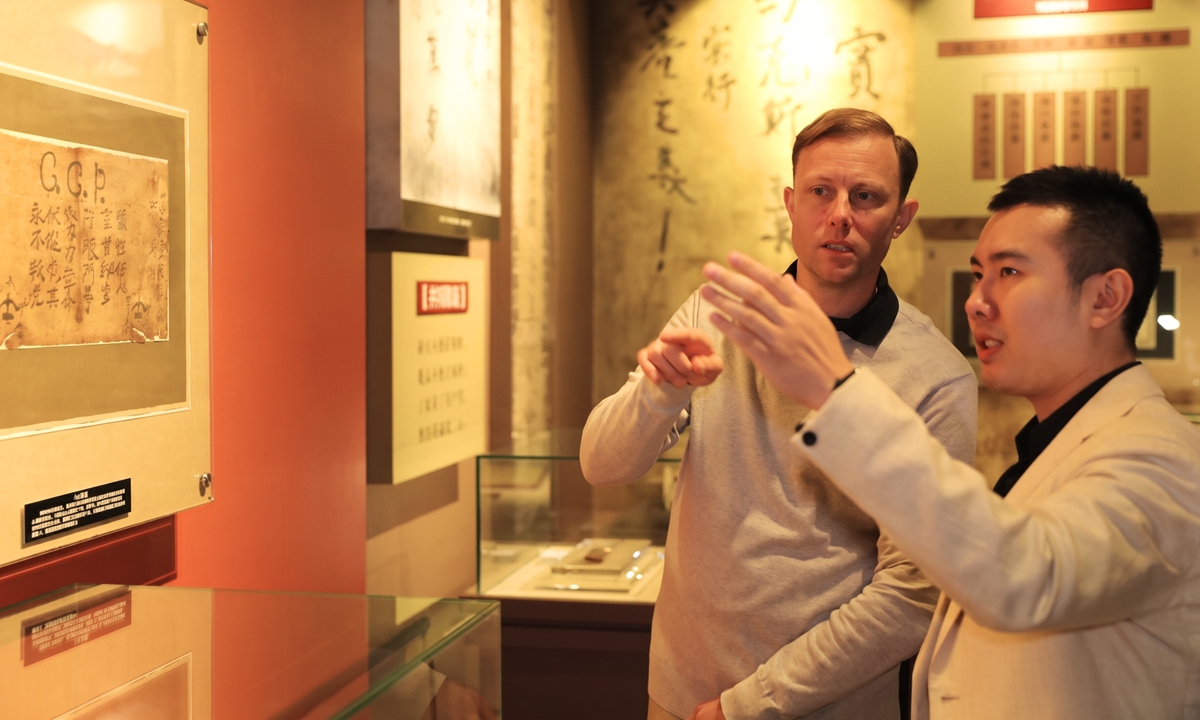
Mao Haofu introduces the Party admission oath to a British Communist Party member at the Jinggangshan Revolution Museum in November 2022. Photo: Courtesy of Mao Haofu
His efforts in innovative cross-border communication have yielded tangible results, as he recalled that after one immersive bilingual presentation, a foreign guest reflected on the two years and four months of arduous revolutionary struggles in Jinggangshan and summed up the core takeaway: "prevailing against desperate odds by standing firmly with the people."
"This concise yet penetrating comment perfectly interprets the essence of the Jinggangshan Spirit. It made me truly realize the powerful impact of bilingual narration and innovative international communication," Mao Haofu said.
Drawing on his English proficiency, Mao Haofu has shared Jinggangshan's stories with guests from more than 60 countries, 50 political parties and 400 foreign dignitaries. He has also spoken to reporters from over 30 major overseas media outlets such as the Associated Press and Reuters.
Beyond serving foreign delegations, Mao Haofu and his team aim to bring red stories to ordinary people across the globe. Leveraging a variety of new media platforms, they constantly release bilingual red cultural content for global online audiences. "I want to continue what my grandfather did for 50 years, and share the Jinggangshan Spirit with the whole world," he said.
Just like the revolution spread from a single spark to a prairie fire, the red stories and CPC spirit, with unwavering efforts of people like Mao Haofu's grandfather and himself, can continuously pass on and inspire people.
RELATED ARTICLES