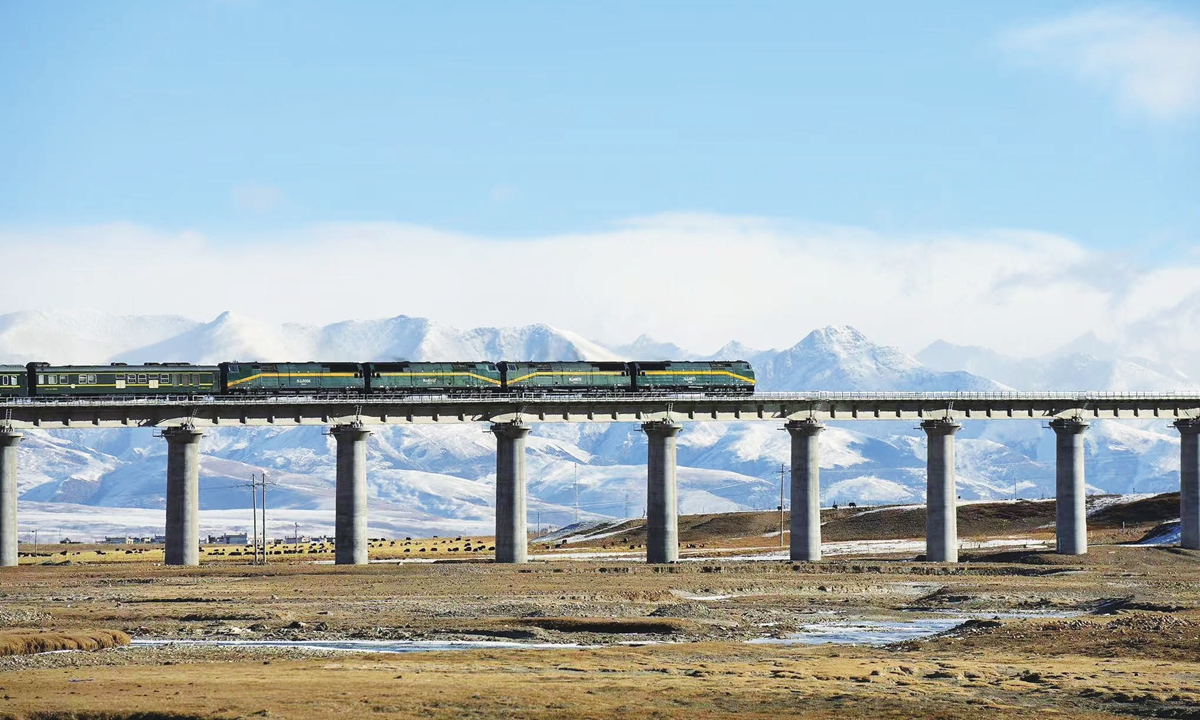
A train travels across a bridge in Damxung county, Southwest China's Xizang Autonomous Region on July 1, 2026. Photo: VCG
Editor's Note:National support for Xizang's development has yielded remarkable achievements. Over the decades, numerous volunteers from across the country have come to Xizang, making indispensable contributions to the autonomous region's growth. Their efforts focus on various fields such as education, healthcare and infrastructure. Despite harsh conditions, these volunteers persevere in their roles, writing chapters of endeavor on the snowy plateau. Each diary they have penned serves as a vivid testament to the building of the Chinese national community. Against this backdrop, the Global Times launches the "My Xizang Diary" series, presenting firsthand reflections from these dedicated volunteers. This is the seventh installment of the series.
In February this year, I completed my two-year assignment to support the China Railway Qinghai-Xizang Group Co., Ltd, serving as the deputy director of the Locomotive and Rolling Stock Maintenance Center at the Golmud-Lhasa section of the Qinghai-Xizang Railway, also known as the "Sky Road."
Every day on the Qinghai-Xizang Railway is a challenge. Stretching 1,956 kilometers, it is the highest and longest plateau permafrost railway in the world. The thin air and low oxygen levels mean that locomotive air compressors frequently trigger overheating alarms, threatening to bring trains to a halt at any moment. As staff dispatched to assist the railway operation, we had to remain on standby around the clock, ready to respond to emergencies whenever they occurred.
I had barely settled into my new post when my first major test arrived. It was the middle of the 2024 Spring Festival travel rush. Late one night, just before a train was due to enter service, an unusual problem emerged. Every time it started moving, the braking system failed. Yet the moment it returned to the depot, all data reverted to normal, and the problem could not be pinpointed. We knew we couldn't afford to let the problem go. With every train needed for daytime service during the Spring Festival travel rush, we had only a few hours before sunrise to find the answer. We boarded the train ourselves and followed it, determined to catch the elusive culprit.
After checking the train again and again, we became convinced the problem was somewhere in the rooftop braking unit. That night, with temperatures below -20 C, we climbed onto the roof as freezing winds swept across the plateau. When we finally took the unit apart, everything became clear. The burn marks and signs of electrical damage were right in front of us. We replaced the damaged part, and the train was back in service on schedule the very next morning.
When we watched the train glide through the station in the pale light of dawn, we all let out a long sigh of relief.
Emergency response, however, was just one part of our work. More often than not, our job was to identify hidden problems through routine operations. The plateau's unique climate and terrain meant that every fault presented an unprecedented technical hurdle. One of the toughest cases involved locomotive air compressors that kept triggering overheating alarms for weeks. The problem appeared, disappeared and refused to leave any clues. We decided not to wait for the fault to come to us any longer. Instead, we went with the locomotives.
Carrying portable oxygen cannula, we rode thousands of kilometers between Golmud and Lhasa, turning the driver's cab into our moving laboratory. We logged every alarm, every location, every gradient and every operating condition. Whenever the thin air made it hard to breathe, we plugged into the locomotive's onboard oxygen supply and kept working.
After more than 10,000 kilometers of field observations, the answer finally emerged. The compressor wasn't the problem at all. An overly long oil return pipe was restricting the flow of oil, causing temperatures to rise after long hours of operation. Once we redesigned the pipeline, the alarm rate dropped by half. The project later won us the first prize for technical achievement awards from the Quality Management Group of Qinghai Province.
The year 2026 marks the 20th anniversary of the Qinghai-Xizang Railway's full operation. From 2006 to 2026, this engineering marvel has operated safely for two full decades. My two years working in Xizang gave me a profound appreciation of the railway's importance to the region's development.
One conversation has stayed with me. A colleague from Xigaze told me that when he went to university in Chengdu in 2002, the journey took nearly a week - first by bus to Lhasa, then another long bus ride to Golmud and finally by train. When the Qinghai-Xizang Railway opened in 2006, the same trip was cut to just two days. At that moment, I realized that what we were maintaining wasn't just a railway. We were helping keep people's lives moving.
Today, the railway has handled 104 million passenger trips and 824 million tons of cargo, connecting the plateau more closely with the rest of China and providing strong support for more balanced regional development. The Qinghai-Xizang Railway is not merely a transportation corridor for people and goods; it is also a pathway to prosperity for the plateau and a bridge connecting people of different ethnic groups. Even more importantly, the spirit forged through building this heavenly railway continues to inspire generations of builders and guardians to devote themselves to the snowy plateau, making an irreplaceable contribution to Xizang's development.
The Lhasa Locomotive and Rolling Stock Maintenance Center, where I worked, was established in 2021. The first group of assigned railway professionals built it from the ground up, putting systems, facilities and operating procedures in place. When our team arrived, we inherited the foundation they had laid and focused on making it stronger. Our priorities were improving safety, strengthening quality control and, most importantly, training local technicians. Through a "1+N" mentoring program, each experienced engineer worked closely with several local colleagues, sharing practical skills and troubleshooting experience. Over two years, we helped train eight local technical specialists who are now able to diagnose complex faults and carry out maintenance independently. The greatest legacy of paired assistance is not simply solving today's problems, but leaving behind a team that, on its own, can solve tomorrow's problems, helping keep the Qinghai-Xizang Railway running safely for years to come.
Every day, trains glide past snow-covered mountains while passengers marvel at the breathtaking scenery outside their windows. Few of them know how many people work through freezing nights, climb onto train roofs in thin air, or spend hours tracking elusive faults to make that journey possible. Looking back, those two years in Xizang were far more than a job. They became one of the defining experiences of my life. The mountains remain silent, and so do the rails. But every train that completes its journey safely is a quiet tribute to the generations of railway workers who have kept this lifeline running.
The author is a senior railway engineer with China Railway Lanzhou Group. From December 2023 to February 2026, he served as the deputy director of the Lhasa Locomotive and Rolling Stock Maintenance Center under China Railway Qinghai-Xizang Group on a temporary assignment in Xizang. opinion@globaltimes.com.cn
RELATED ARTICLES