Photo: VCG
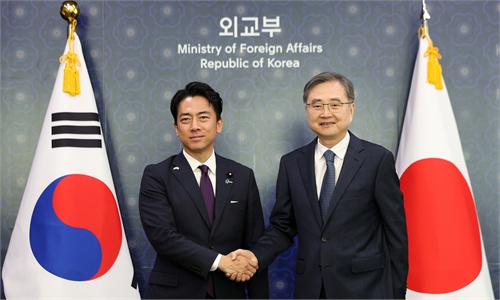
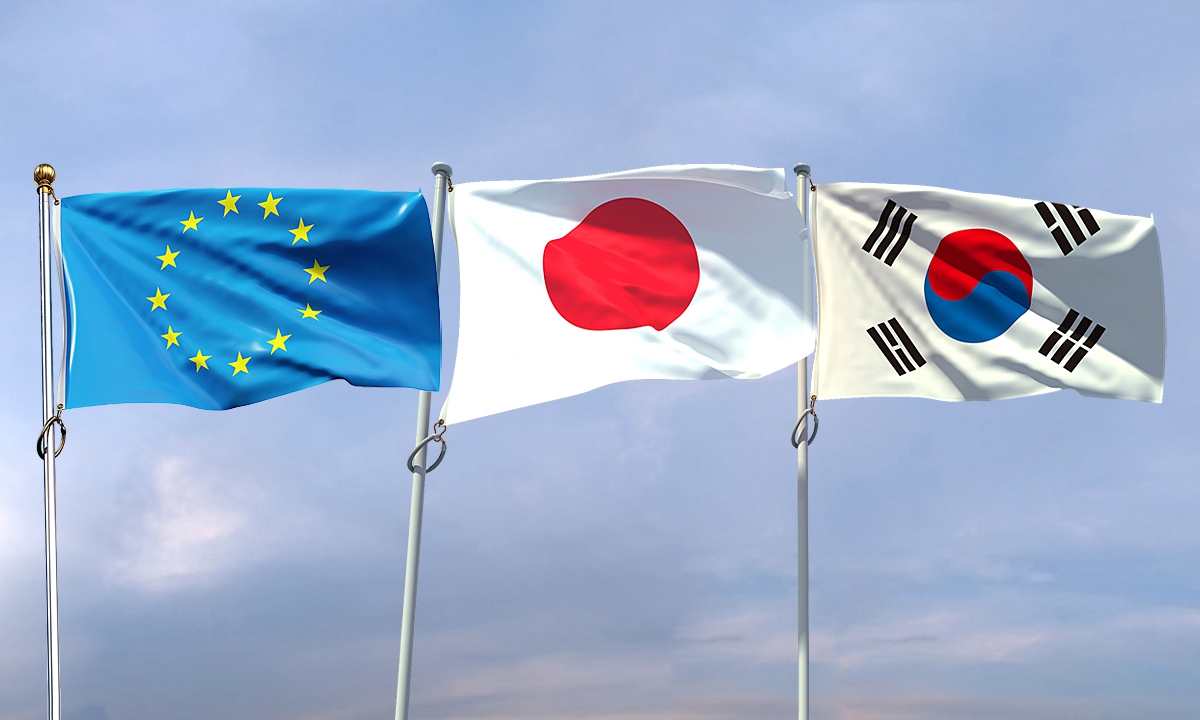
Recently, a South Korean scholar published an article declaring that establishing a trilateral cooperation mechanism among the EU, Japan and South Korea has become "more feasible and important than ever before." He suggested that the three sides start by building a Track 1.5 dialogue involving officials, scholars and business leaders to coordinate on various topics, including critical minerals, supply chain risks and export controls. Once conditions mature, this setup could be elevated to a ministerial-level framework. This proposal is not an isolated idea; it represents the latest manifestation of cross-regional "minilateral cooperation" actively championed by some in Western strategic circles in recent years.Efforts to institutionalize EU-Japan-South Korea cooperation have accelerated rapidly since 2024. Building on calls by European think tanks for supply chain early-warning systems, anti-coercion tools and a trilateral summit, the EU signed bilateral security and defense partnerships with both Tokyo and Seoul in late 2024. This momentum surged further after that, marked by proposals for a formal trilateral summit framework, an initiative within Brussels for a NATO-style "Geoeconomic Deterrence Pact" with Seoul and Tokyo, as well as the launch of a new Competitiveness Partnership between the EU and South Korea. Together, these incremental steps have systematically paved the way for a deeper cross-regional partnership.
Currently, the bilateral mechanisms the EU established with Japan and South Korea, spanning trade, digital affairs, green transition, economic security and defense, have essentially formed two parallel institutional tracks. What some Western scholars are now advocating is simply connecting these two parallel tracks into a cohesive triangle.
The three parties share several structural motivations for cooperation. First, the uncertainty in Washington's foreign policy - bundling security commitments with tariffs and cost-sharing - has exposed the limits of "ally status." Second, all three face the headwinds including aging demographics, shrinking labor forces, declining industrial competitiveness, and heavy reliance on foreign energy and critical minerals. Finally, the European and Northeast Asian security are increasingly intertwined, driving Seoul, Tokyo and Brussels to seek broader partnerships to address supply chain risks in critical technologies.
For Tokyo and Seoul, Brussels offers a useful hedge against US policy uncertainty in certain areas. Through its vast market, strong regulatory standards and expanding defense needs, the EU could provide Japan and South Korea with key opportunities to diversify in digital trade, green technology, critical minerals, defense industry collaboration and global governance.
However, Europe cannot replace the US as a core security guarantor. Lacking a unified military, nuclear deterrence or the political will to assume defense obligations in Asia, the EU can serve as a market, regulatory and technological partner, but never "another US."
It is worth noting that some initiatives for EU-Japan-South Korea cooperation carries a distinct orientation toward China. Several reports and commentaries explicitly group China alongside Russia as a "shared challenge," advocating for coordinated export controls, investment screening, restrictions on critical technologies and anti-economic coercion mechanisms targeting Beijing.
Yet, equating EU-Japan-South Korea cooperation to a mature anti-China alliance fails to align with reality. Although the three sides differ significantly in their degree of economic reliance on China, security interests and risk perceptions, China remains an indispensable trading partner for all three. Seoul may be reluctant to bear economic costs again by blindly adhering to bloc politics, and internal views on China within the EU have long been divided.
Consequently, while it is highly likely that South Korea, Japan and the EU will establish low-level strategic dialogues and advance project-based cooperation in digital standards, supply chains, critical minerals and economic security - and regular summits cannot be ruled out - the odds of them developing into an "Asian NATO" with collective defense guarantees, or a unified anti-China front, remain limited due to historical friction between Seoul and Tokyo, internal fragmentation within the EU and their shared security dependence on Washington.
The real trend to watch is not the sudden emergence of a grand trilateral alliance, but rather the gradual accumulation of incremental, functional arrangements designed to exclude China under the banners of "de-risking," "resilience" and "regulatory alignment."
While American unpredictability provides the impetus for South Korea, Japan and Europe to cooperate, the "China factor" is often leveraged to grant the effort strategic legitimacy. Whether these three actors choose pragmatic risk diversification or slide toward exclusive bloc politics will ultimately determine whether this potential new triangle becomes a constructive supplement to global multilateralism or just another divisive "small circle."
The author is director and professor at the Center for Korean Peninsula Studies of Shanghai University of International Business and Economics. opinion@globaltimes.com.cn
RELATED ARTICLES