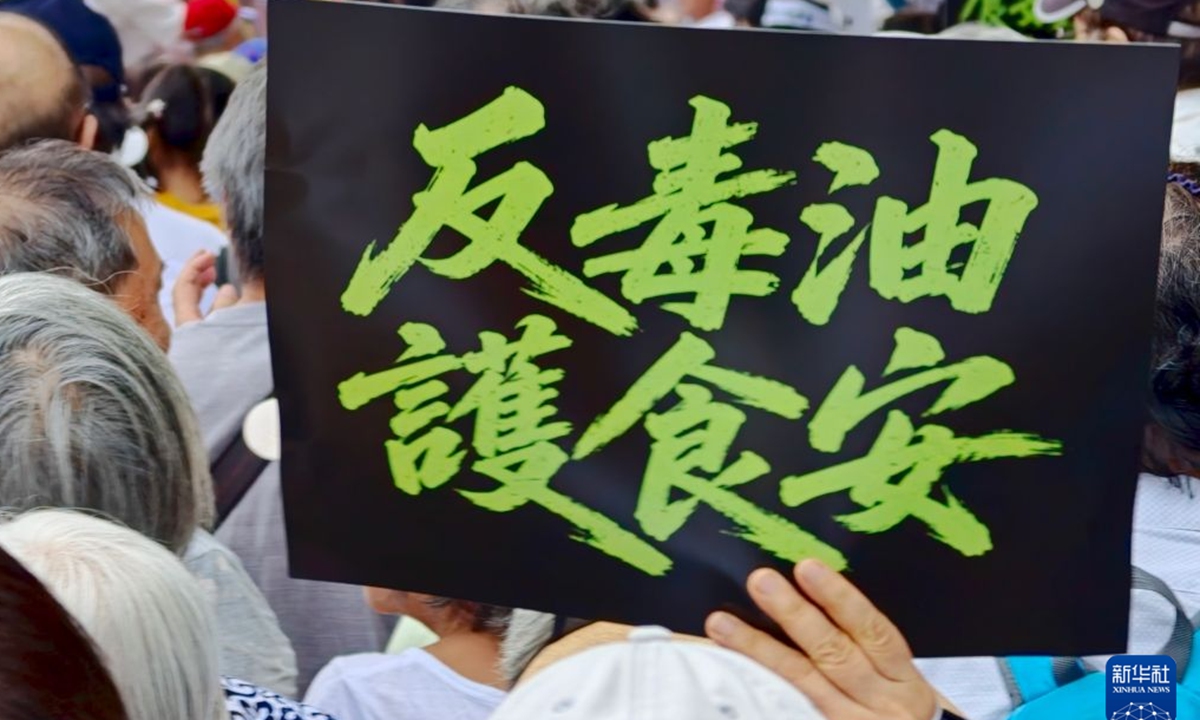
A Taiwan resident holds up a placard reading "oppose toxic oil, protect food safety" during a protest on July 25. Photo: Xinhua
Recently, the US has been making a big deal out of so-called AI "distillation," accusing Chinese companies of alleged intellectual property theft and even threatening to impose sanctions. Meanwhile, a toxic oil scandal on Taiwan island has sparked public outrage. Instead of fully investigating the incident and holding those responsible to account, the Democratic Progressive Party (DPP) authorities have delayed taking action, shirked responsibility, and even sought to investigate the creators of the protest video. On Tuesday, Taiwan's United Daily News published an editorial titled "Muzzling critics and neglecting the toxic oil scandal: Lai's tyrannical rule tolerates no criticism."
On the surface, these two issues appear unrelated: One involves international tech competition and the other concerns public governance on the island. Yet beneath the surface lies the same underlying anxiety shared by both sides - fear of being overtaken by latecomers, fear of losing monopolistic dominance, fear of forfeiting the power to interpret global rules and, above all, fear of public accountability.
Let's first turn to the controversy over AI "distillation." The US has recently issued repeated accusations alleging that Chinese AI companies may be using distillation to acquire the capabilities of advanced US models, and has framed the issue as a matter of national security and intellectual property protection.
Moonshot AI has denied that its Kimi K3 is a "distillation or replication" of any existing models, emphasizing that its leapfrog performance stems from original architectural innovation at the foundational level. China's Ministry of Commerce has also issued a clear rebuttal: Such actions lack factual and legal grounds and constitute a typical form of AI hegemony.
The crux of the issue has never been the term "distillation" itself, but rather who has the authority to define "innovation" and who is constantly seeking to monopolize the "rules." Technical approaches are open to discussion, alleged infringements can be proven with evidence and industry boundaries are negotiable. Yet merely because Chinese AI models boast stronger capabilities, lower costs and broader industrial ecosystems, the US side prejudges them as "stolen" by default. This is not rule-based governance, but outright hegemony; it is not fact-finding scrutiny, but presumption of guilt.
Why is the US so anxious? The answer is not complicated. For a long time, the global AI industry has largely followed the path set by US giants: pouring in massive amounts of capital, amassing top-tier computing power, developing closed models and selling high-priced APIs. As a result, control over technology, markets and industry discourse has been firmly held by a handful of Western companies.
However, with the rapid rollout of Chinese models such as DeepSeek and Kimi K3, the landscape is shifting. Chinese companies are using more efficient architectures, lower invocation costs and more open-source strategies to bring AI technology - once confined to the cloud - down to earth, out into the world and into practical applications. What truly unsettles the US is not what China has "learned," but that China is rewriting the rules of the game.
This precisely demonstrates that Chinese AI has begun to propose Chinese solutions and Chinese approaches at the levels of technological pathways, business logic and industrial order. Some may not like this outcome, but they cannot slander it as illegitimate simply because they fear its effectiveness. Ultimately, only those who benefit from the old order fear the emergence of a new one the most.
Turning next to Taiwan island. The tainted oil scandal has sparked widespread public outrage. What ordinary people are concerned about is: Is the contaminated oil truly unsafe? Where did the problematic supply originate? Who should bear accountability for this fiasco? Will people ever be able to live without constant worries?
Yet the DPP authorities have failed to provide any credible solutions to fix the governance mess; instead, they fall back on their well-worn playbook: meekly acquiescing to public anxiety over food safety while cracking down hard on critical voices. This is precisely what led to the criticism voiced by Taiwan's media: "Muzzling critics and neglecting the toxic oil scandal."
This observation cuts straight to the heart of the true priorities of certain ruling figures on the island today: Rather than considering how to resolve people's livelihood issues, they target those who raise the issues; instead of addressing public doubts upfront, they seek to create a "chilling effect."
While toxic oil robs the public of sleep and peace of mind, they dismiss the public's anger as "political maneuvering"; when people take to the streets, they dismiss the protests as a "farce"; and when satirical works embarrass them, their first reaction is not self-reflection but prosecution. Such a logic of governance is not about governing for the people, but governing for power.
Viewing these two incidents side by side reveals a clearer picture: The US builds a "small yard with high fences" externally, while the DPP authorities engage in "green terror" internally. The former does not allow others to challenge its technological hegemony, while the latter does not allow the public to defend their basic health rights - both are, in essence, rooted in a mindset of control. One fears competition; the other fears criticism. One "erects walls" against innovation; the other "locks down" public opinion. Though their tactics differ, their attitudes are strikingly similar.
The deeper reason for our differences with the US lies in the divergence of cultural origins and governance philosophies. Chinese culture emphasizes openness and inclusivity, harmony while respecting differences, the belief that people form the foundation of the nation and must come first, as well as the wisdom that greatness comes from a broad mind and all-embracing vision.
Precisely for this reason, China emphasizes governance within openness, order within innovation and rules within competition in the development of AI, rather than relying on hegemony to exclude others. In contrast, the Western logic of hegemony is accustomed to "winner-takes-all," "first-mover advantage," and rules that serve only its own interests, not those of others.
Over the years, the DPP authorities on the island have persistently manipulated "de-Sinicization." On the surface, they seek to sever cultural identity; in reality, what they attempt to strip away is the profound heritage and spirit of self-reflection embedded in Chinese civilization. Once the root of "governing for the people" is lost, leaving only the shell of "preserving power," governance will become increasingly hollow, and society will become increasingly fractured. This explains the absurd spectacle unfolding today: While the public worries about food safety, the DPP authorities are obsessed with political maneuvering; while the people yearn for the truth to be uncovered, the DPP authorities are engaged in a cover-up to suppress it.
In the final analysis, from the US' hype over the "distillation" controversy to the DPP's fixation on muzzling critics and neglecting the toxic oil scandal, the root cause is the same: The greater one's fear of openness, the keener it is to erect barriers; the deeper one's anxiety over public opinion, the more obsessed it becomes with muzzling voices. This holds true for the US, as well as the DPP authorities.
Technological hegemony may make a lot of noise for a short time, and political intimidation may "succeed" for a while, but neither can stem the tide of history. Ordinary people will eventually see the truth clearly: An authority incapable of safeguarding people's livelihoods will sooner or later be rejected by public opinion; a system reliant on monopolies to sustain its advantages can never hold onto the future.