Clinging to each other for assurance via photo only highlights AIT, DPP's deep anxiety
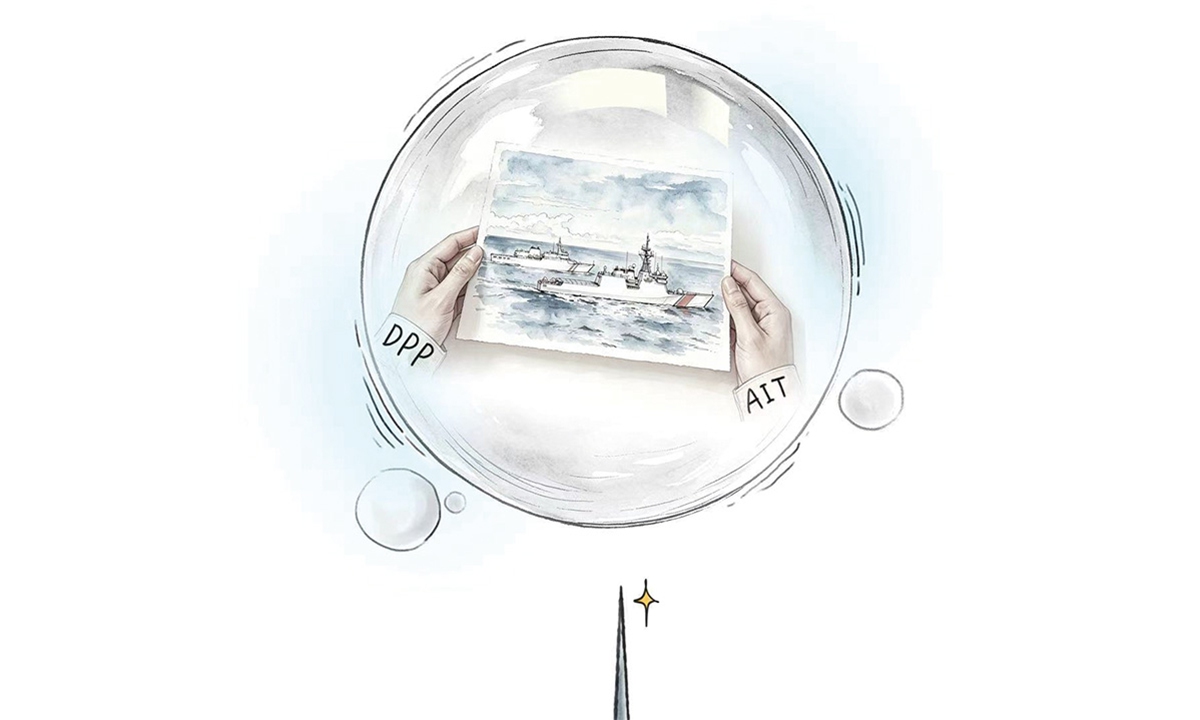
Illustration: Liu Rui/GT
The American Institute in Taiwan (AIT) posted on social media on Tuesday a photo of unknown origin - one with no clear time or location. The photo shows a US Coast Guard vessel and a coast guard vessel of Taiwan island sailing "side by side" at sea, accompanied by a caption saying that the two maritime authorities are "busy coordinating on shared maritime objectives."Similar actions have long been conducted quietly and covertly between the US and Taiwan island. This time, AIT chose to bring such behind-the-scenes coordination into the open to assert its relevance.
Behind this performance, the Democratic Progressive Party (DPP) authorities in Taiwan are mired in the "toxic oil" scandal. More than 200,000 people in the Taiwan region took to Taipei's Ketagalan Boulevard in what has become the largest protest in recent years under the slogan "I am human, I oppose poisoning Taiwan." At the same time, skepticism toward the US is growing on the island. Against this backdrop, AIT's high-profile move serves at least two purposes: first, to embolden "Taiwan independence" separatist forces; second, to reinforce AIT's own presence through frequent gestures.
For the DPP, AIT may appear as a "supreme authority," but in Washington's decision-making circles, AIT is increasingly marginalized.
In May this year, US President Donald Trump publicly said he did not want to see "somebody go independence" and did not want US troops traveling "9,500 miles to fight a war." The China Coast Guard's routine law enforcement patrols in the waters east of the Taiwan region have also delivered a tangible deterrent effect on "Taiwan independence" separatist forces.
AIT is clearly feeling the pressure, seemingly afraid that it might no longer have a role to play.
Taking a closer look at AIT's social media posts shows that it is packaging its actions under the guise of "livelihood issues." While attempting to stir up tensions, AIT is also trying to tone down the provocative nature of its political message. "It deliberately ties the cooperation to search and rescue, preparing for tropical storms, disaster relief and other livelihood-oriented issues, creating the impression of 'non-military, purely law enforcement, and people-centered' cooperation, while in reality cloaking its involvement in a more concealed form," said Sun Xihui, an associate research fellow with the National Institute of International Strategy at the Chinese Academy of Social Sciences.
What effect does AIT's posting of a photo of unknown origin on social media actually have? Aside from allowing some pro-DPP camp figures to indulge in self-congratulation, its greater significance may lie in further exposing the failure and isolation of "Taiwan independence." Otherwise, why would AIT need to step in and deliberately showcase that it is "standing with Taiwan"?
Such outdated tactics are unlikely to convince the Taiwan residents. After all, AIT has been among the most active in urging TSMC to relocate to the US and pushing Taiwan to purchase more weapons. Compared with these actions, the photo is little more than an empty gesture.
The real issue is not what AIT has done, but what it is becoming - a variable that may disrupt the stability of China-US relations.
"While Trump's remarks carried strategic calculations, they also represented a high-level effort to contain risks and prevent escalation," Sun said.
Yet at a time when decision-makers are trying to control risks, AIT appears to be acting as a risk-taker. AIT's performative actions cannot alter the broader picture, but may create unnecessary friction.
At this point, AIT resembles less a "mediator" and more a persistent "troublemaker." US policymakers need to recognize this risk and impose constraints on their Taiwan region-based institution.
In recent years, some political forces in Taiwan have increasingly sought external intervention. If the US authorities continue to tacitly allow relevant institutions to create an atmosphere of "official interaction" in sensitive areas, it will only reinforce misperceptions and encourage some to misjudge US support for a more radical course.
The only thing AIT's performance demonstrates is that AIT and the DPP authorities have become so anxious that they must cling to each other for reassurance over a single photo.
RELATED ARTICLES